
Chile passes law establishing annual day of friendship and solidarity with Palestine
Chile’s parliament has just codified a new day of remembrance that goes beyond ceremony, linking the nation’s own multicultural fabric to the enduring struggle for Palestinian human rights.
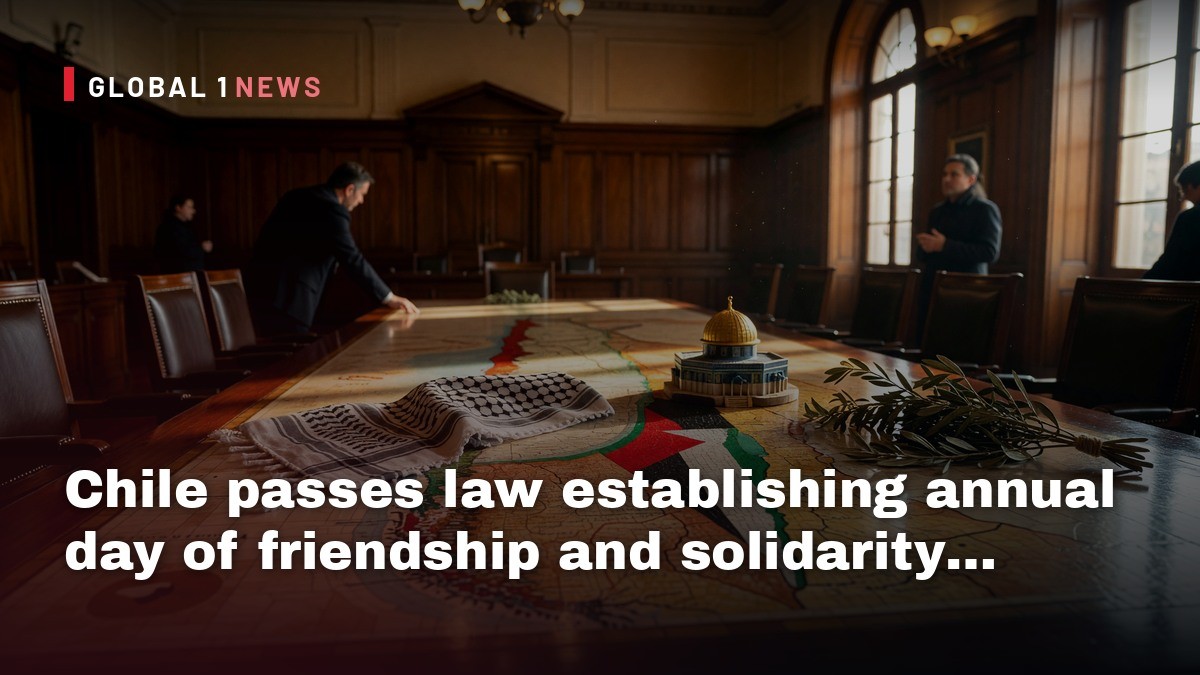
Chile’s parliament has just codified a new day of remembrance that goes beyond ceremony, linking the nation’s own multicultural fabric to the enduring struggle for Palestinian human rights. Law No. 21,843, published in the Official Gazette on 22 October 2026, designates 7 January as the annual Day of Chilean‑Palestinian Friendship and Solidarity. While the date marks the historic moment in 2011 when Chile formally recognised Palestine as a sovereign state, the legislation also embeds a clear commitment to the United Nations’ universal human‑rights framework and to the protection of the Palestinian people.
From proposal to law: the parliamentary journey
The initiative first appeared on the legislative agenda in January 2024, when a group of deputies introduced a bill to honour the historic ties between Chile and Palestine. After two years of debate, the proposal moved to the Senate, where several amendments were adopted before it returned to the lower house. On 22 September 2026, the Chamber of Deputies gave the bill a decisive majority, securing 100 votes in favour. The Senate followed suit, approving the measure with 30 supporting votes. The swift passage through both chambers reflects a broad political consensus that the relationship with Palestine is not merely symbolic but integral to Chile’s national identity.
Senator Vlado Mirosevic, who championed the bill, explained that the legislation “speaks of something that is not foreign to Chile; it speaks of ourselves and our history.” His words echo the sentiment expressed by many legislators that the Palestinian diaspora has been woven into Chile’s industrial, social and cultural development since the early 20th century. The law’s final form contains two concise articles: the first establishes 7 January as the annual day of friendship and solidarity; the second authorises commemorative activities that reaffirm Chile’s adherence to UN human‑rights principles and the rights of the Palestinian people.
Why 7 January matters
The choice of 7 January is rooted in a pivotal diplomatic act. On that day in 2011, under President Sebastián Piñera, Chile officially recognised Palestine as an independent and sovereign state. Legislative records from the Library of the National Congress of Chile confirm that commemorating this decision was a core aim of the bill from its inception. By anchoring the new holiday to that historic recognition, Chile signals that its support for Palestinian self‑determination is anchored in concrete policy, not merely rhetorical.
Senator Matías Walker, speaking during Senate deliberations, highlighted the date’s significance as a reminder of Chile’s longstanding endorsement of a peaceful settlement based on a two‑state solution, in line with international resolutions. The law therefore serves both as a cultural commemoration and as a reaffirmation of Chile’s diplomatic stance on the Israeli‑Palestinian conflict.
Human‑rights language at the core
Beyond marking a calendar date, Law No. 21,843 explicitly ties the celebration to the United Nations’ universal human‑rights protection system. The second article authorises “commemorative activities … reaffirming Chile’s commitment to UN human‑rights principles and the rights of the Palestinian people.” This language elevates the day from a symbolic gesture to a platform for advocacy, education and solidarity actions that foreground the humanitarian crisis in Gaza and the West Bank.
Congresswoman Carolina Tello underscored this intent, stating that the day will provide an opportunity to “raise awareness about human rights and respect for international law.” She added that the initiative aims to “prevent what we are witnessing in Palestine from happening in other parts of the world,” linking Chile’s domestic human‑rights agenda to the broader global struggle against genocide and oppression.
Community voices: Palestinian contributions to Chile
Senators Vlado Mirosevic and Sergio Gahona both stressed the deep roots of the Palestinian community in Chile. Mirosevic noted that Palestinians and their descendants have contributed to the country’s industrial, social and cultural development while maintaining enduring ties to their ancestral homeland. Gahona added that families originally from Bethlehem, Beit Jala and Beit Sahour have played a significant role in Chile’s economic and social fabric.
These testimonies reflect a lived reality: Chile is home to one of the largest Palestinian diasporas outside the Arab world. The new law recognises that diaspora not merely as a demographic statistic but as an integral part of the nation’s soul, deserving of public acknowledgement and protection of its collective memory.
International implications and diplomatic resonance
The passage of Law No. 21,843 arrives at a moment when many Latin American countries are reassessing their positions on the Israeli‑Palestinian conflict. By embedding a day of solidarity into its national calendar, Chile joins a growing cohort of states that are translating diplomatic recognition into concrete public policy. The Palestinian Embassy in Chile welcomed the law as “an important milestone in relations between the two countries,” highlighting that the legislation “recognises the shared history and strong bonds between the two peoples.”
Such a move may encourage other nations to adopt similar measures, reinforcing the normative power of international law and human‑rights discourse. It also signals to the Israeli government that Chile’s support for Palestinian rights is both public and institutional, potentially influencing diplomatic dialogues in multilateral forums.
Looking ahead: how the day may be observed
Law No. 21,843 authorises “commemorative activities” that can range from cultural exhibitions and educational seminars to public vigils and artistic performances. The legislation’s language leaves room for civil society, schools, and governmental bodies to design programmes that illuminate the human cost of the conflict, promote dialogue, and celebrate the contributions of the Palestinian community to Chilean society.
Early statements from the Palestinian Embassy suggest that the first observance in January 2027 will likely feature joint events with Chilean NGOs, exhibitions of Palestinian art, and panels on international law. Such activities could serve as a catalyst for broader public engagement, ensuring that the day does not remain a mere calendar entry but becomes a recurring platform for advocacy and remembrance.
Why the day matters for human‑rights advocacy
For a journalist focused on the human‑rights dimension of Middle Eastern stories, Chile’s new law offers a tangible example of how diaspora communities can shape foreign policy and amplify the plight of their homelands. By codifying solidarity into law, Chile provides a legal and moral framework that can be invoked whenever the rights of Palestinians are threatened.
In practice, the day could become a focal point for campaigns demanding accountability for violations of international humanitarian law, for calls to lift blockades, and for urging the United Nations to act decisively. It also offers a venue for Chilean citizens to confront the humanitarian crisis in Gaza and the West Bank not as distant news, but as a lived reality that resonates with their own national narrative of immigration, struggle, and resilience.
This article was produced with AI-assisted research and editorial support. Reporting is based on the source material cited below. Sources: Middle East Monitor; middleeastmonitor.com; Global1.News (26 October 2026).
By Fatima Al-Rashid, Staff Writer
What's Your Reaction?
 Like
0
 Dislike
0
 Love
0
 Funny
0
 Wow
0
 Sad
0
 Angry
0

Gulf/MENA Correspondent at Global1.News. Based in Doha, covering Gulf politics, energy markets, diplomacy, and development across the Middle East and North Africa. Tracks the economic transformation of the Gulf states.













Comments (0)