
Beachfront Horror: Ukraine's Drone War Reaches Russia's Holiday Coast
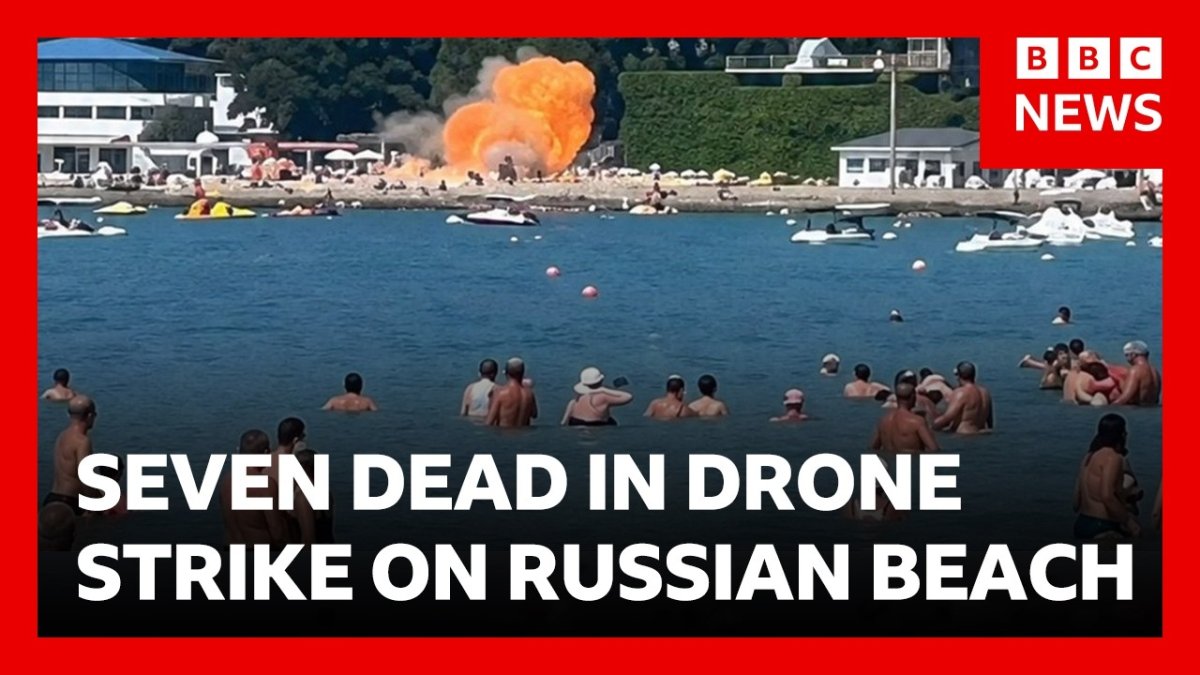
In a recent BBC News report, a Ukrainian drone strike on a crowded beach in southern Russia left seven people dead, including three children, and injured dozens more — the latest sign that the war is no longer something distant Russians watch on their screens, but something arriving on their own shores.
In a recent BBC News report, a Ukrainian drone strike on a crowded beach in southern Russia left seven people dead, including three children, and injured dozens more — the latest sign that the war is no longer something distant Russians watch on their screens, but something arriving on their own shores.
Beachfront Horror: Ukraine's Drone War Reaches Russia's Holiday Coast
Moscow, Russia — 4 August 2026 — A drone crashed into a busy beach near the Black Sea resort village of Arkhipo-Osipovka on Monday, killing seven people including three children and wounding about 40 more, according to regional authorities. The strike came amid an escalating campaign of Ukrainian long-range attacks on Russian infrastructure, and it has forced Russians to confront a question the Kremlin has long tried to avoid: what happens when the war comes home?

The Beach Strike: What Happened and What We Know
In social media footage verified by the BBC, a drone can be seen hurtling towards a cliffside before crashing into a fireball on the beach below as tourists look on from the shore and in the water. Krasnodar region governor Veniamin Kondratyev said the total number of injured reached 40, with 17 people taken to hospital. He accused Ukraine of "a deliberate strike on civilians." Ukraine has not commented. Both sides deny targeting civilians deliberately. The incident occurred on a Monday when the beach was filled with families enjoying the summer season in the Krasnodar region, a popular destination for domestic tourism.
It remains unclear what the drone was targeting. Some Ukrainian Telegram channels have claimed it crashed onto the beach as a result of electronic warfare that jammed the drone's signal. Several eyewitnesses quoted by Russian media said gunfire preceded the explosion, indicating air defences may have tried to shoot it down. Tourists and residents of Arkhipo-Osipovka told local media that no sirens sounded ahead of the attack. This lack of warning left holidaymakers exposed in an area far from the front lines, highlighting gaps in Russia's defensive network even in resort zones.
"We covered ourselves with sun loungers, and didn't see where it exploded," one holidaymaker said. Another said they could hear "gunfire, like a machine gun" followed by an explosion. "This all happened in front of my children. My child is having a nervous breakdown," said a third. The beach near Arkhipo-Osipovka, with its warm climate, long sands and developed tourist infrastructure, is a popular holiday destination for Russians — particularly since sanctions curtailed international travel for many. These accounts illustrate the sudden intrusion of conflict into spaces previously viewed as safe havens for ordinary citizens seeking respite from daily pressures.
The strike's timing during peak holiday season amplified its reach through social media, where videos spread rapidly despite official efforts to manage information. Regional authorities in the Krasnodar region moved quickly to secure the area and provide medical support, yet the event has prompted questions among residents about preparedness for future incidents. Analysts suggest such attacks test the limits of Russia's air defence systems when deployed across vast territories, including civilian recreational zones. The psychological toll on survivors and witnesses extends beyond immediate injuries, affecting families who now associate a traditional summer escape with sudden danger.

The Wildberries Campaign: War at the Warehouse Door
The beach strike was not an isolated incident. In recent weeks Ukrainian strikes have in particular targeted warehouses belonging to Wildberries — a large online retailer dubbed the "Russian Amazon" — with dozens of its warehouses dotted around Russia, many located thousands of kilometres from the Ukrainian border, now reported hit. The latest strike hit a warehouse in the Vladimir region, east of Moscow, overnight into Monday. This pattern shows a deliberate focus on logistics nodes that sustain broader economic activity across the country.
Kyiv says Wildberries depots are used to supply the Russian military, a claim Moscow denies. Yet the platform sold a variety of military-related goods such as body armour until recently, alongside items with both civilian and drone-production applications. BBC Verify has analysed satellite imagery showing the aftermath of strikes on Wildberries facilities across Russia, including a huge plume of black smoke rising from a site in Novosemeykino and a charred area measuring roughly 220m by 100m on a warehouse roof in Ryazan. These images provide visual evidence of the scale of damage inflicted on commercial infrastructure.
The scale of the campaign has forced the company to respond. With strikes mounting, Wildberries employees have been banned from bringing smartphones onto warehouse premises; from 3 August, only push-button mobile phones without cameras are permitted on site, according to a notice the company's press service confirmed to state news agency Tass. The new rules aim to prevent employees from capturing and disseminating footage of drone attacks online. Workers at affected sites now operate under heightened restrictions that alter daily routines in facilities spread from the western regions to areas near St Petersburg.
Independent observers note that the restrictions reflect concerns over uncontrolled information flow in an era when smartphone footage can reach global audiences instantly. The policy change affects thousands of employees who previously used personal devices for communication and documentation. This adjustment underscores how commercial operations intertwined with national logistics face direct pressure from sustained long-range operations. The cumulative effect on supply chains serving both civilian consumers and other sectors continues to unfold as additional facilities come under scrutiny.
Ukraine's Deep-Strike Strategy
Over the course of the last year, Ukraine has had increasing success in carrying out long-range strikes deep into Russia, hitting energy infrastructure and commercial warehouses it says are used for military purposes. On several occasions these strikes have caused civilian deaths — eight people in different Russian cities were killed at the weekend alone. Early on Tuesday, a warehouse facility was hit by drones near Russia's second-biggest city, St Petersburg, according to regional governor Alexander Drozdenko, who did not name the facility. The evolution of this campaign reflects Ukraine's adaptation to constraints on ground operations by leveraging precision munitions and unmanned systems to reach targets hundreds of kilometres inside Russian territory.
The strategic rationale centres on degrading Russian logistics and supply chains without committing ground forces. Ukrainian officials maintain that facilities such as Wildberries warehouses support the broader war effort through storage and distribution of materials. The targeting debate involves distinctions between clear military sites and commercial locations that may serve dual purposes. Russian air defence performance has varied against successive waves of drones, with some intercepted while others reach their objectives. Analysts suggest the campaign aims to raise the domestic cost of the war for ordinary Russians and weaken public support for the Kremlin's offensive by demonstrating that distance offers no absolute protection.
Ukrainian statements frame these operations as legitimate responses to infrastructure enabling sustained military activity. The approach avoids direct confrontation on the battlefield while imposing economic and psychological pressure. Success in reaching sites near major population centres like St Petersburg and Moscow demonstrates expanded reach developed over months of refinement. This method carries inherent risks of collateral effects, yet Kyiv presents it as a necessary component of its defensive posture against ongoing Russian advances.
Moscow's Response and the Kremlin's Narrative
Russia's Foreign Ministry called the beach strike an act of terrorism, and Governor Kondratyev framed it as "a deliberate strike on civilians." Ukrainian President Volodymyr Zelensky, speaking earlier on Monday, said Vladimir Putin seeks to "drag out" the war and that he cannot guarantee when Ukrainian efforts would leave Russia with "no alternative but peace." The Kremlin's terrorism framing aligns with state media portrayals that emphasise civilian victims and portray Ukrainian actions as indiscriminate. Coverage in official outlets stresses the holiday setting and the presence of children to underscore the narrative of unjustified aggression.
The tension between official narratives of a special military operation and the reality of civilian casualties on Russian soil creates a growing disconnect for domestic audiences. Strikes on holiday beaches and commercial warehouses puncture the insulation many Russians have experienced since the conflict began. Steve Rosenberg, the BBC's Russia editor, has written that the targeting of Wildberries is bringing the war closer to home, and that until recently war was something happening far away for many Russians — that is changing. This shift carries domestic political risk for Putin, as public tolerance for distant operations may erode when visible impacts reach everyday spaces.
Analysts suggest these developments test the Kremlin's ability to maintain unified support amid visible reminders of vulnerability. State responses focus on condemnation and promises of strengthened defences rather than acknowledgment of strategic shifts. The contrast with earlier assurances that the operation would remain contained far from Russian population centres highlights evolving perceptions among citizens who previously viewed the conflict as remote. Such incidents may influence internal debates about the sustainability of prolonged engagement.
Russia's Civilian Toll and the Escalation Spiral
Russia, for its part, has launched attacks on residential areas and cities from the start of its full-scale invasion of Ukraine in February 2022, killing and injuring thousands of civilians. On Saturday, at least nine people were killed and dozens injured in Russian ballistic missile strikes on Kyiv, according to Ukrainian President Volodymyr Zelensky; the city's mayor said a residential building in the Shevchenkivskyi district was partially destroyed, trapping people inside. Last week a strike on a building in Ukraine's Kryvyi Rih area killed a family of ten. The symmetry of civilian suffering on both sides of the front line underscores the mutual humanitarian costs of long-range strike warfare.
The psychological impact on Russian holidaymakers and workers at targeted facilities includes heightened anxiety and disrupted routines. Footage circulating on independent channels and social media challenges state media control, allowing ordinary citizens to witness events directly. Verification of claims remains difficult in real time due to restricted access and competing narratives from both sides. The escalation spiral risks further cycles of retaliation as each party responds to perceived threats against its territory and population.
Both Russian and Ukrainian authorities continue to assert that their operations prioritise military objectives while denying deliberate civilian targeting. The pattern of strikes on urban and recreational areas illustrates how modern conflict extends beyond traditional battlefields into spaces used by non-combatants. This dynamic affects public morale in affected regions and complicates efforts to limit broader societal disruption.
Analysis and Implications
The beach strike at Arkhipo-Osipovka could mark a turning point in how Russians experience a war the Kremlin has insisted is being fought far from home. The strikes signal Ukraine's evolving capabilities and reach, allowing operations against logistics networks deep inside Russian territory. The strategic calculation behind targeting civilian-adjacent sites like Wildberries involves Kyiv's argument that the depots supply the Russian military, while critics warn of civilian risk associated with such choices. This approach creates a dilemma for Western allies supporting Ukraine, who must balance assistance with concerns over escalation thresholds.
The potential for further escalation on both sides remains evident, including possible Russian retaliation against Ukrainian cities already under pressure. What this means for any future peace negotiations is that, as Zelensky put it, the goal is to leave Russia with "no alternative but peace," but the road there is running through Russian beaches and warehouses, not just the front line. The return of visible conflict to Russian soil challenges Putin's domestic standing by eroding the separation between the operation and everyday life for citizens who had grown accustomed to its distance.
Forward developments will depend on whether sustained pressure alters internal Russian calculations or prompts intensified countermeasures. The involvement of commercial infrastructure and recreational areas broadens the scope of consequences beyond military personnel, affecting supply chains and public sentiment alike. Observers will monitor how these trends influence the overall trajectory toward any negotiated outcome.
By Irina Volkov, Staff Writer
This article was produced with AI-assisted research and editorial support. Reporting is based on sources cited in the article.
What's Your Reaction?
 Like
0
Like
0
 Dislike
0
Dislike
0
 Love
0
Love
0
 Funny
0
Funny
0
 Wow
0
Wow
0
 Sad
0
Sad
0
 Angry
0
Angry
0

Russia/Eastern Europe Correspondent at Global1.News. Covering Russian politics, energy, security, and the shifting dynamics of the post-Soviet space. Provides clear-eyed analysis on one of the world's most opaque regions.














Comments (0)