
Demand for AI skills surges 267% across non-tech professions in Israel's shifting labor market
Artificial intelligence is no longer the exclusive domain of Israel's hi-tech sector.
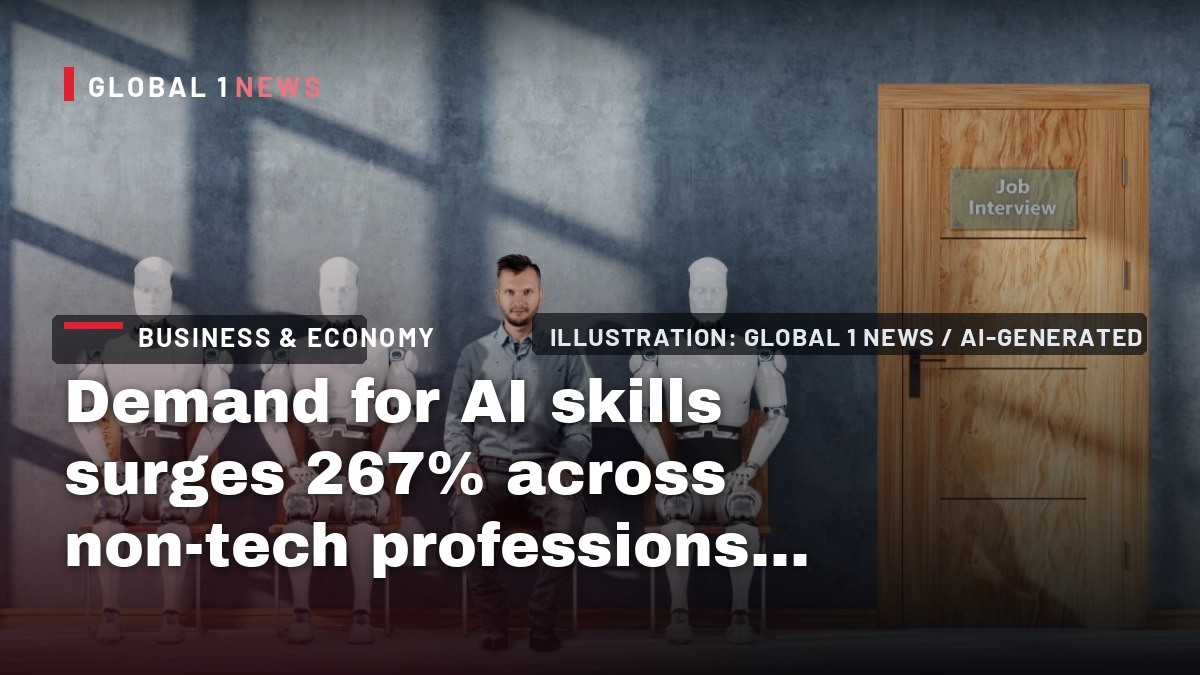
Artificial intelligence is no longer the exclusive domain of Israel's hi-tech sector. New data from ALLJOBS, one of the country's leading career and recruitment platforms, shows demand for AI-related skills has surged by as much as 267% — including in professions far removed from the technology industry, such as finance, human resources, and teaching.
The figures, presented by ALLJOBS vice president Liat Ben-Torah Shoshan in a Tuesday interview on 103FM, paint a picture of a labor market in rapid transformation. As Israeli employers across sectors scramble to integrate AI tools into their daily operations, the skills workers need — and the way they present themselves to potential employers — are changing at a pace unseen in decades.
A year of astronomical growth in AI demand
Speaking as her company's research department wrapped up its annual review, Ben-Torah Shoshan described the increases as "very strong" and particularly notable outside the technological sphere. "In non-technological fields as well, we are seeing some very interesting jumps," she said.
The scale of the growth is striking, but Ben-Torah Shoshan cautioned that part of the explanation lies in the low baseline. "We are seeing astronomical numbers because we are comparing them with periods when demand for AI was low, so we are seeing significant growth," she explained. In other words, the 267% figure reflects a market that has moved from minimal AI adoption to widespread integration in a relatively short period.
Despite the dramatic shift, the broader employment picture remains stable. Ben-Torah Shoshan noted that unemployment rates are low and that ALLJOBS currently lists more than 34% more job openings than in the comparable period last year. "In these areas there is stability," she said.
AI moves from buzzword to core job requirement
Perhaps the most significant finding is that AI has moved beyond the realm of hype. "We are identifying changes, and the world of AI is growing significantly. It is not just a buzzword," Ben-Torah Shoshan said. "You can really see the investment both in technological fields and certainly in mid-tech and low-tech, such as finance, human resources, and teaching."
The shift is visible from both sides of the hiring equation. Employers are increasingly listing AI proficiency as a requirement in job postings, while job seekers are highlighting their AI skills on résumés with growing frequency. "You can see an emphasis on the world of artificial intelligence and related fields, for example in job requirements and in how candidates mention it on their résumés," Ben-Torah Shoshan said.
This dual movement — demand from employers and supply from candidates — suggests that AI literacy is becoming a baseline expectation across the Israeli workforce, not a differentiator reserved for software engineers in Tel Aviv or Herzliya.
Finance, HR, and teaching lead the non-tech surge
Digging deeper into the data, Ben-Torah Shoshan highlighted specific professions where AI skills are becoming increasingly essential. "We are seeing an increase in accountant and bookkeeping positions, financial manager roles, and in requirements for proficiency in artificial intelligence tools," she said.
For accountants and bookkeepers, the integration of AI tools means automating routine tasks such as data entry, reconciliation, and preliminary analysis. Financial managers are expected to use AI for forecasting, risk assessment, and portfolio optimization. In human resources, AI is being deployed for candidate screening, employee engagement analysis, and workforce planning.
The teaching profession, too, is being reshaped. Educators in Israeli schools and universities are increasingly expected to incorporate AI tools into lesson planning, personalized learning, and student assessment. The demand reflects a broader global trend, but in Israel — a country that prides itself on its innovation ecosystem — the adoption appears to be happening faster than in many other markets.
Hi-tech layoffs drive retraining and adaptation
The surge in AI demand comes against a backdrop of prolonged turbulence in Israel's hi-tech sector. "We have been seeing rounds of layoffs in hi-tech for quite some time," Ben-Torah Shoshan acknowledged. The wave of job cuts that began in the global tech downturn has continued, forcing many experienced professionals to rethink their career trajectories.
"Quite a few of these candidates are required to make professional adjustments, such as undergoing training and learning various tools required for their positions," she said. The retraining imperative is not limited to acquiring new digital skills; it extends to understanding how AI is changing the very nature of existing roles.
For Israeli hi-tech workers who have spent years specializing in specific technologies, the shift can be disorienting. A software developer who once focused on traditional coding may now need to understand how to integrate AI models into applications. A data analyst may need to master machine learning frameworks. The learning curve is steep, but the alternative — obsolescence — is far less appealing.
Hardware's quiet renaissance alongside AI
One of the more surprising findings from the ALLJOBS data is the resurgence of hardware roles. "We are seeing roles changing their nature," Ben-Torah Shoshan said. "We understand, for example, that the hardware field has grown significantly alongside the development of artificial intelligence, and more and more students are choosing to study engineering and electronics."
The connection between AI and hardware is logical: AI models require specialized chips, sensors, and edge devices to function effectively. Israel, with its strong semiconductor and electronics ecosystem — home to companies like Intel's development centers and Mobileye's autonomous driving technology — is well-positioned to benefit from this trend.
The growing interest in engineering and electronics among students suggests that the next generation of Israeli workers is already responding to the market's signals. This is a positive development for an economy that has long relied on its technology sector as a primary growth engine.
Implications for Israeli workers and job seekers
For the average Israeli worker, the message from the data is clear: AI skills are no longer optional. Whether you are a teacher in Beersheba, an accountant in Jerusalem, or a financial manager in Tel Aviv, familiarity with AI tools is becoming a prerequisite for career advancement.
Job seekers should take note of how they present themselves. Ben-Torah Shoshan's observation that candidates are increasingly mentioning AI on their résumés suggests that this is becoming a competitive differentiator. Those who can demonstrate practical AI proficiency — not just familiarity with the concept — will likely have an edge in the hiring process.
For employers, the data underscores the importance of investing in training and upskilling. The companies that thrive in the coming years will be those that help their existing workforce adapt to AI rather than simply hiring new talent with the required skills.
The broader economic context
Israel's labor market has long been characterized by a paradox: a world-class hi-tech sector that drives exports and innovation, alongside persistent productivity challenges in the rest of the economy. The AI revolution has the potential to address this gap by bringing advanced tools to traditional industries.
The stability Ben-Torah Shoshan noted — low unemployment and a growing number of job openings — provides a foundation for this transformation. Workers who lose their jobs in hi-tech layoffs have options, but they must be willing to adapt. The retraining culture that has developed in Israel, supported by both government programs and private-sector initiatives, will be crucial in helping these workers transition to new roles.
The Israel Innovation Authority and the Ministry of Economy have long promoted digital skills training, and the private sector has responded with a proliferation of coding bootcamps and professional development courses. The ALLJOBS data suggests that these efforts are paying off, but also that the pace of change is accelerating.
What lies ahead for Israel's labor market
Looking forward, the trends identified in the ALLJOBS data are likely to intensify. As AI tools become more sophisticated and more accessible, their integration into non-tech professions will deepen. The accountant who uses AI for audit automation today may be managing AI-driven financial systems tomorrow.
The challenge for Israel is to ensure that the benefits of this transformation are widely shared. The country's hi-tech sector has created enormous wealth, but it has also contributed to income inequality and regional disparities. The spread of AI skills into mid-tech and low-tech professions offers an opportunity to broaden the economic base.
For now, the data from ALLJOBS provides reason for cautious optimism: the Israeli labor market is adapting to the AI era with remarkable speed. The 267% surge in AI demand is not just a statistic — it is a signal of fundamental change in how Israelis work and what they need to succeed.
As Ben-Torah Shoshan put it, AI is "not just a buzzword." It is becoming the connective tissue of the modern Israeli economy, linking the hi-tech towers of Tel Aviv with the classrooms, offices, and financial departments across the country. The workers and employers who recognize this reality — and act on it — will be best positioned to thrive in the years ahead.
This article was produced with AI-assisted research and editorial support. Sources: The Jerusalem Post.
By Hannah Berg, Staff Writer
What's Your Reaction?
 Like
0
Like
0
 Dislike
0
Dislike
0
 Love
0
Love
0
 Funny
0
Funny
0
 Wow
0
Wow
0
 Sad
0
Sad
0
 Angry
0
Angry
0

Israel Correspondent at Global1.News. Based in Tel Aviv, covering Israeli politics, security, technology, and society. Provides balanced, deeply-sourced reporting on one of the most closely-watched regions in the world.













Comments (0)