
AI Misinformation Emerges as a Critical Test for China's Disaster Governance
Typhoon Noul's landfall has unleashed a torrent of AI-generated fake videos showing fabricated deaths, exaggerated floods, and nonexistent power outages, sparking panic buying and complicating official rescue operations across affected regions.
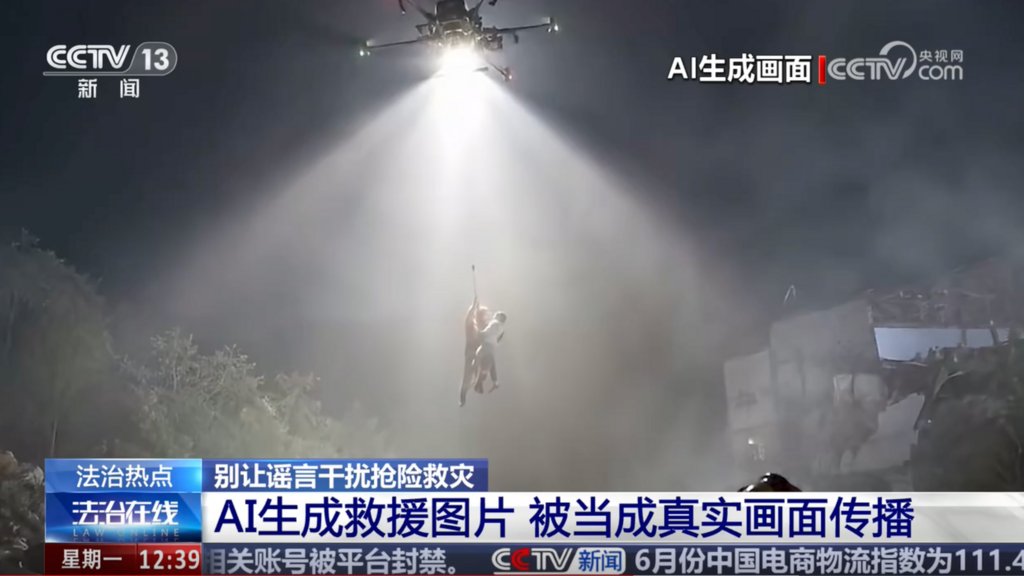
Typhoon Noul's landfall has unleashed a torrent of AI-generated fake videos showing fabricated deaths, exaggerated floods, and nonexistent power outages, sparking panic buying and complicating official rescue operations across affected regions. This surge in synthetic content tests China's disaster governance at a moment when public trust and rapid information flows are already strained by prior storms. Authorities now confront not only physical flooding but also a parallel crisis of digital deception that threatens coordinated evacuations.
China Battles AI Fakes Amid Typhoon Noul Disaster
Beijing, China — Article continues...
The Phenomenon of AI-Generated Fake Videos
Following the landfall of Typhoon Noul, social media platforms have been flooded with AI-created videos depicting dead bodies in floodwaters, exaggerated flooding in unaffected regions, and fabricated emergency responses. These materials have triggered panic buying in some areas after false claims of power outages circulated widely. Content creators exploit disaster coverage to boost engagement, as noted by Huang Zhihua of the Zhejiang Police Department, who highlighted deliberate fabrication for attention and views.
The accessibility of AI tools has lowered barriers dramatically, allowing individuals without technical expertise to produce realistic yet entirely false content on a large scale. This phenomenon builds on earlier incidents, such as fake images of crocodiles released into rivers after real snake escapes from a breeding farm in Hengzhou, Guangxi.
The Disaster Context of Typhoon Noul
Typhoon Noul struck China over the weekend prior to 27 July 2026, compounding challenges from recent powerful storms and flooding that have already strained rescue operations and evacuations. Authorities face the added burden of managing public panic amid complex logistics, where misleading videos about emergency efforts can disrupt coordinated responses.
These events occur against China's ongoing exposure to natural disasters, where rapid information flows can either support or undermine official efforts. The combination of real flooding incidents and fabricated details creates an environment ripe for confusion during mass evacuations.
Official Response from Public Security Authorities
Police departments have established specialized task forces to monitor short video platforms closely, investigating cases swiftly and imposing penalties ranging from fines to detention. Gao Kai of the Ningbo Public Security Bureau urged the public to approach unknown sources with skepticism and rely on official announcements, emphasizing that the internet is not a lawless zone.
Arrests and punishments have already occurred for bogus reports, with authorities stressing that creators of false content will face consequences up to seven years in prison when harm is severe. This operational focus aims to deter malicious activity during active disaster periods.
Regulatory Framework and Cyberspace Administration Actions
The Cyberspace Administration's 23 July nationwide crackdown targets fabricated data, malicious editing, staged scenes, misattributed historical events, and impersonation of officials across short-video platforms. Local branches received explicit directions to intensify reviews while platforms must enhance content moderation. Existing statutes already prescribe penalties up to seven years when severe harm results, yet the rapid evolution of accessible AI generation tools creates enforcement gaps that predate the current disaster period. Huang Zhihua of the Zhejiang Police Department has noted that creators deliberately exploit disaster coverage for attention, underscoring why the Administration pairs platform obligations with swift investigations by specialized task forces.
Existing laws are viewed by some experts as sufficient, yet the rapid evolution of AI technology outpaces legal updates. Professor Gao Fuping from East China University of Political Science and Law has argued that public education campaigns must accompany enforcement actions, including publicized punishment cases, to deter misuse rather than the underlying technology. Calls for mandatory AI-content stamping have surfaced in expert discussions, but re-editing can strip such markers, limiting long-term effectiveness. This regulatory approach reflects the tension between maintaining information integrity during active flooding and the need for frameworks that keep pace with AI capabilities, as authorities investigate cases ranging from fines to detention without awaiting new legislation.
Expert Analysis on Technological and Societal Risks
Professor Chen Bin, writing in the newspaper of the Communist Party's Central Party School, has observed that AI lowers technical barriers to the point where individuals without expertise can rapidly produce convincing yet fabricated text, images, audio, and video. This capability amplifies risks during disasters when false emergency-response claims circulate. Professor Xu Xiaoke of Beijing Normal University has stressed that detection technology consistently lags behind generation tools, producing an ongoing cat-and-mouse dynamic that no single technical solution can resolve. He advocates geographic verification with timestamps and rigorous source checking as complementary measures.
Professor Gao Fuping has identified motivations spanning amusement to deliberate attempts to incite panic or social unrest, noting that harm arises from misuse rather than the technology itself. These expert assessments highlight how AI tools, while advancing national capabilities, simultaneously strain institutional responses to misinformation. The constant evolution of generation methods requires sustained investment in verification infrastructure alongside legal penalties, ensuring that enforcement keeps pace with the speed at which fabricated content reaches mass audiences during crises such as Typhoon Noul.
The Trust Deficit in Official Information Channels
Instances where government-controlled media have been asked to soften descriptions of disasters have contributed to public mistrust. Past incidents have widened the gap between official narratives and public perception, creating openings for fabricated disaster content. The 2021 arrest of local officials in Henan province for underreporting 139 deaths established a precedent of skepticism toward government figures. Similarly, instructions to describe the Liulan Dam breach near Nanning as an "opening" or "gap" rather than a major failure, following at least 26 downstream deaths, reinforced perceptions that authorities soften reporting. These patterns make it easier for malicious actors to exploit existing doubts when AI-generated videos claim power outages or exaggerated flooding.
Historical cases, including the 2021 arrest of local officials in Henan province for underreporting 139 deaths, have widened this trust vacuum. Such patterns make it easier for bad actors to exploit skepticism during emergencies like Typhoon Noul. Professor Gao Fuping has linked such historical underreporting to the current environment where false videos trigger panic buying. The resulting trust vacuum complicates efforts by public security bureaus to direct citizens toward official announcements. Gao Kai of the Ningbo Public Security Bureau has emphasized that the internet is not a lawless zone, yet past credibility issues mean enforcement alone cannot fully restore confidence. Analytical focus therefore turns to how repeated downplaying of disaster severity creates structural vulnerabilities that AI tools can readily exploit during subsequent emergencies.
Legal Accountability and Platform Responsibilities
Lawyer Peter Pang, based in Shanghai and Washington, argued that AI app creators and publishing platforms must share legal accountability with individual creators. He illustrated how panic induced by fake posts could lead to real harm, such as accidents, placing responsibility on those enabling the spread.
Professor Gao Fuping called for public education paired with enforcement, including publicity of punishment cases. He maintained that harm stems from misuse rather than the technology itself, though Professor Chen Bin noted emerging legal questions as AI advances faster than frameworks can adapt.
Strategic Implications for China's AI Ambitions
China's 2017 policy declaration positioned AI as the main driving force of national progress, with Xinhua reporting over 6,000 AI companies operating domestically. This strategic emphasis supports technological self-sufficiency and broader regional influence goals. Yet the same generative tools now complicate disaster governance by enabling rapid production of misleading content that undermines coordinated evacuations and public compliance. Professor Xu Xiaoke has advocated building trusted information infrastructure, including official early-warning systems accessible to news organizations, as essential to managing these risks.
Professor Xu Xiaoke advocated building trusted information infrastructure, including official early warning systems accessible to news organizations. This aligns with broader objectives of technological self-sufficiency, where managing AI-generated risks becomes essential to maintaining social stability and regional influence amid growing global scrutiny of information integrity. The dual-use nature of AI creates a policy tension: leadership in generation capabilities must be balanced against the imperative to maintain social stability. Professor Chen Bin has noted emerging legal questions as AI advances faster than regulatory adaptation. This dynamic affects China's ability to project reliable information both domestically and internationally, where scrutiny of content integrity intersects with ambitions for multilateral influence. Effective responses therefore integrate enforcement, platform accountability, and infrastructure development to align AI-driven progress with the requirements of crisis communication.
By Prof. Marcus Chen, Staff Writer
This article was produced with AI-assisted research and editorial support. Reporting is based on sources cited in the article.
What's Your Reaction?
 Like
0
Like
0
 Dislike
0
Dislike
0
 Love
0
Love
0
 Funny
0
Funny
0
 Wow
0
Wow
0
 Sad
0
Sad
0
 Angry
0
Angry
0

World Politics Analyst at Global1.News. Based in Beijing, covering US-China relations, global trade, and geopolitical strategy. Brings deep analytical perspective to the power dynamics shaping international affairs.















Comments (0)