
Xi, Jordan's King Deepen China-Jordan Strategic Partnership
Chinese President Xi Jinping and King Abdullah II of Jordan held talks in Beijing, signing cooperation documents and a joint statement deepening the China-Jordan strategic partnership - covering Gaza, the West Bank, the Strait of Hormuz and a suite of economic agreements.
Xi, King Abdullah II Hold Talks in Beijing as China-Jordan Strategic Partnership Deepens
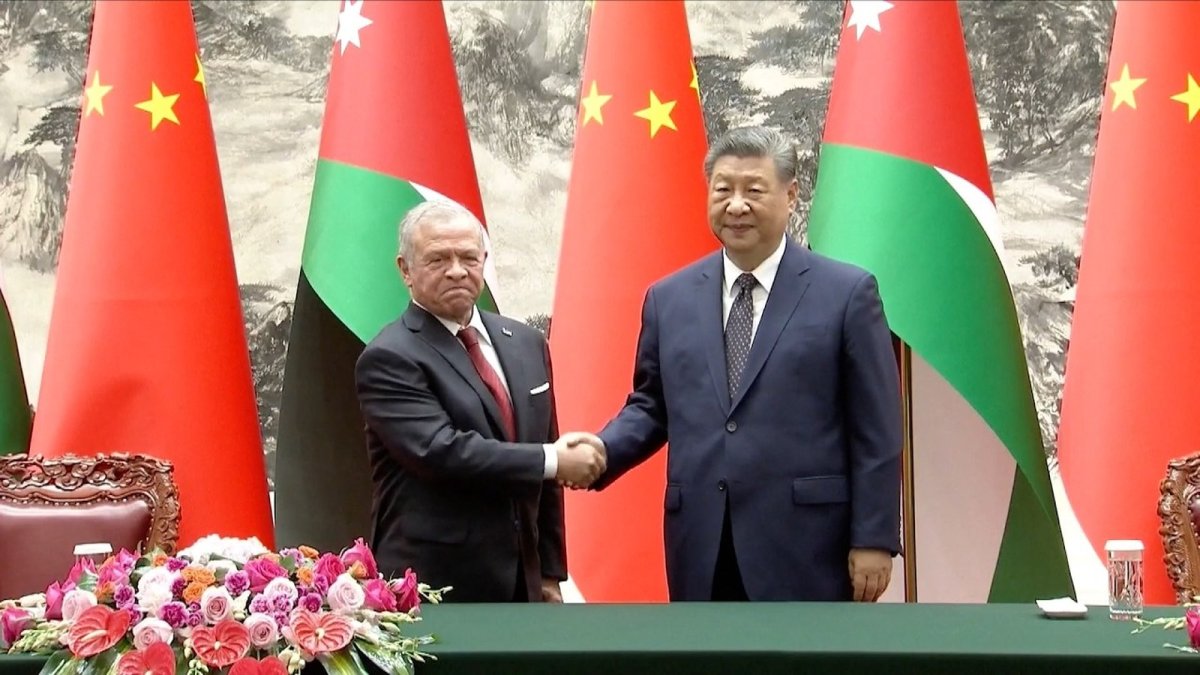
In a recent CGTN report, footage from the Great Hall of the People in Beijing captured Chinese President Xi Jinping and King Abdullah II of Jordan attending a signing ceremony for a series of cooperation documents, marking the culmination of a six-day state visit that has recalibrated the Hashemite Kingdom’s diplomatic posture. The August 24, 2026, talks, which followed a formal welcome ceremony complete with a 21-gun salute on Tiananmen Square, produced a joint statement on deepening the China-Jordan strategic partnership and a suite of memoranda spanning digital economy, civil aviation, and judicial cooperation. While the visit’s optics were ceremonial, the substance reflects a deliberate strategic calculation by Amman to diversify its economic dependencies amid a volatile regional security environment, even as it preserves its foundational alliance with Washington.
 The joint statement issued following the talks outlines a comprehensive agenda: deepening cooperation in trade, investment, energy and minerals, agriculture, tourism, and education, while exploring emerging sectors including green economy, digital economy, artificial intelligence, and advanced industries. Notably, both sides committed to taking practical steps to launch direct flights between the two countries as soon as possible, a logistical measure that would significantly enhance people-to-people ties and business connectivity. The statement also records Jordan’s support for China’s bid to host the permanent secretariat of the UNCLOS Biodiversity Beyond National Jurisdiction (BBNJ) Agreement in Xiamen, underscoring Amman’s alignment with Beijing on multilateral governance issues.
 By Prof. Marcus Chen, Staff Writer
A Strategic Partnership Entering Its Second Decade
The visit, King Abdullah’s ninth to China since assuming the throne in 1999 and his first since the establishment of the strategic partnership in 2015, carried symbolic weight as the two nations prepare to mark the 50th anniversary of diplomatic relations in 2027. According to the Ministry of Foreign Affairs readout, President Xi characterized the relationship as a “living example of win-win cooperation and mutual learning between countries with different social systems and of different sizes.” He further emphasized that developing ties with Jordan “aligns with the prevailing trend of Global South countries seeking strength through unity,” a framing that situates the bilateral relationship within Beijing’s broader narrative of South-South solidarity.
The joint statement issued following the talks outlines a comprehensive agenda: deepening cooperation in trade, investment, energy and minerals, agriculture, tourism, and education, while exploring emerging sectors including green economy, digital economy, artificial intelligence, and advanced industries. Notably, both sides committed to taking practical steps to launch direct flights between the two countries as soon as possible, a logistical measure that would significantly enhance people-to-people ties and business connectivity. The statement also records Jordan’s support for China’s bid to host the permanent secretariat of the UNCLOS Biodiversity Beyond National Jurisdiction (BBNJ) Agreement in Xiamen, underscoring Amman’s alignment with Beijing on multilateral governance issues.
Economic Realities: Trade Imbalance and Investment Potential
The economic context of this visit is defined by a stark asymmetry. Jordanian-Chinese trade reached nearly $6.7 billion in 2025, but the composition is heavily tilted in Beijing’s favor: Chinese exports to Jordan totaled approximately $6.29 billion, while Jordanian exports to China amounted to just $430 million. This imbalance, while significant, has not deterred Amman from seeking deeper integration. In a Xinhua interview during the visit, King Abdullah articulated a vision of Jordan as a “regional manufacturing and export hub,” citing the kingdom’s natural resources, skilled workforce, stable business environment, strategic location, and extensive network of trade agreements. Chinese investment in Jordan stands at an estimated $3.56 billion, a figure that remains well below Beijing’s footprint in neighboring Egypt and Iraq. However, the visit produced tangible commitments aimed at closing that gap. The signing ceremony included an economic and technical cooperation agreement providing a grant worth an estimated $14.7 million for humanitarian assistance and development cooperation, alongside a memorandum under which the Chinese government will provide 800 training opportunities to the Jordanian government this year. These instruments, while modest in scale, signal a sustained Chinese commitment to capacity-building in the kingdom.
Regional Flashpoints: Gaza, the West Bank, and the Hashemite Custodianship
The joint statement’s most consequential language addresses the Middle East’s unresolved conflicts. On Gaza, both sides consolidated support for the ceasefire, demanded the immediate, adequate, and unrestricted flow of humanitarian aid, and emphasized the pivotal role of the Jordanian land corridor in delivering assistance to Palestinians. The statement explicitly affirms that any arrangements must ensure Palestinians govern themselves, preserve the unity of the West Bank and Gaza Strip, and pave the way for the Palestinian National Authority to resume its responsibilities. Both parties also expressed support for UNRWA, the UN agency for Palestinian refugees. On the West Bank and East Jerusalem, the statement expresses deep concern at what it terms Israel’s “dangerous escalation”—settler violence, land confiscation, settlement construction and expansion, and attempts to alter the historical and legal status quo of Muslim and Christian holy sites in Jerusalem. All unlawful measures aimed at annexing the occupied West Bank are dismissed as null and void. Crucially, the Chinese side explicitly supports the historic role of the Hashemite Custodianship exercised by King Abdullah over Muslim and Christian holy sites in Jerusalem, a recognition that carries significant weight given Jordan’s unique religious authority in the city. President Xi’s remarks on the Palestinian question, as detailed in the MFA readout, rest on four principles: upholding political settlement through the two-State solution; upholding the principle of Palestinians governing Palestine; upholding humanitarianism with the UN Security Council ensuring civilian safety and assistance; and upholding fairness and justice on the basis of international rule of law. These principles, first set out by President Xi in April 2026, have now been formally incorporated into the bilateral joint statement.Navigating the US-Iran Conflict and the Strait of Hormuz
The visit unfolded against a backdrop of acute regional tension. The United States and Israel launched strikes against Iran on February 28, 2026, and Jordan—a US-allied kingdom—has found itself caught in the crossfire. US bases in Jordan have been targeted by Iranian forces since the conflict began, and Israeli and Iranian missiles frequently cross Jordanian airspace. The Strait of Hormuz remains closed to most shipping, and US-Iran peace talks have stalled, with President Trump stating on August 24 that Iran was “totally collapsing.” The joint statement addresses this crisis directly, underscoring the importance of upholding the ceasefire between the United States and Iran and reaching a comprehensive solution through dialogue and negotiation. Both sides emphasized that the Strait of Hormuz is a vital international corridor for trade in goods and energy, and that normal shipping traffic must be restored. This language reflects Jordan’s acute vulnerability: as a transit state and a frontline recipient of regional instability, Amman has a direct interest in de-escalation and the reopening of critical maritime routes.Strategic Calculus: Diversification Without Rupture
Analysts view this visit as a calculated hedge rather than a realignment. Taylor Luck, senior Middle East correspondent for the Christian Science Monitor, argues that the visit “signals a recognition in Jordan that its overreliance on America is not sustainable in the long term, and increasingly, not even in the short term.” Jordan, he suggests, is positioning “to tie the kingdom’s economic future to supply chains and Hormuz-alternative corridors that may emerge from the current war.” This interpretation aligns with Al-Monitor’s assessment that Jordan is not choosing Beijing over Washington but pursuing a middle path—preserving the US relationship that underpins its security while expanding economic ties with China. The United States authorized a $2.1 billion package of economic, military, and budgetary support to Jordan in 2026, and the US security relationship remains central to the kingdom’s stability and national defense. Yet the visit’s deliverables—including memoranda on industrial and supply chains, the “Air Silk Road” under the Belt and Road Initiative, and a green hydrogen project with China’s UEG Green Hydrogen Development Holding Limited valued at $1.155 billion—demonstrate that Amman is actively cultivating alternatives. Jordan’s significant silica deposits, a key raw material for solar panel production, and its Economic Modernisation Vision, which aims to absorb at least 1 million new young workers into the labor market by 2033, provide a compelling investment narrative for Chinese firms.Multilateral Alignment and the Road Ahead
The joint statement also reflects convergence on global governance issues. Jordan applauds the four global initiatives—development, security, civilization, and governance—and appreciates the Community with a Shared Future for Mankind initiative and the Belt and Road Initiative. King Abdullah extended an invitation to President Xi to visit Jordan at a time to be agreed, and China expressed support for Jordan hosting the High-Level Conference on Humanity in War under the Global Initiative to Galvanise Political Commitment to International Humanitarian Law. For Beijing, the visit advances its strategic objective of deepening engagement with the Global South and building alternative multilateral frameworks. For Amman, it offers a pathway to economic diversification and a hedge against an unpredictable US security umbrella. The 50th anniversary of diplomatic relations in 2027 will provide the next milestone, but the foundations laid in Beijing this week—from direct flights to digital economy cooperation—suggest a relationship that is maturing beyond symbolism into substantive partnership. Whether this middle path can withstand the pressures of a region in turmoil remains an open question, but both capitals have signaled their intent to pursue it with deliberate purpose.Disclosure: This article was produced with the assistance of AI tools and reviewed by editorial staff.
This article was produced with AI-assisted research and editorial support. Reporting is based on sources cited in the article.
What's Your Reaction?
 Like
0
Like
0
 Dislike
0
Dislike
0
 Love
0
Love
0
 Funny
0
Funny
0
 Wow
0
Wow
0
 Sad
0
Sad
0
 Angry
0
Angry
0

Marcus Chen
World Politics Analyst at Global1.News. Based in Beijing, covering US-China relations, global trade, and geopolitical strategy. Brings deep analytical perspective to the power dynamics shaping international affairs.












Comments (0)