
What Role Does Denuclearization Have in North Korea-US Dialogue Today?
In the wake of President Donald Trump’s August 16 decision to curtail the annual Ulchi Freedom Shield joint exercise, the United States has once again placed the denuclearization question at the centre of its diplomatic calculus with the Democratic People’s Republic of Korea (DPRK).
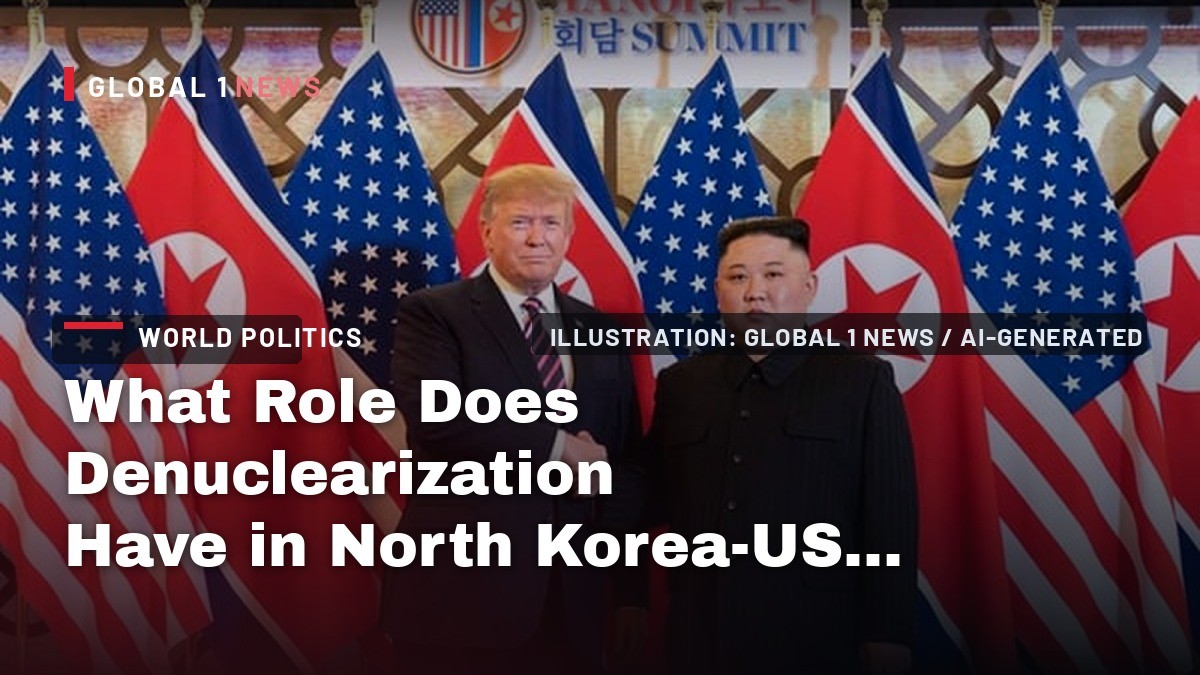
In the wake of President Donald Trump’s August 16 decision to curtail the annual Ulchi Freedom Shield joint exercise, the United States has once again placed the denuclearization question at the centre of its diplomatic calculus with the Democratic People’s Republic of Korea (DPRK). The move, framed by the White House as a gesture to reduce “inappropriate and hostile” signalling, was met on August 19 with a terse rebuke from a statement attributed to Kim Yo Jong, who dismissed the reduction as “unworthy of comment” and reiterated that the drill retained a “provocative and offensive feature.” A subsequent foreign‑ministry‑style communique, issued two weeks later, underscored Pyongyang’s broader stance: any détente was “pointless” while the United States remained “committed to the complete denuclearization of the DPRK.” These exchanges illuminate a deepening impasse over whether denuclearization can remain the pre‑condition for any renewed dialogue.
Historical Context of the Denuclearization Precondition
The present friction must be understood against the backdrop of the 2018‑19 diplomatic overtures that briefly softened inter‑Korean tensions. The February 2019 Hanoi Summit, which ended without an agreement, marked a turning point. In the aftermath, North Korean Ambassador to the United Nations Kim Song declared in December 2019 that “denuclearization is already gone out of the negotiation table,” signalling a hardening of Pyongyang’s position. Since then, the DPRK has repeatedly asserted that the nuclear question is non‑negotiable, a stance reinforced by the August 19 and subsequent statements cited above. The evolution from tentative engagement to an absolute refusal to discuss denuclearization reflects a strategic calculus by the Kim regime: nuclear capability is now viewed as a core security guarantee, rendering any concession on the issue politically untenable.
Nevertheless, the regime has not entirely closed the door on engagement. Repeated references to “excellent” personal relations between Kim Jong Un and President Trump, and the invocation of “good memories and feelings,” indicate that Pyongyang continues to value the symbolic capital of a personal rapport, even as it refuses to place nuclear disarmament on the negotiating table. This duality—maintaining a personal goodwill narrative while maintaining a hardline policy posture—creates a paradox that Washington must navigate if it wishes to move beyond the status quo.
U.S. Domestic Constraints on Policy Flexibility
President Trump’s overtures are constrained by domestic political realities. The administration’s claim that the Ulchi exercises are “costly” and “hostile” must be balanced against the broader U.S. strategic consensus that a nuclear‑free Korean Peninsula remains a core objective. The South Korean Ministry of National Defense, for instance, estimates North Korea’s warhead stockpile at between 80 and 120, while the President himself has publicly cited a figure of 57. These divergent estimates underscore the uncertainty surrounding the DPRK’s nuclear capacity, yet both figures reinforce the perception of a substantial threat.
Moreover, the United States is bound by a lattice of legal and political commitments—including United Nations Security Council resolutions, sanctions regimes, and the broader non‑proliferation architecture anchored by the Nuclear Non‑Proliferation Treaty (NPT) Review Conference and the International Atomic Energy Agency (IAEA). Any shift away from a denuclearization‑first policy would therefore entail not only a recalibration of bilateral strategy but also a potential destabilisation of the global non‑proliferation regime, a risk that U.S. policymakers cannot ignore.
Strategic Implications for Regional Allies
Allied governments, particularly the Republic of Korea, view denuclearization as a non‑negotiable cornerstone of regional security. The Korean Peninsula’s security architecture is predicated on the assumption that a nuclear‑free North Korea would reduce the strategic calculus for both Seoul and Tokyo, limiting the need for forward‑deployed U.S. forces and large‑scale joint exercises. A U.S. policy shift that downplays denuclearization could therefore strain the U.S.–ROK alliance, compelling Seoul to reassess its own security posture and potentially seek greater self‑reliance.
In addition, the broader Northeast Asian security environment—marked by heightened great‑power competition and North Korea’s military aid to Russia—means that any perception of U.S. concession on denuclearization could be interpreted by Beijing and Moscow as a weakening of the U.S. resolve, thereby altering the strategic balance in the region. The Korean Ministry of National Defense’s estimates of DPRK warhead numbers, cited above, serve as a reminder that the perceived threat remains significant for all regional actors.
The Viability of an Arms‑Control‑Centric Approach
One policy alternative floated within the Trump administration is a shift from a denuclearization‑first posture to a framework centred on arms control and risk reduction. This would entail moving the dialogue away from the absolute demand that Pyongyang relinquish its nuclear arsenal, and toward incremental measures—such as limiting missile testing, establishing hot‑line communications, or agreeing to a moratorium on certain nuclear‑related activities. The source material notes that the White House has demonstrated a willingness to abandon “status‑quo policies” in other contexts, suggesting a possible openness to such a recalibration.
However, the feasibility of this approach is uncertain. The DPRK has not articulated any concrete expectations for what a “drop denuclearization” policy would look like in practice. The August 19 foreign‑ministry‑style statement simply rejected the notion of détente while insisting on the denuclearization precondition, without specifying the precise actions Washington would need to take. Consequently, any arms‑control‑centric proposal would need to be carefully crafted to avoid appearing as a de‑facto recognition of North Korea as a nuclear‑armed state—a step that could undermine the global non‑proliferation regime.
Potential Concessions and Their Risks
Even if Washington were to entertain a de‑emphasis on denuclearization, the lack of clarity regarding North Korean concessions poses a strategic risk. The source material indicates that there is “no indication thus far of what may be negotiable with denuclearization off the agenda,” whether in the form of arms‑control measures or broader trade‑offs such as curbing North Korea’s military aid to Russia. Without a clear set of reciprocal steps, any U.S. concession could simply be met with a Pyongyang “walk‑away,” having achieved its primary objective of removing denuclearization from the agenda.
Furthermore, the internal political calculus within the United States may render such concessions unsustainable. A policy that appears to reward Pyongyang for simply dropping a precondition—without securing tangible security gains—could be politically untenable, especially given the entrenched domestic consensus that denuclearization remains a non‑negotiable goal.
Forward‑Looking Assessment: Paths to a Viable Dialogue
Given the entrenched positions on both sides, a viable pathway forward may involve a phased, confidence‑building approach that acknowledges the reality of North Korea’s nuclear arsenal while seeking to limit its expansion and reduce regional tensions. Such a framework could begin with mutually agreed‑upon risk‑reduction measures—such as a temporary freeze on missile launches or the establishment of a joint monitoring mechanism—while explicitly keeping denuclearization on the agenda as a long‑term objective rather than an immediate precondition.
In parallel, the United States would need to coordinate closely with Seoul and Tokyo to ensure that any concessions are calibrated to preserve alliance cohesion and to maintain the credibility of the broader non‑proliferation regime. Engaging think‑tanks such as the Asan Institute or the Korea Development Institute (KDI) could provide the analytical depth required to design such incremental steps, while diplomatic channels through the Ministry of Foreign Affairs (MOFA) could manage the delicate messaging needed to avoid domestic backlash.
Ultimately, the September 2026 diplomatic landscape reflects a stalemate in which both Washington and Pyongyang cling to core strategic imperatives—U.S. non‑proliferation credibility and North Korean regime survival. Bridging this divide will demand a nuanced, multi‑track strategy that balances immediate risk reduction with the long‑term goal of a nuclear‑free peninsula, a balance that will test the adaptability of U.S. foreign policy and the resilience of regional security architectures alike.
This article was produced with AI-assisted research and editorial support. Reporting is based on the source material cited below. Sources: The Diplomat; thediplomat.com; Global1.News (13 September 2026).
By Prof. David Park, Staff Writer
What's Your Reaction?
 Like
0
Like
0
 Dislike
0
Dislike
0
 Love
0
Love
0
 Funny
0
Funny
0
 Wow
0
Wow
0
 Sad
0
Sad
0
 Angry
0
Angry
0

East Asia/Technology Correspondent at Global1.News. Seoul-based voice covering Korean politics, technology, business, and culture. Analyzes how technology and geopolitics intersect across East Asia.













Comments (0)