
Western US Wildfires Force Mass Evacuations as Fire Season Worsens
Tens of thousands of people have fled their homes as wildfires rage across the American West, and the smoke from those flames is already drifting toward Latin America. From Reno, Nevada, to Spokane, Washington, the 2026 fire season is rewriting the rules of climate catastrophe — and the hemisphere is watching. The American West Is Burning — And Latin America Feels the Heat Reno, Nevada – United States, August 23, 2026 — The city of Reno is under siege once again as the human-caused Haw
Tens of thousands of people have fled their homes as wildfires rage across the American West, and the smoke from those flames is already drifting toward Latin America. From Reno, Nevada, to Spokane, Washington, the 2026 fire season is rewriting the rules of climate catastrophe — and the hemisphere is watching.
The American West Is Burning — And Latin America Feels the Heat
Reno, Nevada – United States, August 23, 2026 — The city of Reno is under siege once again as the human-caused Hawk Fire races toward its suburbs, the latest chapter in a fire season that has already consumed millions of acres across the West.

The West Is Burning — Tens of Thousands Flee
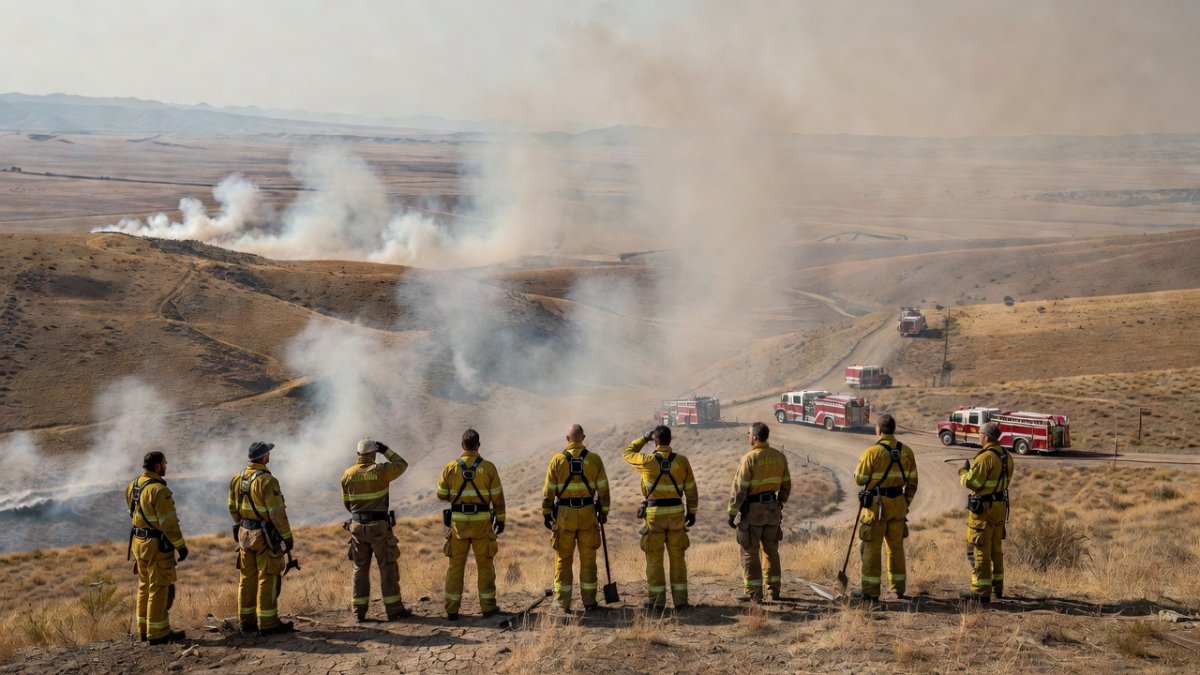
The images from the first week of August 2026 will not soon leave the collective memory of the American West. As Al Jazeera English reported on August 11, 2026, in a segment titled "Western US wildfires force tens of thousands to evacuate," the scale of the disaster was staggering. Fires across the western United States forced tens of thousands of people to flee their homes, destroyed entire neighborhoods, and required dramatic aircraft rescues of residents trapped by advancing flames. This was not a single blaze but a synchronized assault of fire across multiple states, a phenomenon that has become the terrifying new normal for a region in climatic freefall. The video footage showed columns of smoke rising like volcanic plumes, orange skies at midday, and convoys of cars snaking along highways under a hail of embers. It was a portrait of a landscape under siege, and the numbers only reinforced the visual horror.
In Spokane, Washington, the crisis was already a week old. Beginning around August 4, wildfires on the outskirts of the city had destroyed at least 700 buildings and forced tens of thousands to flee. The evacuation order affected over 60,000 residents, turning the city into a ghost town of boarded-up storefronts and abandoned vehicles. Hundreds of structures were lost to the flames, and the human cost—in terms of trauma, displacement, and the loss of irreplaceable belongings—was incalculable. The National Interagency Fire Center (NIFC) reported that between August 10 and 11, firefighters were actively responding to more than a dozen wildfires that had each exceeded 100,000 acres in size. The geographic spread was immense: more than 30 fires burned in Oregon, over 20 in Washington, and an additional 10 in Idaho. The entire Pacific Northwest was, for all intents and purposes, ablaze.
This was not a routine fire season. The NIFC had elevated the nation to Preparedness Level 5 (PL5), the highest possible wildland fire activity and deployment level. This designation signals that all available firefighting resources are committed and that the system is operating at maximum capacity. Nationwide, 29,000 personnel were assigned to firefighting duties, with over 18,000 of them concentrated in the Northwest Interagency Coordination Center alone. The sheer logistics of feeding, housing, and directing this army of firefighters was a monumental task, but the fires were outpacing even this massive mobilization. As the smoke drifted south and east, a question began to form in the minds of climate scientists and policy makers alike: if this is what the American West looks like, what does it portend for the rest of the hemisphere, particularly for Latin America?
Reno Under Siege: The Hawk Fire at the City's Edge
While the Pacific Northwest dominated headlines, the city of Reno, Nevada, became the epicenter of a more intimate and terrifying drama. In early August, the Bug Fire and the Fred Mountain Fire had already forced more than 5,000 people to evacuate. The Bug Fire grew from 6,500 to 17,000 acres in a single weekend, while the Fred Mountain Fire exploded from a mere 40 to 1,400 acres in the same period. The Reno Livestock Event Center was converted into an emergency shelter, housing more than 300 animals—horses, goats, and llamas—whose owners had nowhere else to turn. But the worst was yet to come. By August 22 and 23, a new blaze, the Hawk Fire, erupted in Washoe County, and it was immediately clear that this one was different. It was a human-caused fire, as classified by Washoe County Sheriff Darin Balaam, and it began near the Hawk Meadow Trail, a popular hiking spot on the city's edge.
The Hawk Fire grew with terrifying speed, expanding to more than 4,450 hectares (10,500 acres) in a matter of days. The winds, which had been the primary driver of the fire's erratic behavior, pushed flames toward suburban neighborhoods. At least six people were injured, and the evacuation orders were unprecedented in their scope. A staggering 42,000 residents were ordered to leave their homes immediately, with another 45,000 placed in a warning zone, ready to flee at a moment's notice. Nearly 10,000 homes and businesses lost power as the fire threatened critical infrastructure. Approximately 400 personnel were assigned to fight the blaze, but they were fighting a losing battle against the wind. Nevada Governor Joe Lombardo declared a state of emergency in Washoe County and mobilized the Nevada National Guard, deploying two helicopter crews and 60 troops to assist with evacuations and firefighting efforts.
The human drama unfolded in real-time on local news. Reno Mayor Hillary Schieve issued a desperate plea to the public: "If you have been told to evacuate, please don't wait! Structures have already been burned in this fire, and your life is more important than a building." Her words were echoed by Richard Edwards, chief of Truckee Meadows Fire and Rescue, who described the situation with grim understatement: "The Hawk Fire is a very dynamic incident for us, as it's being driven by the winds." Residents like Tyler Duvall told the Associated Press that the fire was so mild on Saturday morning it wasn't "even a concern"—by Sunday, his house was in the evacuation zone. Retired firefighter Ted Melden, who had moved to Reno from South Carolina just this month, survived his second local wildfire in two weeks. The randomness of the destruction, the speed of the spread, and the helplessness of the residents defined the Hawk Fire as a symbol of the new era of megafires.
What This Means for Latin America
For those of us reporting from Latin America, the images of Reno and Spokane are not just distant tragedies; they are a preview of our own future, and in many cases, our present. The wildfire smoke that billowed from the American West did not respect national borders. As the New York Times has noted, wildfires in Canada, the United States, and Mexico routinely send smoke throughout the continent, creating a hemispheric air quality crisis. The drought and heat conditions that are fueling the American fires are the same conditions spanning the US Southwest and northern Mexico, where the Sonoran and Chihuahuan Deserts are creeping northward. The climate engine that drives these fires is not a local phenomenon; it is a planetary one, and Latin America is on the front lines of its consequences.
Consider the parallel fire crises unfolding across our region. The Amazon rainforest, the Cerrado savanna, and the Pantanal wetlands are all experiencing fire seasons that are lengthening and intensifying. In Patagonia, ancient forests are burning with a frequency that was unthinkable a generation ago. Chile has suffered through megafires that have consumed entire towns, and the smoke from these events has drifted across the Andes, affecting air quality in Argentina and Uruguay. The same atmospheric circulation patterns that push fire weather across the western US are also influencing precipitation and temperature regimes in Latin America. When the American West burns, it is a signal that the planetary fire regime is out of balance, and the consequences for Latin America are direct and severe.
The data is unequivocal. A study from the University of Idaho and Columbia University found that human-caused climate change has nearly doubled the area burned in western US forest fires over three decades. NOAA reports that climate change is a dominant driver of increased fire weather across the western US, and the annual fire season has lengthened by about 25 days. For Latin America, this means that the window for controlled burns, agricultural clearing, and traditional land management is shrinking. It also means that the smoke from northern fires will increasingly blanket our cities, triggering air quality alerts and exacerbating respiratory illnesses. The PM2.5 fine particulate matter from wildfire smoke is a major public health hazard, and downwind cities in Mexico, Central America, and even the Caribbean are already feeling the effects. We are all breathing the same air, and it is getting harder to breathe.
Firefighters Across Borders: Mexico's Mutual Aid
In the midst of this catastrophe, a powerful story of solidarity emerged, one that challenges the narrative of a divided hemisphere. As the fires raged in British Columbia and the Pacific Northwest, Mexico stepped forward. According to Mexico News Daily, more than 300 Mexican firefighters were deployed to British Columbia's Thompson/Okanagan region, a critical fire zone. This was part of a larger international mobilization that included 200 Mexican firefighters arriving in BC for 14-day deployments, as part of a contingent of 600 international crews. On August 11, 100 Mexican firefighters arrived at Summerland, a community threatened by the Bald Range fire, which had reached 156 square kilometres and claimed at least one life. Mexican crews were also deployed to Ontario, demonstrating a commitment that spanned the entire breadth of Canada.
This south-to-north climate solidarity is not accidental. President Claudia Sheinbaum has personally initiated Mexican deployments to US and Canadian fires, recognizing that the climate crisis is a shared challenge that requires a shared response. The Mexican firefighters, many of whom are veterans of their own country's brutal fire seasons, brought expertise in terrain and fire behavior that proved invaluable. They were joined by firefighters from Australia and New Zealand, creating a truly global firefighting force. For Latin America, this is a profound statement. It shows that we are not merely victims of a crisis caused by the industrialized north; we are active participants in the solution, offering our bravest and most skilled workers to protect communities thousands of miles away.
The significance of this mutual aid cannot be overstated. It represents a shift in the geopolitical dynamics of disaster response. Historically, aid flowed from north to south, with wealthy nations sending money and equipment to developing countries. Now, we are seeing a more equitable exchange, where Mexican firefighters are treated as equals, respected for their skills and courage. This is not charity; it is solidarity. It is a recognition that the fires in British Columbia and Nevada are our fires too, just as the fires in the Amazon are the world's fires. The deployment of Mexican crews is a model for how the hemisphere must respond to the climate crisis: with shared resources, shared expertise, and a shared commitment to protecting life and land. It is a powerful rebuke to the politics of division, and a hopeful sign that we can face this challenge together.
A Deadly Season's Human Toll
Behind the statistics of acres burned and structures destroyed lies a more profound tragedy: the loss of human life. The 2026 fire season has been exceptionally deadly for firefighters, who are on the front lines of this crisis. On June 29, three firefighters were killed while fighting fires on the Colorado-Utah state line. They were part of the Rifle Interagency Helitack Crew, and they died when wind gusts of about 50 mph intensified fire activity, overwhelming their position. Nathan Matthews, another firefighter on that same team, later succumbed to his injuries, bringing the death toll from that single incident to four. These were not anonymous casualties; they were highly trained professionals who knew the risks and chose to serve anyway.
The deaths continued throughout the summer. Pilot Nicholas Dale of Sooke, British Columbia, was killed in July when his helicopter crashed near Gold Mountain, Colorado. He was a veteran aviator, and his loss was felt deeply across the firefighting community. In another incident, a helicopter responding to the Widemouth 2 Fire in Utah's Fishlake National Forest crashed, killing two crewmen. The investigation into that crash is ongoing, but the loss of life is permanent. US Wildland Fire Service Chief Brian Fennessy, in a somber tribute, called the fallen "the very best the wildland fire community has to offer." His words were a reminder that these are not just numbers; they are fathers, mothers, sons, and daughters who made the ultimate sacrifice.
The human toll extends beyond the firefighters. In Western Canada, the situation was equally dire. The BC Wildfire Service reported 98 wildfires in southwest Canada, with the overwhelming majority classified as "out of control." About 100 fires were burning across British Columbia, with roughly half out of control, leading to 20,000 evacuations in the province. The Bald Range fire near Summerland claimed one life, a civilian who was unable to escape the flames. In the United States, the full civilian death toll from the August fires is still being tallied, but it is certain to be significant. The trauma of evacuation, the loss of homes, and the anxiety of living under a constant threat of fire will have lasting psychological effects on hundreds of thousands of people. This is a crisis that is measured not just in acres, but in broken lives and shattered communities.
The Climate Engine Behind the Flames
To understand why the West is burning with such ferocity, we must look beyond the immediate weather conditions and examine the underlying climate engine. The science is clear, and it is damning. A comprehensive study conducted by the University of Idaho and Columbia University found that human-caused climate change has nearly doubled the area burned in western US forest fires over the past three decades. This is not a natural cycle; it is a direct consequence of greenhouse gas emissions. NOAA has reached a similar conclusion, reporting that climate change is a dominant driver of increased fire weather across the western US. The mechanism is straightforward: warmer temperatures dry out vegetation, turning forests and grasslands into tinderboxes. The annual fire season has lengthened by about 25 days, meaning there is a longer window for fires to ignite and spread.
The 2026 season has been a textbook example of these climate dynamics. NASA documented a severe western snow drought, which left the mountains with far less snowpack than normal. This meant that by late summer, the soil was parched and the vegetation was desiccated. When the winds picked up in August, the conditions were perfect for explosive fire growth. The 2026 US fire year has been among the worst since 2017, with 6.26 million acres burned by late summer, and the season's peak is still ahead. Newsweek reported that "just over 4 million acres burned so far this year," which is around 121 percent of the 10-year running average. These numbers are not just statistics; they are a measure of the accelerating climate crisis.
The implications for Latin America are profound. The same climate drivers that are intensifying fires in the American West are also affecting our region. The drought and heat conditions span the US Southwest and northern Mexico, creating a continuous zone of fire risk. Latin American ecosystems are facing parallel fire crises, from the Amazon and Cerrado to the Pantanal and Patagonia, and Chile's megafires have become a recurring nightmare. Our fire seasons are also lengthening, and our firefighters are being pushed to their limits. The smoke from northern fires is a public health hazard, triggering air quality alerts in downwind cities across Mexico and Central America. The climate engine is global, and its exhaust is fire. We are all in the same burning boat, and the time for denial is long past.
The Bottom Line — What Comes Next
As the smoke begins to clear over Reno and Spokane, the hard questions remain. What comes next? The immediate priority is, of course, the safety of the evacuees and the containment of the fires. But the longer-term challenge is far more daunting. We are facing a future where megafires are the norm, not the exception. The 2026 season has demonstrated that our current firefighting capacity, while heroic, is insufficient to stop the largest blazes. We need a fundamental rethink of land management, forest policy, and urban planning. We need to invest in fire-resistant infrastructure, create defensible space around communities, and restore natural fire regimes through controlled burns. We need to accept that some areas are simply too dangerous to rebuild, and that retreat is sometimes the wisest strategy.
For Latin America, the lessons are clear. We must accelerate our own climate adaptation efforts, recognizing that the fires in the north are a preview of our own future. We must protect our forests, not just for their carbon storage value, but for their role in regulating regional climate and water cycles. We must support our firefighters, who are increasingly being called upon to serve both at home and abroad. The mutual aid between Mexico and Canada is a model for the kind of hemispheric cooperation we need. President Sheinbaum's leadership in deploying Mexican firefighters is a powerful example of climate solidarity, and it should be expanded and institutionalized. We need a permanent framework for sharing resources and expertise across borders, because the fires do not respect national boundaries.
The bottom line is that we are in a new era, and we must adapt or suffer the consequences. The climate engine is not going to stop, and the fires will continue to burn. But we are not powerless. We have the science, the technology, and the human will to mitigate the worst impacts. The question is whether we have the political courage to act. The fires of August 2026 are a warning, but they are also an opportunity. They are a chance to build a more resilient, more cooperative, and more just society. The people of Reno, Spokane, and British Columbia have shown incredible resilience in the face of disaster. The firefighters from Mexico, Australia, and New Zealand have shown incredible solidarity. It is now up to our leaders to match that courage with policy. The future is not written; it is being forged in the flames. We must choose to write a better one.
By Elena Vasquez, Staff Writer
This article was produced with AI-assisted research and editorial support. Reporting is based on sources cited in the article.
What's Your Reaction?
 Like
0
Like
0
 Dislike
0
Dislike
0
 Love
0
Love
0
 Funny
0
Funny
0
 Wow
0
Wow
0
 Sad
0
Sad
0
 Angry
0
Angry
0

Latin America Correspondent at Global1.News. Based in Mexico City, covering politics, economics, energy, and culture across the region. Brings an on-the-ground perspective to stories spanning from the Rio Grande to Patagonia.










Comments (0)