
US Lawmakers Demand Release of American Student Held in Israel
Forty members of the United States Congress, including six senators, have formally demanded the immediate release of Sama Safi, a 20-year-old Palestinian-American student held in an Israeli military prison without charge since June.
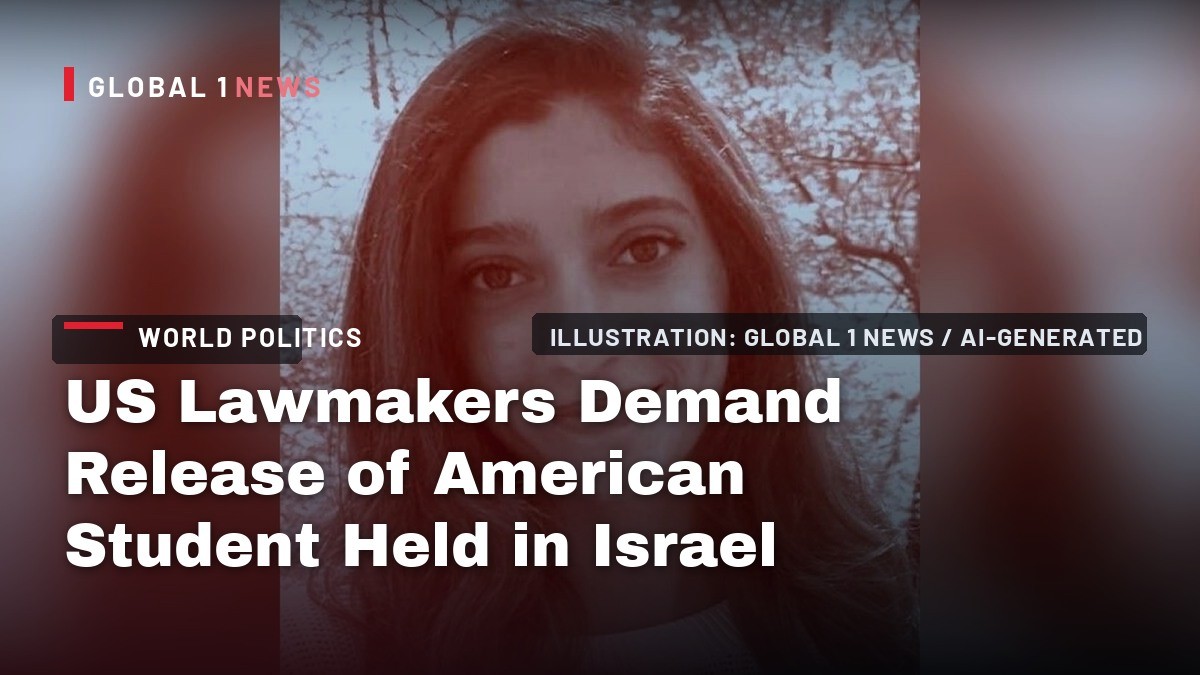
Forty members of the United States Congress, including six senators, have formally demanded the immediate release of Sama Safi, a 20-year-old Palestinian-American student held in an Israeli military prison without charge since June. In a letter addressed to Secretary of State Marco Rubio, the lawmakers cited her "severe chronic health condition" and warned that her life is "at risk on your watch," marking the most significant escalation yet in a months-long campaign to free the Birzeit University student. The letter, reported by Anadolu Agency on Tuesday, details harrowing accounts of mistreatment and accuses Israeli authorities of a "de facto State policy of organized and widespread torture."
Lawmakers demand State Department action
The letter, signed by 40 lawmakers including six senators, urges Secretary Rubio to secure Safi's release, emphasizing that Washington has a "duty to secure the safety and security of US citizens abroad." The legislators wrote that the State Department must prevent "further irreparable harm" to the young woman, who has been held at the Damon military prison near Haifa since her arrest on June 2. "You have a duty to secure the safety and security of US citizens abroad," the lawmakers wrote, asserting that Safi's life is "at risk on your watch." The letter stresses that it is Washington's responsibility to ensure the safety of all Americans overseas, a pointed rebuke to an administration that has thus far only said it is "monitoring the situation." In June, a State Department spokesperson told Anadolu Agency that the administration was "aware of the detention of an American in the West Bank" and that it takes its commitment to assist Americans abroad seriously, though no details were shared due to privacy considerations. The new letter suggests that such passive monitoring is no longer acceptable to a growing bipartisan bloc in Congress.Who is Sama Safi?
Sama Safi is a 20-year-old Palestinian-American psychology student at Birzeit University in the occupied West Bank, with family ties to Tampa, Florida. She was taken from her family home around 3 a.m. during a predawn Israeli military raid on June 2, 2026, and has been held without charge ever since. Safi was not alone in that night's arrests. Other Birzeit students were detained in the same pre-dawn raids, including Natalie Abu Diah, Leila Khalil, and Joulan Abu Awad, as well as a member of the Palestinian women's national soccer team. The mass detention of students from one of Palestine's most prominent universities has drawn widespread condemnation from academic and human-rights organizations. Her family has described the ordeal as a nightmare, noting that Safi was blindfolded and shackled during her initial detention. More than 100 US organizations urged her release in June and July, and senators and lawmakers had called for her freedom as early as mid-June. The August 25 letter from 40 lawmakers is the latest and most forceful escalation in that campaign.A chronic condition left untreated
Central to the lawmakers' demands is Safi's medical condition. She suffers from Familial Mediterranean Fever (FMF), a complex chronic autoinflammatory disorder that causes recurrent fevers — sometimes reaching up to 105 degrees Fahrenheit — and inflammation of the lining of the abdomen, lungs, and joints. The condition requires daily medication and a quarterly injection that Safi must travel abroad to receive. According to the lawmakers' letter, her condition has "rapidly deteriorated" while in custody, and doctors have cautioned she faces "life-threatening damage to her internal organs" if she remains detained without proper treatment. Since returning to detention on August 16 following a brief medical release, Safi has reportedly "not once received her daily medication" nor been evaluated by medical professionals. The letter warns that each passing day without treatment increases the risk of permanent organ damage, including amyloidosis, a potentially fatal complication of untreated FMF. The family's testimony paints a grim picture: a young woman with a manageable chronic condition, now facing a medical emergency in a military prison where basic healthcare appears absent. The lawmakers' letter frames her case not merely as a matter of due process, but as a humanitarian crisis requiring immediate intervention.Allegations of torture and mistreatment
The letter details harrowing accounts of Safi's treatment in custody, describing an environment that the lawmakers characterize as a "de facto State policy of organized and widespread torture." Her testimony includes being shackled, blindfolded, and denied food or water for the first 24 hours of her custody. The legislators also described the use of "shackling and the throwing of gas and stun grenades" into poorly ventilated cells, noting that "stress positions" have caused the student severe chest pain. "These inhumane conditions and violence towards detainees are not unique to one facility," the lawmakers wrote, suggesting a systemic pattern rather than isolated incidents. The allegations are consistent with longstanding reports from Palestinian, Israeli, and international human-rights organizations documenting the treatment of Palestinian detainees in Israeli military custody. Groups including B'Tselem, Amnesty International, and Human Rights Watch have repeatedly documented the use of administrative detention, solitary confinement, and what they describe as ill-treatment of Palestinian prisoners.Legal context: detention without charge and the Geneva Convention
Safi has been held without charge since her arrest, a practice known as administrative detention that allows Israeli authorities to hold individuals indefinitely without trial based on secret evidence. Israeli human-rights organization HaMoked has documented thousands of such cases, with detainees often held for months or years without knowing the allegations against them. The lawmakers labeled Safi's transfer from the occupied West Bank to the Damon military prison near Haifa a "blatant violation of the 4th Geneva Convention." Under international humanitarian law, the transfer of protected persons from occupied territory to the territory of the occupying power is prohibited, regardless of the circumstances. Israel has long maintained that its detention practices are necessary for security reasons and that administrative detention is a preventive measure, not a punishment. However, international legal experts and human-rights organizations have consistently challenged this position, arguing that the practice violates fundamental due-process rights under both international and Israeli law. The case also raises questions about the treatment of dual nationals in Israeli custody. While the United States has historically been reluctant to intervene forcefully in Israeli detention cases, the growing congressional pressure in Safi's case suggests a shift in political dynamics, particularly as the humanitarian toll of the ongoing conflict continues to draw scrutiny.The broader picture: 23,000 detained since the war began
Safi's case is not isolated. According to Palestinian records, approximately 23,000 individuals have been detained in the occupied territory since the current war in the Gaza Strip began. This figure includes men, women, and children, many of whom are held without charge or trial. The mass detention campaign has overwhelmed Israeli military courts, which process hundreds of cases per week with hearings often lasting only minutes. Detainees frequently report being denied access to lawyers, held incommunicado, and subjected to physical and psychological abuse during interrogation. For Palestinians, the detention system is a familiar feature of life under occupation. Generations of families have experienced the predawn raids, the blindfolds, the shackles, and the indefinite uncertainty of a loved one's fate. The international community has repeatedly called for an end to administrative detention and for compliance with international humanitarian law, yet the practice continues unabated. The detention of students like Safi has particular resonance in Palestinian society, where education is seen as a path to resilience and self-determination. Birzeit University, one of the oldest and most prestigious institutions in the occupied territories, has seen dozens of its students detained in recent months, disrupting academic life and instilling fear across campuses.What comes next
The letter to Secretary Rubio represents a significant political moment, but its immediate impact remains unclear. The State Department has not yet issued a formal response to the lawmakers' demands, and Israeli authorities have shown no indication of releasing Safi. Her family, meanwhile, continues to wait. They have called on the US government to treat her case with the urgency it deserves, noting that her medical condition makes every day in detention a matter of life and death. The quarterly injection she requires must be administered abroad, meaning even a release from prison may not be enough — she would need to leave the country for treatment. The broader question of US leverage over Israel's detention policies remains unresolved. While the United States has historically provided Israel with billions in military aid and diplomatic cover, the growing congressional pressure in cases like Safi's suggests that patience may be wearing thin. For now, the international community watches and waits. Human-rights organizations have called for Safi's immediate release on humanitarian grounds, and the 40 lawmakers who signed the letter have made clear that they will continue to press the administration. Whether Secretary Rubio and the State Department will act remains to be seen, but the pressure is mounting. Sama Safi's case has become a symbol of the broader plight of Palestinian detainees — a young woman with a future ahead of her, caught in a system that has held her for nearly three months without charge, without adequate medical care, and without end in sight. By Fatima Al-Rashid, Staff Writer This article was produced with AI-assisted research and editorial support. Sources: Middle East Monitor, Anadolu Agency, The Guardian, Democracy Now, Common Dreams.What's Your Reaction?
 Like
0
Like
0
 Dislike
0
Dislike
0
 Love
0
Love
0
 Funny
0
Funny
0
 Wow
0
Wow
0
 Sad
0
Sad
0
 Angry
0
Angry
0

Fatima Al-Rashid
Gulf/MENA Correspondent at Global1.News. Based in Doha, covering Gulf politics, energy markets, diplomacy, and development across the Middle East and North Africa. Tracks the economic transformation of the Gulf states.















Comments (0)