
Washington's Economic Hammer Falls on Iran as 23 Nights of Quiet Mask a New Kind of War
Washington pivots from airstrikes to economic warfare on Day 176 of the US-Iran war, with a tightening naval blockade and the "toughest sanctions in history" due Monday, as Tehran declares victory and China refuses to abandon Iran.
The One-Two Punch Arrives
Day 176 of the US-Iran war marks a fundamental shift in how the conflict is fought. For 23 consecutive nights, CENTCOM has confirmed no US or Israeli strike inside Iranian territory through the August 22, 0500 ET cutoff. The kinetic campaign that defined the spring has gone quiet, replaced by a tightening naval blockade and the promise of what Treasury Secretary Scott Bessent calls "the toughest sanctions in history."
Bessent told CNBC on Thursday, August 20, that the strategy is a deliberate escalation. "It is a one-two punch. We have the blockade, and we are going to have the toughest sanctions in history," he said. The details arrive Monday, August 24, targeting Iran's shadow fleet and its primary buyer, China, with secondary sanctions on Chinese entities. This is a pivot from bombs to balance sheets, from airstrikes to economic strangulation.
The timing is no accident: President Trump canceled a threatened multi-day campaign late on August 1, and the skies have been quiet since. The pressure has simply moved to the sea and the financial system — and the question is whether Tehran, which claims victory and calls for talks, can survive a siege Washington bets will outlast any bomb.
Blockade Tightens: 68 Vessels Redirected, Two Boarded
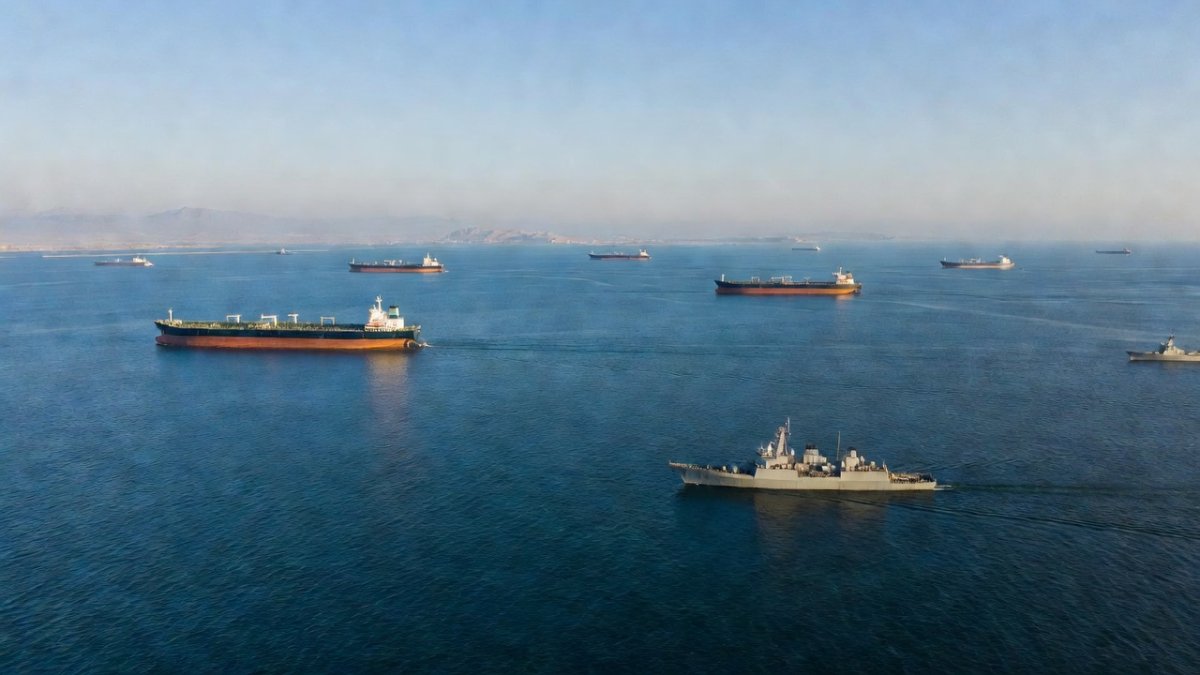
The naval dimension is already producing hard numbers. CENTCOM said August 21 that 68 commercial vessels have been redirected in enforcement of the blockade of Iranian ports, with three disabled and two boarded. More than 20 warships support the operation, patrolling the approaches to the Strait of Hormuz and the Arabian Sea.
The most dramatic incident came August 11, when the vessel Vela Nova was disabled by two Hellfire missiles fired from a Navy helicopter about 71 nautical miles off the Pakistani coast. The message: ships running the blockade will be stopped, by force if necessary. The operation is coordinated from Fort Bragg, North Carolina, with convoys of 15-20 tankers each night transiting the southern Omani channel under US Air Force fighter cover.
These convoys move an estimated 5-10 million barrels of oil per day around Iranian-controlled waters. The blockade is not just about stopping Iranian exports; it is about controlling the flow of the world's energy.
Hormuz Traffic Collapses to 20 Percent of Pre-War Average
The impact on the Strait of Hormuz is measurable. A CNN analysis of UK Maritime Trade Operations figures recorded 103 vessels entering and 89 leaving the strait in the seven days to August 21 — about 20 percent of the pre-war average.
More than 80 percent of liquid cargoes now use the southern Omani route, a longer, costlier path around the most contested waters. Kpler data published by Al Jazeera recorded 236 ships between August 1 and 19, of which 148 went dark, switching off transponders to avoid detection. The shadow fleet is growing — and so is the risk.
The human cost is already visible. The International Maritime Organization counted 65 confirmed shipping incidents and 17 confirmed seafarer fatalities as of August 11. War-risk insurance premiums run 7.5-10 percent of hull value, versus 1-3 percent before the war. Insurers are pricing in the danger.
China Rejects US Demand, Setting Up a New Confrontation
The sanctions package landing Monday will target China, Iran's primary oil buyer, with secondary sanctions on Chinese entities. But Beijing has already made its position clear: "Regarding the Iran issue, sanctions and pressure do not help resolve the problem."
It is a direct rebuke to Washington's demand for cooperation — and a potential US-China economic confrontation that could dwarf the Iran conflict itself. China buys the vast majority of Iran's oil exports and has shown no willingness to abandon that relationship.
Iran's Foreign Minister Abbas Araghchi dismissed the measures as "bound to fail," posting: "We have seen this movie before. Same bull. Different bullies." Spokesman Esmaeil Baghaei called the announcement "an assertion of extraterritorial sovereignty" over UN member states — "a recipe for an abysmal return to full-scale classic colonialism."
Tehran Declares Victory and Calls for Talks
Iran's leadership is projecting confidence even as the noose tightens. President Masoud Pezeshkian said Friday, August 21, in a meeting with doctors: "It is better that we bring the war to an end now as we are in a position of power and dignity... the whole world acknowledges our victory." State media quoted him saying "The entire world approved our victory and the U.S. is hated."
Pezeshkian also defended the June memorandum of understanding against hardline critics: "They cannot find even a single clause in this agreement that indicates capitulation." The Iranian and Omani foreign ministers held a phone call on conditions for resuming negotiations and navigation in the strait.
The military leadership echoes the defiance. IRGC spokesman Hossein Mohebbi said August 20 that missile production has never halted and new warheads exceed earlier models in destructive power, precision and range. General Ali Abdollahi, the armed forces chief of staff, said August 21 that Iranian forces have "preparedness across land, sea, air, air defence and cyberspace" and would answer threats with "crushing, punishing and devastating responses."
The White House Sees a Deal, But Not the Right One
President Trump is framing the situation as a victory in waiting. Speaking at Joint Base Andrews on August 21, he said: "We have total control of that entire region having to do with the Strait of Hormuz... they would love to make a deal, but they're not ready to make the right deal, in my opinion." At a rally the same day, he argued that paying "a tiny little bit more for your gasoline" is worth preventing "a very evil country" from obtaining a nuclear weapon.
The White House is betting economic pain will force Tehran to the table on American terms. But the president's political position is fragile: his approval rating stood at 33 percent in a Reuters/Ipsos poll, the lowest of his presidency.
Washington says Iran is "not ready to make the right deal"; Tehran says it has already won. The economic data suggests time is not on Iran's side — the blockade is strangling its exports, and Monday's sanctions will tighten the squeeze.
American Wallets Feel the Pain: $4.11 Gas and a 703-Point Drop
The costs are already visible in American wallets. Brent crude closed at $93.82 a barrel on August 21, a sixth consecutive session of gains, versus about $66 immediately before the war and a March peak of $119. US crude traded near $86.20, and US retail gasoline averaged $4.11 a gallon in the AAA reading cited August 21, up close to a dollar from a year earlier.
The regional disparities are stark: California is paying $5.59 a gallon, Hawaii $5.43, Washington $5.24. These are the price of the blockade, hitting working families hardest. The Dow Jones Industrial Average shed 703.84 points, or 1.32 percent, to close at 52,759.21 on August 20; the S&P 500 lost 0.87 percent to 7,641.16.
The bond market is flashing warning signs too: the 30-year Treasury yield pushed above 5.25 percent, near a two-decade high, and US total debt passed $40 trillion for the first time that week. The war is being financed on credit, and markets are pricing in the long-term consequences.
The Human Toll: 18 US Killed, 3,636 Iranian Dead
Behind the economic data lies a human cost. The US military has suffered 18 killed in action since February 28, with 687 wounded, per the Defense Casualty Analysis System as updated August 4. Israel has lost 32 or more IDF personnel since March 2; Al Jazeera's compilation puts total deaths in Israel from Iranian and Hezbollah attacks, including civilians, at 60 or more.
Iran's losses are far heavier. HRANA records 3,636 total deaths — 1,221 military, 1,701 civilian, 714 unclassified. Iran's Foundation of Martyrs confirms 3,468 killed; Al Jazeera records at least 3,527 killed and more than 27,000 wounded. The war began February 28, 2026, with US-Israeli airstrikes that killed Supreme Leader Ali Khamenei; his death was announced March 1, and Iran declared 40 days of mourning.
The conflict has spread beyond Iran's borders. Yemen's Houthis claimed a drone attack on the Saudi Aramco refinery at Jazan on August 18 and, on August 17, attacks on a Saudi military ship and four escort vessels off Yemen's Mocha. The UN reported an August 12 strike on a merchant ship off southern Yemen that killed several seafarers. Israel conducted artillery and air operations in southern Lebanon and Gaza, and struck Syria's Abu al-Duhur airbase in Idlib eight times on August 18.
This war has already claimed thousands of lives and disrupted the global economy. Economic warfare may reduce the nightly death toll, but it will not end the suffering — it will change its form, from bombs to blockades. The question is whether either side can find a way out before the pain becomes unbearable.
This article was produced with AI-assisted research and editorial support. Sources: CENTCOM statements, GlobalSecurity.org, Reuters, Al Jazeera, Bloomberg, CNN, IRNA, the International Maritime Organization, and the Defense Casualty Analysis System.
By Jessica Ali, Staff Writer
What's Your Reaction?
 Like
0
Like
0
 Dislike
0
Dislike
0
 Love
0
Love
0
 Funny
0
Funny
0
 Wow
0
Wow
0
 Sad
0
Sad
0
 Angry
0
Angry
0

Editor-in-Chief at Global1.News. Atlanta-based journalist who cuts through the BS and tells it like it is. Lead anchor, host, and the voice you hear when the spin stops and the truth starts.













Comments (0)