
Japan Earthquake: 5.9 Magnitude Shakes Tokyo, Kanto Region
A 5.9 magnitude earthquake struck southern Ibaraki Prefecture early Sunday, shaking Tokyo and the Kanto region, injuring at least five people and disrupting rail service. No tsunami warning was issued, and officials reported no nuclear safety concerns.
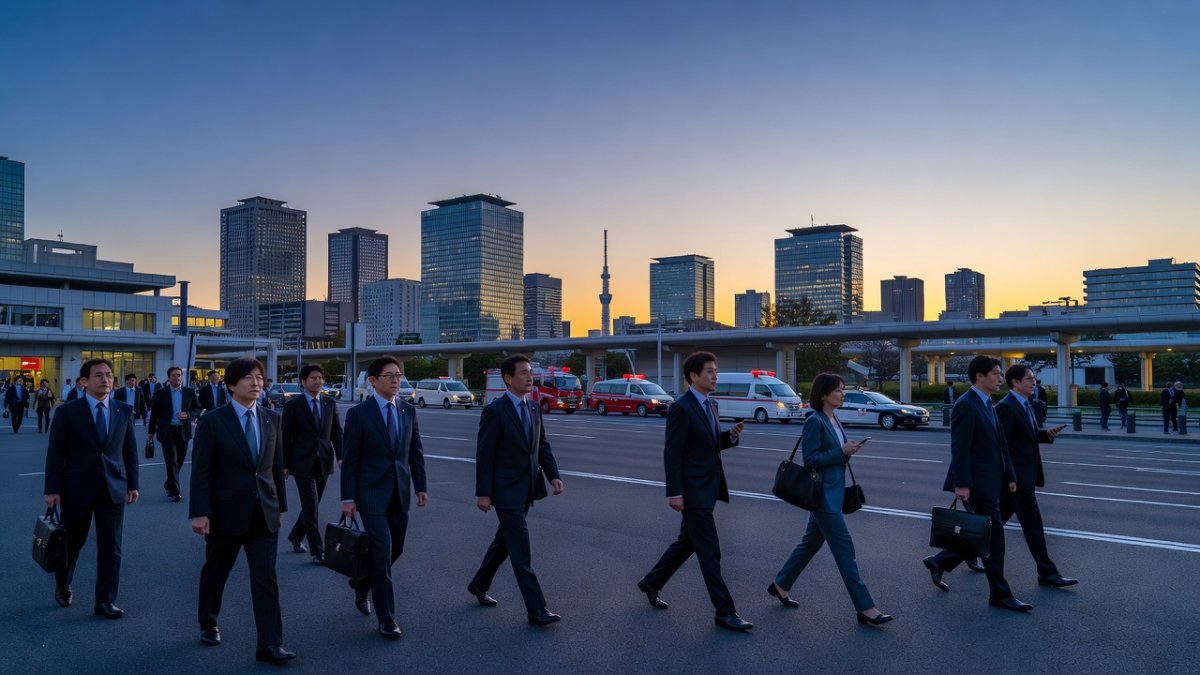
Folks, if you felt the ground move under your feet in Tokyo this morning, you weren’t imagining things. At roughly 2:00 a.m. local time, a magnitude 5.9 earthquake ripped through eastern Japan, shaking the Kanto region with enough force to rattle nerves, halt trains, and send at least five people to seek medical attention. The earth moved, the alarms blared, and for a few tense seconds, the world’s most prepared metropolis did what it does best: it held steady.
Japan Earthquake: 5.9 Magnitude Shakes Tokyo, Kanto Region
Tokyo, Japan — Article continues...
What Happened
Let’s cut through the noise and get to the hard facts, because that’s what you deserve. The Japan Meteorological Agency (JMA) recorded a magnitude 5.9 earthquake striking southern Ibaraki Prefecture at approximately 2:00 a.m. local time on Sunday, August 23, 2026. Some reports pin the exact moment at 1:14 a.m., but either way, this was a middle-of-the-night wake-up call for millions.
The epicenter sat about 70 kilometers deep beneath Ibaraki, a Pacific-coast prefecture roughly 100 kilometers northeast of central Tokyo. That depth matters, folks. A deeper quake spreads its energy across a wider area, which is exactly why the shaking wasn’t confined to one spot. The JMA registered a lower 5 on Japan’s 7-point seismic intensity scale, known as shindo, in Tokyo and across three prefectures: Ibaraki, Tochigi, and the Saitama area. For those unfamiliar with the scale, a lower 5 means strong shaking—shelves can topple, unsecured furniture moves, and people grab doorframes. It’s not a gentle nudge; it’s a firm hand on the shoulder of a sleeping giant.
And here’s the kicker: this wasn’t a deep, distant rumble that only seismologists noticed. This was felt by real people, in real homes, in the most densely populated urban corridor on Earth. Greater Tokyo is home to roughly 37 million souls. When the ground moves here, the entire world watches.
No Tsunami, Limited Damage
Here’s the good news, and I want you to hear it clearly: there was no tsunami warning. The JMA did not issue one, and they didn’t need to. This was a deep, crustal event, not a seafloor rupture. The Pacific didn’t bulge, the coast didn’t retreat, and the ocean stayed put. That’s a win, plain and simple.
But let’s not sugarcoat the rest. At least five people were injured, according to officials. We don’t have names, we don’t have specifics, and I’m not going to invent them for you. What we know is that five human beings had a rough morning. The tremor disrupted rail service across the Tokyo area—because of course it did. Japan’s trains are engineered to stop automatically when tremors are detected, and that’s exactly what happened. Shinkansen bullet trains ground to a halt, commuter lines paused, and thousands of early risers found themselves waiting on platforms, checking their phones, and thanking their lucky stars they weren’t on a moving car when the earth decided to stretch.
Damage was limited. No major structural collapses were reported. No buildings pancaked, no highways crumbled, no skyscrapers swayed dangerously. That’s not luck, folks. That’s engineering. But limited damage doesn’t mean zero damage. There are cracked walls somewhere, shattered dishes, maybe a few overturned vending machines. The cleanup will be quick, but the memory of that 2 a.m. jolt will linger.
Why This Region Feels Every Tremor
Let me break this down for you, because understanding the “why” is what separates informed citizens from scared bystanders. Ibaraki Prefecture sits on the Pacific side of Honshu, Japan’s main island, and it’s a geological hotspot for one simple reason: Japan is parked right on top of a tectonic traffic jam.
Four plates converge here—the Pacific Plate, the Philippine Sea Plate, the Eurasian Plate, and the North American Plate. They’re constantly grinding, sliding, and pushing against each other like commuters on a packed Tokyo subway at rush hour. When that pressure releases, you get an earthquake. Japan experiences about 1,500 felt earthquakes a year. That’s roughly four a day, every day, year-round. Most are so small you’d never notice. But every so often, one crosses the threshold into “whoa” territory, and that’s what happened this morning.
The Kanto region, where Tokyo sits, is particularly sensitive because it’s a basin. Think of it as a bowl filled with soft sediment. When seismic waves hit that bowl, they slosh around, amplifying the shaking. That’s why a quake centered in Ibaraki can rattle Tokyo with surprising intensity. The ground doesn’t just shake; it resonates. This is the same reason the 2011 Great East Japan Earthquake, a magnitude 9.0 monster, caused such extensive shaking in the capital even though the epicenter was far offshore to the north.
Today’s quake was a fraction of that power—5.9 versus 9.0 is a difference of over a thousand times the energy release—but the physics are the same. The ground remembers, and so do the people.
Japan’s Earthquake Playbook
Now, let’s talk about why this wasn’t a catastrophe, because that’s the story that doesn’t get told enough. Japan has spent decades perfecting the art of living on a fault line, and this morning was a textbook demonstration of that playbook.
First, the JMA’s Earthquake Early Warning system. This isn’t science fiction, folks. This is a network of seismometers that detects the initial, less-destructive P-waves and sends alerts to phones, radios, and TV broadcasts before the stronger S-waves arrive. You get seconds—sometimes just five or ten—but those seconds are enough to duck, cover, and hold on. Millions of people in the Kanto region likely got that alert on their phones this morning, a piercing chime that means “drop everything and protect your head.”
Second, building codes. After 2011, Japan hardened its standards even further. New structures are designed to sway and absorb energy, not resist it rigidly. Older buildings have been retrofitted. The result? A magnitude 5.9 at 70 kilometers deep is a stress test, not a demolition order. Tokyo’s skyscrapers are built to ride out quakes like a ship riding waves, and they did exactly that.
Third, the trains. Japan’s rail system is a marvel of automated safety. Seismic sensors along the tracks detect tremors and instantly cut power to trains in the affected area. Bullet trains, which can travel at 300 kilometers per hour, have emergency braking systems that engage automatically. That’s why this morning’s disruption was inconvenient, not deadly. A train full of passengers at speed during a quake is a nightmare scenario; Japan engineered that nightmare out of existence.
And fourth, the culture. This is the part that can’t be coded or constructed. Japanese schools run earthquake drills from kindergarten. Households keep emergency kits with water, food, and flashlights. September 1 is Disaster Prevention Day, a national reminder that the earth is not your friend. This isn’t paranoia; it’s preparation. When the ground shakes at 2 a.m., people don’t panic. They act.
Nuclear Safety Questions
I know what you’re thinking, because I’m thinking it too. Every time Japan shakes, the question of nuclear power looms large. The 2011 disaster at Fukushima, triggered by a magnitude 9.0 quake and a massive tsunami, is a scar on this nation’s psyche. So when the earth moves near Ibaraki, people ask: what about the reactors?
Here’s what we know, and I’m sticking strictly to the verified facts. Officials reported no nuclear safety concerns raised in connection with this earthquake. That’s the official line, and I’m going to give it to you straight. The Tokai No. 2 nuclear power station sits in Ibaraki, roughly 50 kilometers from the epicenter area. But officials have not flagged any issues, and there is no indication of abnormal readings or damage.
I’m not going to speculate, folks. I’m not going to spin conspiracy theories or suggest that officials are hiding something. What I will say is this: the fact that no nuclear concerns were raised within hours of the quake is a testament to the post-2011 safety upgrades. Japan’s nuclear regulators are among the strictest in the world now, and plants that operate do so under intense scrutiny. This was a moderate quake, deep and manageable. It was not a Fukushima scenario. But you better believe that every sensor at every facility in the region was checked, and you better believe that the public will demand transparency in the coming days.
What This Means for the Region
So, what’s the takeaway for the 37 million people in greater Tokyo, and for the millions more watching from abroad? First, this is a reminder that Japan is not a place that “might” have earthquakes. It’s a place that does have earthquakes, regularly, and will continue to have them. This morning’s event was a routine stress test, and the region passed.
For residents, the message is simple: check your emergency kit, secure your furniture, and know your evacuation route. If you didn’t feel this one, you’ll feel another one eventually. That’s not fear-mongering; that’s geography. For travelers, the message is equally clear: Japan’s infrastructure is designed to keep you safe. Follow the instructions of local authorities, download the JMA’s earthquake app, and don’t run outside during shaking. Inside, under a sturdy table, is where you want to be.
For the rest of the world, this is a case study in resilience. A magnitude 5.9 quake in a megacity of 37 million people, and the headline is “limited damage, five injuries.” That’s not an accident. That’s decades of investment in safety, a culture of preparedness, and a government that takes seismic risk seriously. Compare that to other regions of the world where a quake of this size would level buildings and cause mass casualties. Japan is the gold standard, and this morning was a reminder of why.
The Bottom Line
Folks, let me leave you with this. The earth moved this morning, and Japan didn’t flinch. Five people were injured, trains stopped, and dishes rattled. But no tsunami came, no buildings fell, and no nuclear alarms sounded. That’s the story. That’s the victory.
But don’t mistake preparedness for invincibility. The 2011 disaster proved that nature can always throw a curveball. The 5.9 this morning was a warning shot, a reminder that the plates are always moving, always building pressure, always waiting for the next release. Japan is ready for that day, as ready as any nation on Earth can be. And that readiness is a lesson for all of us, no matter where we live.
So tonight, when you go to bed, take a second to think about what you’d do if the ground shook. Do you have a plan? Do you have a kit? Do you know where to go? Because the earth doesn’t care about your schedule, your politics, or your fears. It moves when it moves. The only question is whether you’re ready.
Japan is ready. Are you?
By Jessica Ali, Staff Writer
This article was produced with AI-assisted research and editorial support. Sources: Japan Times, The Japan News (Yomiuri Shimbun), Japan Meteorological Agency, Reuters.
What's Your Reaction?
 Like
0
Like
0
 Dislike
0
Dislike
0
 Love
0
Love
0
 Funny
0
Funny
0
 Wow
0
Wow
0
 Sad
0
Sad
0
 Angry
0
Angry
0

Editor-in-Chief at Global1.News. Atlanta-based journalist who cuts through the BS and tells it like it is. Lead anchor, host, and the voice you hear when the spin stops and the truth starts.















Comments (0)