
The Nurse's Dilemma: Why Some Filipino Nurses Choose to Stay
Filipino nurses face a stark dilemma: stay or migrate. OECD data shows 277,266 Philippine-born nurses work abroad, up 147 percent since 2000. Low pay and burnout push many to leave, but some, like Regie Legaspi and Angela Opeña, choose to stay for vocation and opportunity.
The Nurse's Dilemma: Why Some Filipino Nurses Choose to Stay
The Financial Chasm That Drives the Exodus
The numbers tell a painful story. A newly registered nurse in New Zealand can earn more than six times the starting salary for a government nurse in the Philippines. For a nurse supporting a family in a sari-sari store economy where every peso counts, that difference is not just statistics — it is the ability to send children to school, to build a home, to provide a future."The difference is significant, and it's understandable why many Filipino nurses are drawn to opportunities overseas," said Legaspi, who has been a nurse for 16 years. "Some leave to provide a better future for their families, while others seek professional growth and better working conditions. At the same time, there are nurses who choose to stay because they believe in serving their fellow Filipinos."This financial chasm has deep roots in Philippine governance and budget priorities. The Department of Budget and Management has long faced pressure to increase healthcare spending, but salary adjustments for government nurses have consistently lagged behind the demands of the profession. Meanwhile, destination countries like New Zealand — with a population of 5.36 million in 2024 — continue to face growing demand for nurses, actively recruiting from countries like the Philippines to fill their gaps.A New Life in Aotearoa: The Pull of Better Conditions
For Charissa Escobia, the decision to migrate was driven by a combination of professional and personal factors. A registered midwife nurse in the Philippines who worked in a state hospital for more than 12 years, she now works in a private nursing home in New Zealand. She emigrated with her husband and son, settling in the North Island in August 2023."Since moving here, I've noticed a significant improvement in my standard of living. Life here feels quieter, safer and more balanced," said the Taranaki-based nurse. "My hands still care for patients, but I no longer burn out doing it."Escobia cited better pay, a fairer workload, improved nurse-to-patient ratios, and more career opportunities as key reasons for her move. "There are still staffing pressures here in New Zealand, but here, safe staffing is recognized as a right, not a luxury," she said. "In the Philippines, the nursing shortage is a constant. Short-staffing and overtime happen almost every day, hence burnout is unavoidable."Her words echo the experience of countless Filipino nurses who have taken the long path of requalifying and starting afresh in a first-world country. It is a journey marked by sacrifice — leaving behind family, familiar faces, and the comfort of home. Escobia admitted it has been difficult being away from her loved ones, but the trade-off has been worth it for her family's future.Although the cost of living in New Zealand is comparatively higher, Escobia said she is still able to support her family back home and save. She believes the overall lifestyle outweighs the difference. And in a statement that cuts to the heart of the matter, she said that if salaries and conditions in the Philippines were comparable to New Zealand, she would have chosen to stay. "Not because the Philippines is easier, but because home is where my heart is," she said.The Strain on Philippine Hospitals
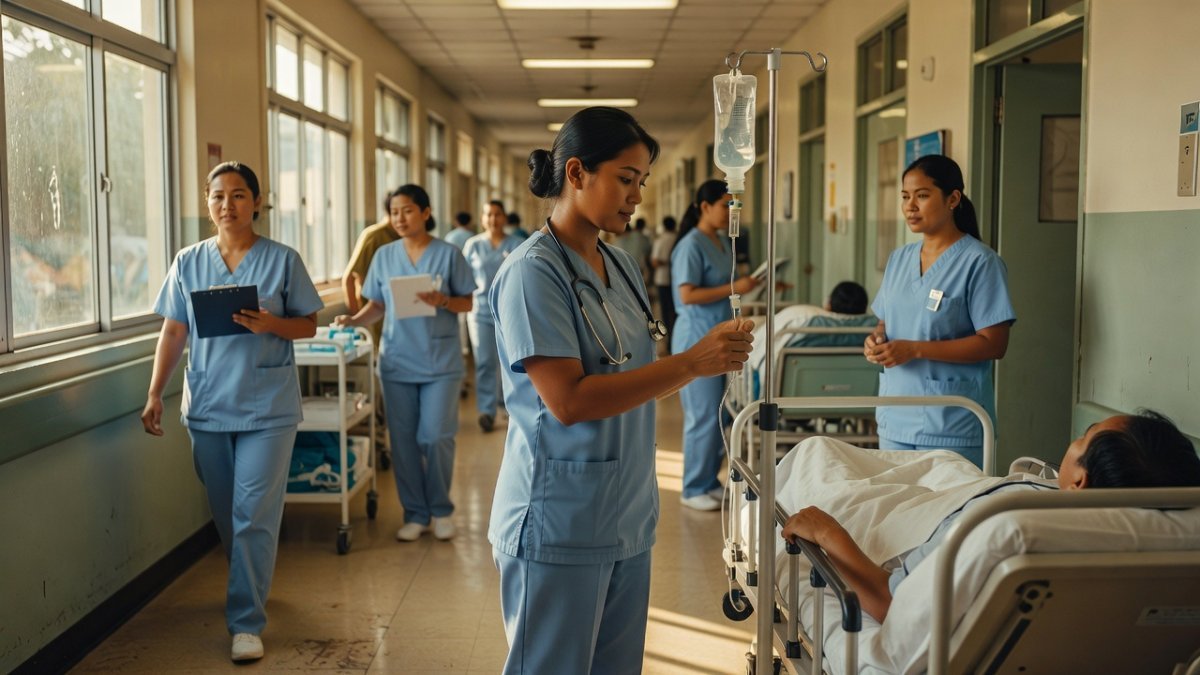
Back home, the impact of this exodus is felt most acutely in public hospitals, where nurses like Angela Opeña work under conditions that would be unthinkable in many developed countries. Opeña, a nurse supervisor at Bicol Regional Hospital and Medical Center, has been a nurse for 10 years and works in the pediatric intensive care unit, which has a capacity of 10 beds."Working in a public or government hospital was challenging. Everything you need is not provided automatically," Opeña said. "In the government hospital, you will learn how to improvise things just to provide something for your patient."The staffing situation is dire. "We are short-staffed every day because the manpower of ICU is supposed to be one to one, but currently with my staffing today it is one nurse to three patients," she said.This ratio — one nurse to three critically ill children — is not just a matter of convenience; it is a matter of life and death. In intensive care units around the world, one-to-one nursing is considered the standard of care. In the Philippines, our nurses are stretched thin, forced to make impossible choices about which patient needs them most at any given moment.The pressure and low compensation have made Opeña consider working overseas. "But I still have a reason to stay," she said. "I still feel the satisfaction of caring for the needy, especially in a state hospital. I still want to provide them the care that they deserve even if they have nothing."Her commitment is admirable, but it comes at a cost. Opeña said many of her colleagues have already left to work overseas, while others are considering doing the same. Each departure adds to the burden of those who remain, creating a vicious cycle of burnout and attrition.The New Zealand Connection: A Growing Filipino Presence
The flow of Filipino nurses to New Zealand shows no signs of slowing. Internationally trained nurses now make up more than one-third of New Zealand's nursing workforce, with Filipinos representing one of the largest ethnic groups in the profession. The Nursing Council of New Zealand reported that Filipino nurses accounted for around 14 percent of the country's 80,000 nurses who held an annual practicing certificate during the 2024 to 2025 registration year.This is not just a statistic — it represents thousands of Filipino families separated by oceans, thousands of barangays losing their healthcare providers, and thousands of patients in Philippine public hospitals waiting longer for care. The remittances sent home by these nurses help sustain the Philippine economy, but they cannot replace the presence of a nurse at a bedside in a government hospital in Bicol or Manila.The Philippine government has taken notice, but concrete solutions remain elusive. The Department of Health has acknowledged the nursing shortage, and various bills have been filed in Congress proposing salary increases and improved working conditions for healthcare workers. However, these measures are still being deliberated, and their implementation timelines remain uncertain.The Heart of the Matter: Why Some Choose to Stay
Despite the overwhelming financial incentives to leave, there are nurses like Legaspi and Opeña who choose to stay. Their reasons are deeply personal and rooted in a sense of vocation that transcends monetary compensation.For Legaspi, the decision to stay was about professional growth and alignment with his personal goals. The opportunity to pursue a doctorate through a scholarship and take on a director position at a private hospital offered him a path forward that he could not find overseas. "It was an opportunity that aligned with my personal and professional goals, so I chose to stay," he said.For Opeña, it is about the satisfaction of serving the needy. "I still feel the satisfaction of caring for the needy, especially in a state hospital. I still want to provide them the care that they deserve even if they have nothing," she said.These stories of commitment are inspiring, but they also highlight a troubling reality: the Philippine healthcare system is relying on the goodwill and sacrifice of individual nurses to fill systemic gaps. The burden should not fall solely on the shoulders of those who choose to stay. The government, private hospitals, and society as a whole must do more to make staying a viable and attractive option.As the Philippines continues to grapple with this nursing exodus, the stories of Legaspi, Escobia, and Opeña serve as powerful reminders of the human cost of this crisis. For every nurse who leaves, there is a family left behind, a hospital short-staffed, and a community losing a trusted caregiver. For every nurse who stays, there is a sacrifice made and a commitment honored.The question is not whether Filipino nurses will continue to be sought after by countries like New Zealand — that is already certain. The question is whether the Philippines can create conditions that make staying a choice, not just a sacrifice. Until then, the dilemma of stay or leave will continue to haunt the corridors of our hospitals and the hearts of our nurses.What Policymakers Can Do: Keeping Nurses at Home
The path forward will require more than sentiment. The Department of Health has acknowledged the nursing shortage, and lawmakers in Congress have filed bills proposing salary increases, better staffing ratios, and improved working conditions for healthcare workers. These measures are still being deliberated, and their implementation timelines remain uncertain — but the direction of the debate matters.
Experts point to several concrete steps that could tilt the balance: competitive pay for government nurses, safer nurse-to-patient ratios in public hospitals, scholarship and career-growth programs that reward those who stay, and stronger support for hospital staff who carry the heaviest workloads. The Department of Budget and Management has a central role to play in funding these commitments, alongside local government units that run district hospitals and rural health units in the provinces.
None of this is quick or easy. But as the stories of Legaspi, Escobia, and Opeña show, many Filipino nurses do not want to leave. They want to serve their own communities — their own kapitbahay, their own barangay health centers. The challenge for the nation is to make that choice possible, not just admirable.
This article was produced with AI-assisted research and editorial support. Sources: PhilStar.com (Aug. 24, 2026).By Bella Reyes, Staff WriterWhat's Your Reaction?
 Like
0
Like
0
 Dislike
0
Dislike
0
 Love
0
Love
0
 Funny
0
Funny
0
 Wow
0
Wow
0
 Sad
0
Sad
0
 Angry
0
Angry
0

Philippines/Southeast Asia Correspondent at Global1.News. Manila-based journalist covering Philippine politics, environment, maritime security, and social issues. Passionate about marine conservation and the communities protecting the Philippines' natural heritage.














Comments (0)