
Russian General Targeted in Moscow Restaurant Bombing as Death Toll Rises to Five
At least five people were killed and 21 wounded when a female suicide bomber detonated a device outside an upscale Moscow restaurant on Saturday evening. Reports link the blast to a birthday celebration for Col. Gen. Alexander Chaiko, the newly appointed commander of Russia's Aerospace Forces.
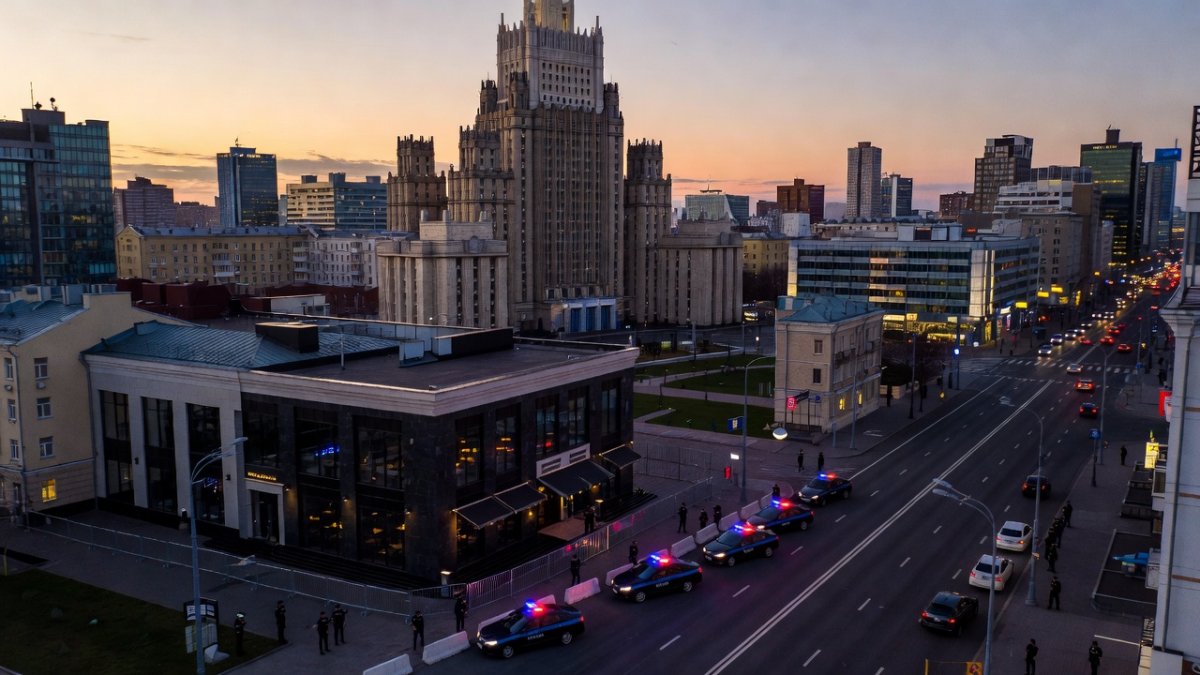
A female suicide bomber detonated an explosive device outside the Balzi Rossi restaurant in central Moscow on Saturday evening, killing at least three people and wounding 21 others. The death toll later rose to five, according to multiple Russian media outlets. Reports have linked the blast to a birthday celebration for Colonel General Alexander Chaiko, the newly appointed commander of Russia's Aerospace Forces, though key details remain unverified.
Russian General Targeted in Moscow Restaurant Bombing as Death Toll Rises to Five
Moscow, Russia — The explosion occurred just before 8 p.m. near an upscale Italian restaurant housed in one of Moscow's Stalin-era skyscrapers at Kudrinskaya Ploshchad. Russia's National Anti-Terrorism Committee described the incident as a terrorist attack carried out by a woman who attempted to enter the premises with a homemade device disguised as a gift. A security guard who stopped her was killed alongside the attacker when the package detonated.
What Happened
The blast took place outside the Balzi Rossi restaurant and registered the equivalent of one kilogram of TNT, packed with metal balls, according to preliminary reports cited by Kommersant. The attacker's remains were recovered 15 meters from the site. Russia's National Anti-Terrorism Committee confirmed the woman as the suspected perpetrator and stated she was killed in the detonation.
Authorities have not released an official account of how the device was constructed or whether the attacker knew its contents. Kommersant reported that the woman may have been unaware she was carrying a bomb.
The Victim Toll
At least three people died in the initial blast, with the toll rising to five by Sunday, according to Telegram channel 112, pro-Kremlin broadcaster Ren TV, and the newspaper Izvestia. Twenty-one others were wounded. Moscow Mayor Sergei Sobyanin expressed condolences to the families of those killed and described the event as a brutal terrorist attack.
The Russian Embassy in Italy also put the number of fatalities at five in a statement issued on Monday.
Who Was Targeted
Reports indicated the restaurant was hosting a birthday celebration for Colonel General Alexander Chaiko, who turned 55 on July 27, along with events marking his appointment as commander of Russia's Aerospace Forces. A sign reading "Alexander 55" appeared on the restaurant stage in video footage from the gathering.
Chaiko himself was not injured. Unverified reports from Telegram channels and the exiled outlet Vyorstka suggested his daughter Maria Chaiko may have been among the wounded, along with other possible attendees from the Federal Security Service and Defense Ministry.
Who Is General Chaiko
Colonel General Alexander Chaiko was appointed commander of Russia's Aerospace Forces in May. He previously served as commander of Russia's Eastern Military District during the initial phase of the full-scale invasion of Ukraine and has faced European Union sanctions over alleged involvement in civilian killings in Bucha in March 2022. The sanctions describe him as the highest-ranking Russian military officer deployed in Ukraine at the beginning of the full-scale invasion.
If the targeting is confirmed, the incident would represent one of the highest-ranking apparent assassination attempts against a Russian general since the start of the full-scale war. His career trajectory from Eastern Military District command to oversight of Aerospace Forces operations places him at the center of planning for air and missile components of the Ukraine campaign.
Official Response
Neither President Vladimir Putin nor his spokesman Dmitry Peskov has commented publicly on the attack. Ukrainian authorities have issued no statements. Moscow Mayor Sergei Sobyanin condemned the blast without assigning responsibility.
The National Anti-Terrorism Committee continues to lead the investigation, with no further details released on possible accomplices or the device's origin.
The Embassy Accusation
Russia's Embassy in Italy blamed Ukraine for the attack, stating that "the bloody tentacles of [President Volodymyr] Zelensky’s terrorist gang have reached an Italian restaurant in Moscow." The embassy claimed the choice of venue was intended to intimidate Italians working in Russia.
Ukrainian officials have not responded to the accusation. The claim remains without supporting evidence from Russian authorities.
Unanswered Questions
Investigators have not confirmed whether General Chaiko was the intended target or established a direct connection to the war in Ukraine. The FSB's counterintelligence posture in Moscow has come under scrutiny given the attack's proximity to senior security and military figures.
Details about the attacker's identity, possible handlers, and how the device reached the restaurant remain unverified. Senior officials from the Defense Ministry and lawmakers were reportedly expected at the event, according to the Telegram channel VChK-OGPU. Victim lists circulating on Russian media and Telegram channels have not been officially verified by authorities, and the anonymous nature of VChK-OGPU reporting leaves several claims open to further confirmation. Kyiv has maintained complete silence on the incident and has not claimed responsibility for any role in the bombing.
Security Implications
The placement of a device equivalent to one kilogram of TNT and packed with metal balls in central Moscow near a Stalin-era skyscraper raises immediate questions about FSB counterintelligence effectiveness. Such an attack in a venue frequented by Kremlin elites suggests gaps in screening protocols for locations tied to high-ranking military personnel. The reported detail that the attacker may have been unaware she carried the bomb, according to Kommersant, points to possible use of unwitting couriers, complicating standard threat detection methods.
This could indicate that security arrangements around Russia's military leadership require urgent reassessment, particularly as events involving Aerospace Forces command draw together officials from the Defense Ministry and FSB. A successful strike so close to one of Moscow's Seven Sisters skyscrapers would undermine the perceived invulnerability of the ruling elite's inner circle, where such landmarks symbolize continuity of state power. The psychological effect on FSB and Defense Ministry leadership could be profound, fostering heightened paranoia and mutual suspicion within security structures already stretched by wartime demands. In past incidents of this nature, the Kremlin has typically responded with intensified security crackdowns, expanded internal surveillance, and tighter controls on access to elite venues, measures that often extend beyond immediate investigations to reinforce regime cohesion.
The War's Reach
The pattern of the war extending into Russian cities has accelerated in recent months, with Ukrainian drone strikes on Russian territory reaching new intensity. Russia's Defense Ministry reported downing 635 drones in a single night during one recent wave of attacks, underscoring the scale of incursions targeting airfields, refineries, and other infrastructure. Strikes on energy facilities and logistics hubs have already disrupted civilian life far from the front lines. The apparent bombing in central Moscow now marks a further escalation, bringing direct violence into the capital's most protected districts. This development shifts the domestic narrative from one of distant conflict to immediate vulnerability, challenging official assurances that the war remains contained beyond Russia's borders and potentially eroding public confidence in the state's ability to shield its core institutions.
Information Warfare
The propaganda battle over attribution has intensified in the absence of a unified official line. The Russian Embassy in Italy issued its unproven claim linking the attack to Ukrainian actors, while the Kremlin itself has offered no formal statement. Pro-Kremlin media outlets close to the security services have focused on the rising death toll and graphic details to frame the incident as evidence of foreign terrorism. Each side leverages the event to advance its narrative: Russian state-aligned voices portray it as proof of Ukrainian aggression requiring harsher measures, whereas the lack of verified evidence allows Kyiv's silence to be interpreted by some observers as strategic restraint. This dynamic illustrates how such attacks become tools in the broader information contest, with unconfirmed reports from channels like VChK-OGPU feeding competing accounts without independent corroboration.
Wider Context
Earlier assassination-style attacks on Russian military figures linked to the war have followed a pattern of operations reaching into Russian territory, including drone strikes and sabotage incidents. This event signals an expansion of the conflict's reach into the capital, where such actions test the limits of domestic security measures.
Analysts suggest the incident may reflect Ukrainian capabilities to conduct targeted operations despite official Ukrainian silence on the matter. The absence of claims or denials from Kyiv leaves open interpretations about attribution and intent.
Political and Institutional Fallout
The lack of public statements from President Putin and Dmitry Peskov contrasts with the embassy's direct accusation and Sobyanin's description of a brutal terrorist attack. This approach could indicate a deliberate strategy to avoid escalation in rhetoric while investigations proceed. VChK-OGPU's claim that FSB and Defense Ministry officials attended the event underscores how the blast intersected with core power structures, potentially prompting internal reviews of elite protection protocols.
Further developments will likely shape how the Kremlin manages internal protection for its security apparatus in the coming weeks.
By Irina Volkov, Staff WriterThis article was produced with AI-assisted research and editorial support. Reporting is based on sources cited in the article.
What's Your Reaction?
 Like
0
Like
0
 Dislike
0
Dislike
0
 Love
0
Love
0
 Funny
0
Funny
0
 Wow
0
Wow
0
 Sad
0
Sad
0
 Angry
0
Angry
0
Russia/Eastern Europe Correspondent at Global1.News. Covering Russian politics, energy, security, and the shifting dynamics of the post-Soviet space. Provides clear-eyed analysis on one of the world's most opaque regions.











Comments (0)