
Russian Convoy Resupplies Syrian Coastal Facilities for First Time Since Moscow-Damascus Deal
Last week a four‑vessel Russian convoy docked at the Syrian port of Tartus, delivering supplies to the naval and air facilities that have long underpinned Moscow’s foothold in the Levant.
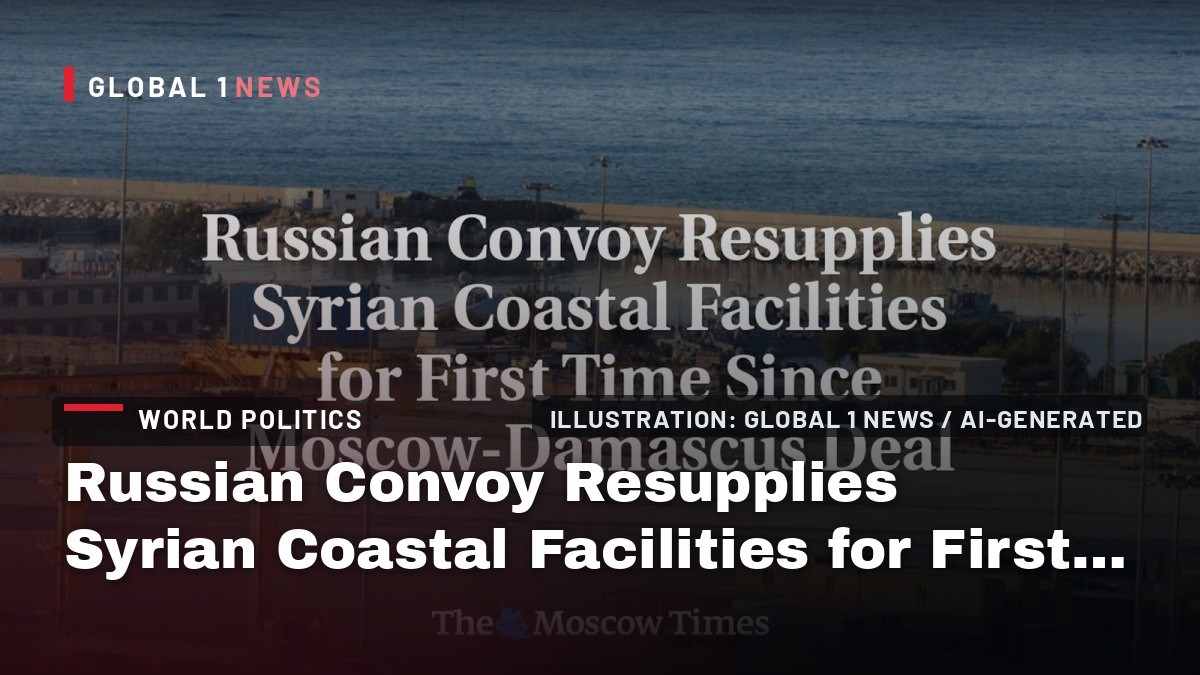
Last week a four‑vessel Russian convoy docked at the Syrian port of Tartus, delivering supplies to the naval and air facilities that have long underpinned Moscow’s foothold in the Levant. The operation marks the first resupply mission since Damascus and Moscow signed a new agreement on 9 August 2026 governing the future of Russia’s military presence in Syria. The convoy’s arrival, tracked by Reuters and maritime‑intelligence firm SynMax, offers a concrete early indication that the terms of the deal are already being put into practice.
Logistics of the September convoy
The convoy left the Strait of Gibraltar and proceeded east across the Mediterranean, where its vessels ceased transmitting AIS signals shortly after crossing the strait, a standard practice for Russian naval movements seeking operational security. Satellite imagery captured the group’s progress, confirming its arrival at Tartus on 7 September 2026. On 8 September, the Ro‑Ro cargo ship Sparta and the navy replenishment oiler Akademik Pashin were seen moored at piers 3 and 4 respectively, while a Russian tanker, General Skobelev, remained offshore.
A Reuters reporter observed the two vessels docked on 9 September, and a surveillance balloon was noted hovering over the port during the unloading operation. SynMax identified the fourth ship as the Udaloy‑class destroyer Admiral Levchenko. The presence of a destroyer alongside logistics vessels underscores the dual nature of the mission: both supply and a visible show of force.
The new Moscow‑Damascus agreement
The August 9 2026 accord, reached after 18 months of negotiations following the December 2024 overthrow of President Bashar al‑Assad, redefines the legal status of Russia’s bases. Under the deal, civilian facilities used by Russia at Tartus will be transferred to Syrian control, while military sites will become joint training centers. Crucially, the agreement stipulates that Russian forces will remain at both Tartus and Khmeimim, preserving Moscow’s strategic depth in the region.
By linking civilian infrastructure to Syrian authority, the Kremlin aims to insulate its presence from potential future sanctions or diplomatic pressure. At the same time, the joint‑training provision creates a framework for deeper military integration with Syrian forces, potentially expanding Russian influence over Syrian defence policy.
Strategic value of Tartus and Khmeimim
Tartus is Russia’s sole naval repair and replenishment hub in the Mediterranean, enabling warships to receive maintenance, fuel, and supplies without returning to the Black Sea or the Black Sea Fleet’s home ports. The port’s capacity to service surface combatants, as demonstrated by the presence of the destroyer Admiral Levchenko, is a critical element of Moscow’s power‑projection across the Mediterranean, the Middle East, and Africa.
Khmeimim airbase, located inland, serves as the primary launch point for Russian air operations in the region. The base’s runway and support facilities allow for the deployment of fighter jets, transport aircraft, and UAVs, providing Moscow with a rapid‑response capability that can be leveraged in conflicts from Libya to the Sahel. The convoy’s delivery of ammunition, as reported by a Syrian military source and a Russian‑Syrian businessman, suggests that the resupply was intended to sustain ongoing air operations as well as ground‑force readiness at both sites.
Sanctions and the legal grey zone
Two of the vessels involved—Sparta and General Skobelev—are subject to U.S. sanctions. Sparta, a Ro‑Ro cargo ship, has long been used in Russian military logistics in Syria and is listed under sanctions for facilitating the transport of military equipment. General Skobelev, a tanker, is sanctioned for its role in moving Russian oil abroad. Their participation in the convoy highlights Moscow’s willingness to operate sanctioned assets in support of its strategic objectives, accepting the risk of secondary sanctions on entities that interact with them.
The presence of a surveillance balloon over Tartus during the unloading operation may reflect an effort to monitor the activity of foreign intelligence services, particularly given the heightened scrutiny of sanctioned vessels. It also signals an intent to document the operation for internal records, ensuring compliance with the terms of the new agreement while maintaining operational security.
Implications for regional power dynamics
The resupply convoy demonstrates that Russia is not merely maintaining a symbolic presence in Syria but is actively ensuring the operational readiness of its assets. By delivering ammunition and other supplies, Moscow signals to regional actors—Turkey, Israel, and the Gulf states—that its ability to influence events in the Eastern Mediterranean remains intact.
Furthermore, the joint‑training centers envisaged by the August agreement could enable Syrian forces to operate Russian equipment more effectively, deepening Moscow’s leverage over Damascus. This development may complicate the calculus of Western powers that have sought to curtail Russian influence by supporting opposition groups or imposing diplomatic pressure on the Syrian regime.
Domestic media repression and the role of independent reporting
The Moscow Times, the source of the convoy details, has recently been designated an “undesirable” organization by Russia’s Prosecutor General’s Office, criminalising its activities and exposing its staff to prosecution. This designation follows an earlier “foreign‑agent” label, reflecting an escalating crackdown on independent journalism within Russia.
Despite these pressures, the outlet has managed to obtain and publish information about the convoy through two unnamed sources familiar with the operation. The ability of independent media to surface such details underscores the importance of external reporting in shedding light on Kremlin activities that are otherwise obscured by state‑controlled narratives.
Future outlook for Russian logistics in Syria
Given the successful delivery of supplies in early September, it is reasonable to anticipate that Moscow will continue to use similar convoys to sustain its Syrian bases. The inclusion of a destroyer in the convoy suggests that future missions may combine logistical support with a visible naval presence, reinforcing deterrence against potential interference by rival powers.
Monitoring of AIS data, satellite imagery, and maritime‑intelligence reports will remain essential for tracking the cadence of these resupply operations. Any deviation—such as a reduction in convoy frequency or a shift to alternative ports—could signal a strategic recalibration, perhaps in response to evolving sanctions regimes or changes in the regional security environment.
This article was produced with AI-assisted research and editorial support. Reporting is based on the source material cited below. Sources: The Moscow Times; themoscowtimes.com; Global1.News (15 September 2026).
By Irina Volkov, Staff Writer
What's Your Reaction?
 Like
0
Like
0
 Dislike
0
Dislike
0
 Love
0
Love
0
 Funny
0
Funny
0
 Wow
0
Wow
0
 Sad
0
Sad
0
 Angry
0
Angry
0
Russia/Eastern Europe Correspondent at Global1.News. Covering Russian politics, energy, security, and the shifting dynamics of the post-Soviet space. Provides clear-eyed analysis on one of the world's most opaque regions.














Comments (0)