
Russia's MC-21 Jet Test Flight: Sanctions Milestone
Russia's MC-21, the flagship passenger jet built with fully domestic parts, completed its maiden flight over Irkutsk this week. The milestone underscores how sanctions forced an overhaul of the program as Rostec targets certification by late 2026.
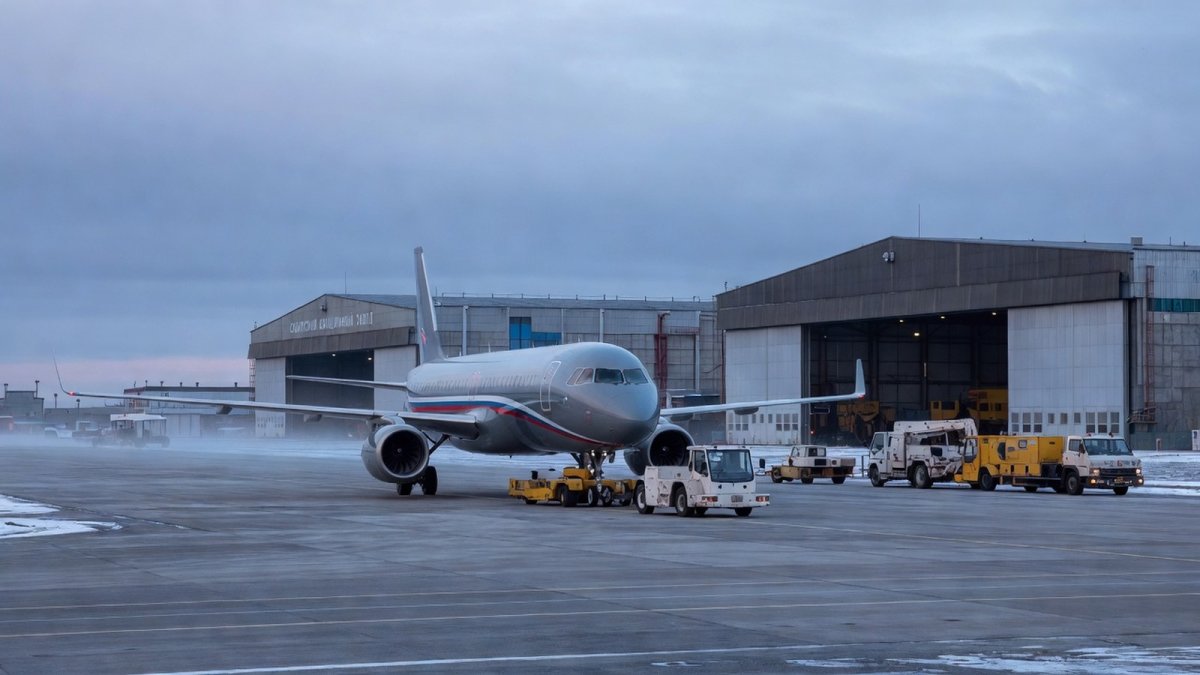
Russia's MC-21 Flagship Jet Takes to the Skies — A Sanctions-Era Milestone
The mass-production model of Russia's MC-21 passenger jet completed its first test flight this week, marking a concrete step in the Kremlin's long-running effort to build a fully domestic civil airliner. United Aircraft Corporation announced the milestone on Monday, days after President Vladimir Putin visited the assembly plant in Siberia. The flight underscores how sanctions have forced a complete overhaul of the program originally launched in 2009.
The Maiden Flight Over Irkutsk
The MC-21-310 took off from the Irkutsk Aviation Plant airstrip and remained airborne for one hour and 23 minutes. It reached speeds of 600 kilometers per hour and altitudes of 6,000 meters. Test pilot Roman Taskayev stated afterward that the first assembly-line aircraft performed well and completed the full flight plan without deviation.
Putin's Visit and Fresh State Orders
President Putin toured the Irkutsk facility on July 24, where test pilots briefed him on preparations. United Aircraft Corporation CEO Vadim Badekha confirmed that the factory is now preparing an initial batch of 18 airliners. The government approved additional production orders immediately after the presidential visit, tying the program directly to Kremlin industrial priorities.
Delays Triggered by Western Sanctions
The MC-21 program began in 2009 with an original target of mass production in 2016. Sanctions imposed after 2014 repeatedly blocked access to foreign engines, avionics, and composite materials, pushing timelines back year after year. Developers now state that every component has been replaced with Russian-made equivalents to bypass those restrictions.
The MC-21 program initially incorporated Western engines, avionics, and composite materials to meet performance and certification standards attractive to international customers. Sanctions imposed after 2014 restricted access to these components, and further measures in recent years eliminated remaining supply options. Developers responded by launching a comprehensive replacement effort that shifted every major system to domestic equivalents, extending development timelines across multiple phases of the project.
According to program statements, the Pratt & Whitney PW1000G engine option was canceled along with associated Western avionics packages, requiring redesign of integration points and extensive ground testing. This import-substitution process unfolded over several years as Russian industry adapted manufacturing processes and validated new configurations. Analysts suggest the repeated adjustments reflect broader challenges in rebuilding supply chains under sustained external restrictions, with each sanction wave prompting additional engineering reviews.
The cumulative effect has been a multi-year postponement of serial production goals originally set for the mid-2010s. Rostec has described the resulting aircraft as fully independent of foreign suppliers, though the extended timeline illustrates the technical and logistical demands of such a transition in a sanctions environment.
Rostec's All-Domestic Supply Chain
State defense conglomerate Rostec, which controls United Aircraft Corporation, has driven the shift to an entirely Russian supply chain. The MC-21-310 variant uses two Aviadvigatel PD-14 engines produced by United Engine Corporation, a Rostec subsidiary. This import-substitution effort forms part of a broader Kremlin strategy to shield civil aviation from further Western export bans.
The PD-14 engine, developed by Aviadvigatel and produced by United Engine Corporation under Rostec, powers the MC-21-310 variant and marks the first all-new Russian turbofan engine family introduced in decades. This powerplant replaces earlier foreign options and forms the core of efforts to achieve complete domestic propulsion capability. Rostec has coordinated output across its subsidiaries to ensure engine production aligns with airframe assembly schedules at United Aircraft Corporation facilities.
Composite wing structures, previously reliant on imported materials, have been transitioned to Russian manufacturing sources as part of the same vertical integration strategy. Rostec consolidated various aviation design bureaus and factories into a unified holding structure in recent years, enabling centralized control over research, development, and production. This approach supports the broader goal of insulating civil programs from external supply disruptions.
Officials at Rostec have emphasized that the resulting supply chain encompasses engines, avionics, and structural components entirely within Russian entities. Analysts suggest this consolidation strengthens state oversight but also concentrates risk within a single industrial group, potentially affecting future scalability and innovation rates.
Certification Timeline and Testing Volume
Rostec CEO Sergey Chemezov has set a target of completing certification by late 2026, with commercial flights expected to follow months later. Chief designer Vitaly Naryshkin noted that roughly 220 to 230 certification flights will be needed to validate the import-substituted configuration. Running production in parallel with testing, he said, will allow United Aircraft Corporation to shorten the interval between certification and first deliveries.
Import-substituted re-certification requires redesign and re-testing of affected systems to confirm compliance with Russian airworthiness standards under the new configuration. Rostec has indicated that roughly 220 to 230 flights will support validation of the revised MC-21, with production activities proceeding alongside these tests to compress the path to initial deliveries. This parallel approach aims to reduce the lag between certification approval and operational readiness.
Russian certification through Rosaviatsia focuses on domestic regulatory requirements, whereas EASA and FAA type certificates involve separate evaluations that current sanctions have made unattainable for Russian-built aircraft. Without Western validation, the MC-21 remains limited to markets accepting Russian documentation. Analysts suggest this distinction could constrain export prospects even if domestic certification proceeds on schedule.
Running manufacturing in tandem with ongoing flight trials represents a deliberate strategy to accelerate overall program momentum. Rostec statements frame the late-2026 certification target as achievable provided testing volumes remain on track, though the absence of international certificates underscores the program's primarily national orientation.
Challenging the Boeing-Airbus Duopoly
Russian airlines face restricted access to new Boeing and Airbus aircraft because of sanctions and leasing restrictions. The MC-21 is positioned as the primary domestic alternative. A shortened MC-21-210 variant carrying about 140 passengers and retaining the PD-14 engine is already under development to address different route requirements within Russia.
Meaning for Rostec's Industrial Empire
This flight represents more than a technical test; it demonstrates how Rostec has restructured its aviation subsidiaries around full-cycle domestic production. The program now depends on coordinated output from United Aircraft Corporation plants, Aviadvigatel engine facilities, and supporting Rostec entities, illustrating the vertical integration the Kremlin has pursued since sanctions intensified.
Effects on Ordinary Russians and Global Aviation
For Russian travelers, the milestone could eventually ease pressure on aging fleets if serial production scales as planned. Yet the extended timeline also highlights the costs of isolation from Western suppliers. Globally, successful certification would give Russia its first new narrowbody since the Soviet era, offering a modest counterweight to the Boeing-Airbus duopoly even if initial volumes remain limited to the domestic market.
The MC-21's progress shows how sanctions have reshaped Russia's aviation sector into a closed-loop system centered on state-owned enterprises. Whether this model can deliver reliable, competitive aircraft at scale remains the central question facing United Aircraft Corporation and Rostec in the months ahead.
Russia's airline fleet includes a mix of aging Soviet-era aircraft and foreign jets acquired before 2022, many now subject to leasing restrictions that limit access to new Western deliveries and spare parts. Successful MC-21 production could provide carriers with a domestically supported alternative, potentially easing fleet renewal pressures for routes within Russia. For passengers, this might translate to more consistent service on domestic networks if output volumes increase steadily in coming years.
Deliveries of the MC-21 would signal Russia's ability to sustain civil aviation manufacturing despite external isolation, offering a narrowbody option tailored to internal route structures. A shortened variant under development could further address varying capacity needs across regional operations. Analysts suggest these developments carry geopolitical weight by demonstrating an independent production capability in a sector long dominated by Boeing and Airbus.
Globally, a domestically certified narrowbody would represent Russia's first such aircraft since the Soviet period, though initial volumes are expected to remain focused on the home market. The program's progress highlights how sanctions have redirected industrial priorities toward self-reliance, with implications for both Russian travelers seeking reliable service and international observers tracking shifts in aviation supply chains.
By Irina Volkov, Staff WriterThis article was produced with AI-assisted research and editorial support. Reporting is based on sources cited in the article.
What's Your Reaction?
 Like
0
Like
0
 Dislike
0
Dislike
0
 Love
0
Love
0
 Funny
0
Funny
0
 Wow
0
Wow
0
 Sad
0
Sad
0
 Angry
0
Angry
0

Russia/Eastern Europe Correspondent at Global1.News. Covering Russian politics, energy, security, and the shifting dynamics of the post-Soviet space. Provides clear-eyed analysis on one of the world's most opaque regions.














Comments (0)