
PLA Joint Naval-Air Drills at Huangyan Dao Reflect Beijing's Measured Deterrence Approach
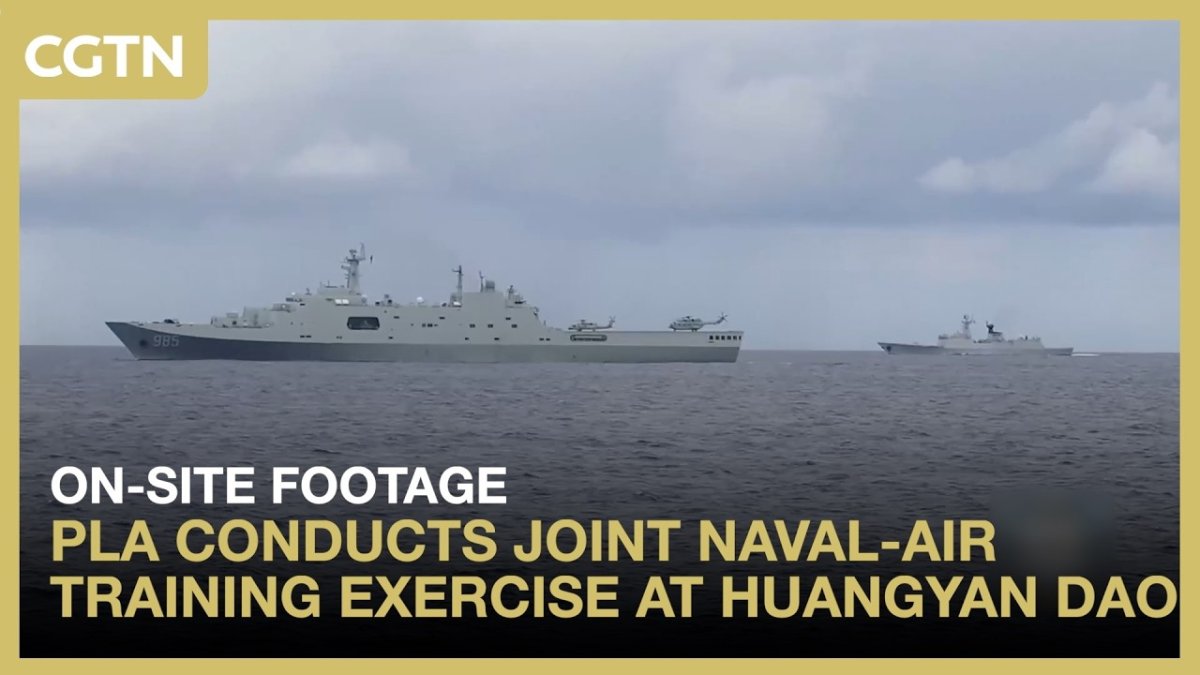
In a recent CGTN report presenting on-site footage of the People's Liberation Army conducting joint naval-air training near Huangyan Dao, the exercise underscores ongoing efforts to maintain operational readiness in contested waters. The footage shows coordinated maneuvers involving naval vessels and aircraft, consistent with routine training patterns observed in the South China Sea.
In a recent CGTN report presenting on-site footage of the People's Liberation Army conducting joint naval-air training near Huangyan Dao, the exercise underscores ongoing efforts to maintain operational readiness in contested waters. The footage shows coordinated maneuvers involving naval vessels and aircraft, consistent with routine training patterns observed in the South China Sea. Public details on the precise timing and scope remain limited, yet the activity occurs amid continued Philippine resupply operations and China Coast Guard enforcement measures.
Historical Roots of the Scarborough Shoal Standoff
The 2012 standoff at Scarborough Shoal marked a turning point in Sino-Philippine maritime relations. Chinese vessels maintained a sustained presence following an initial confrontation involving fishing boats, leading to effective administrative control by Beijing. This episode established a precedent for gray-zone tactics that combined coast guard presence with diplomatic signaling. Subsequent years saw periodic tensions without escalation to direct military clashes, reflecting both sides' interest in avoiding uncontrolled confrontation. The 2012 events built on earlier incidents, including fishing disputes in the late 1990s and early 2000s, where Manila and Beijing alternated between protest notes and temporary withdrawals. Over time, these patterns illustrated how administrative control could shift through persistent but non-kinetic measures rather than outright seizure.
Gray-zone tactics employed after 2012 involved layered deployments of maritime militia, coast guard cutters, and occasional naval overwatch, calibrated to stay below thresholds that might invoke mutual defense commitments. This approach allowed Beijing to consolidate de facto administration while preserving diplomatic space for bilateral talks. ASEAN reactions at the time were muted, with several members prioritizing economic ties over collective pushback, setting the stage for later divisions in regional responses. The incremental nature of these operations demonstrated how repeated low-intensity actions could normalize presence without triggering formal alliance responses from external powers.
Legal Framework and the 2016 Arbitral Outcome
The 2016 South China Sea arbitral tribunal ruling addressed multiple claims, including those around Huangyan Dao, and found certain Chinese positions inconsistent with the United Nations Convention on the Law of the Sea. Beijing has consistently rejected the ruling's validity and continues to assert sovereignty based on historical rights. The China Coast Guard Law, enacted to clarify enforcement authorities, provides a domestic legal basis for operations that support these claims. These positions shape Beijing's approach to any foreign activity near the feature. The tribunal's findings received uneven reception across ASEAN, with the Philippines and Vietnam welcoming the ruling; Cambodia and Laos aligned with Beijing's preference for bilateral dialogue; Malaysia and Indonesia adopted cautious, non-committal positions.
Enforcement under the China Coast Guard Law has enabled more structured patrols and boarding procedures, reducing ambiguity in rules of engagement for Chinese forces. This legal instrument aligns with broader efforts under the Dual Circulation strategy to strengthen maritime governance as part of national security priorities. The law's provisions on the use of force, vessel inspection, and hot pursuit have shifted operational dynamics by permitting coast guard units to conduct interdictions independently of naval support, thereby lowering the visibility of military involvement while sustaining pressure on foreign vessels. Limited public data on specific enforcement actions near Huangyan Dao since the law's implementation constrains detailed assessment, yet the framework supports sustained presence without requiring new legislation. These changes have allowed Beijing to maintain administrative control through routine enforcement rather than episodic naval deployments.
Philippine Security Arrangements and External Partnerships
The Enhanced Defense Cooperation Agreement between the United States and the Philippines has expanded access to additional Philippine bases for rotational American forces. This development increases the potential for combined operations and rapid response capabilities in the region. Philippine resupply missions to features near Huangyan Dao have tested enforcement boundaries, prompting calibrated responses from Chinese maritime agencies. Such dynamics illustrate Manila's strategy of leveraging alliance commitments to offset capability gaps. The trajectory of EDCA base expansion has focused on sites in northern Luzon and Palawan, chosen for their proximity to key sea lanes and potential utility in logistics support.
US-Philippines alliance dynamics have evolved through joint exercises that emphasize interoperability in maritime domain awareness, though Washington has avoided explicit commitments to escort resupply missions. This measured posture reflects American interest in deterrence signaling without immediate entanglement. For Manila, external partnerships provide diplomatic cover and material assistance, yet they also introduce risks of escalation if Chinese responses intensify. Historical precedent shows that alliance activation thresholds remain deliberately high to prevent automatic involvement. In the context of US-China strategic competition, these arrangements serve as instruments for Washington to project influence into the first island chain while testing Beijing's tolerance for incremental challenges to its administrative claims.
Signaling Through Joint Training Activities
The recent PLA naval-air exercise at Huangyan Dao demonstrates Beijing's capacity to integrate air and sea assets in proximity to disputed features. Such drills serve to reinforce presence without crossing into kinetic conflict, aligning with a deterrence posture that prioritizes control over escalation. Limited public information on specific tactics employed leaves room for interpretation, yet the visible coordination signals readiness to respond to perceived challenges to administrative control. This approach fits within broader objectives of consolidating influence across the South China Sea while managing relations with ASEAN neighbors. Integration of air and naval elements allows for rapid shifts between surveillance, interdiction, and withdrawal, embodying the measured deterrence that avoids irreversible commitments.
These activities also support China's technological self-sufficiency goals by testing domestically produced platforms under realistic conditions. Within the broader US-China strategic competition, the drills function as calibrated signals that counterbalance American alliance-building efforts without inviting direct confrontation. Gray-zone dynamics here involve the deliberate use of training to project capability thresholds, deterring Philippine operations through demonstrated responsiveness rather than explicit threats. Second-order effects include heightened vigilance among neighboring coast guards and potential adjustments in commercial shipping patterns to minimize encounters. The pattern of incremental reinforcement mirrors earlier phases of presence consolidation, where repeated drills gradually normalized operational footprints and complicated external intervention calculations.
Regional Stability Risks and ASEAN Positioning
ASEAN member states maintain varied positions on South China Sea issues, with some favoring bilateral negotiations and others supporting multilateral frameworks. The risk calculus for stability hinges on whether exercises and resupply operations remain below thresholds that trigger alliance obligations. Second-order effects could influence trade routes vital to the Global South and affect EU interest in freedom-of-navigation principles. Beijing's emphasis on technological self-sufficiency in naval systems supports sustained operations, yet mutual restraint remains essential to prevent miscalculation. Code of conduct negotiations under ASEAN auspices have progressed slowly, with disagreements over geographic scope and legal bindingness complicating consensus.
Regional stability risks extend to energy and commodity flows through the South China Sea, where disruptions could raise costs for import-dependent economies in the Global South. EU statements on navigation freedoms have grown more frequent, though practical involvement remains limited to diplomatic channels. ASEAN's internal diversity continues to constrain unified responses, allowing bilateral diplomacy to shape outcomes more than collective declarations. The gray-zone environment amplifies these divisions, as states weigh economic interdependence against sovereignty concerns without clear escalation pathways.
Strategic Calculus for All Parties Involved
Each actor pursues distinct objectives: China seeks to solidify effective control consistent with its territorial assertions, while the Philippines aims to preserve access through alliance support. The United States balances alliance credibility against the costs of direct involvement. Limited transparency around exercise parameters constrains precise assessment of intent, yet the pattern suggests incremental reinforcement rather than abrupt shifts. Historical precedent from the 2012 episode indicates that sustained presence can alter facts on the water without immediate resort to force. For Beijing, the calculus prioritizes avoiding major-power confrontation while advancing administrative realities; for Manila and Washington, the focus lies in maintaining access and credibility without provoking uncontrolled escalation.
Second-order effects for ASEAN include pressure to accelerate code of conduct talks and diversify economic partnerships to hedge against maritime friction. Trade route stability remains a shared concern, as any sustained disruption would disproportionately affect developing economies reliant on these corridors. The overall trajectory points to continued managed competition rather than resolution, with all parties calibrating actions to preserve strategic flexibility. Deterrence signaling through such exercises thus serves to shape the operational environment incrementally, testing resolve while leaving room for diplomatic off-ramps.
By Prof. Marcus Chen, Staff WriterThis article was produced with AI-assisted research and editorial support. Reporting is based on sources cited in the article.
What's Your Reaction?
 Like
0
Like
0
 Dislike
0
Dislike
0
 Love
0
Love
0
 Funny
0
Funny
0
 Wow
0
Wow
0
 Sad
0
Sad
0
 Angry
0
Angry
0

World Politics Analyst at Global1.News. Based in Beijing, covering US-China relations, global trade, and geopolitical strategy. Brings deep analytical perspective to the power dynamics shaping international affairs.













Comments (0)