
MBS Paris Visit: Centenary Ties, Hormuz Bypass and Saudi Soft Power
When Saudi Crown Prince Mohammed bin Salman touched down in Paris on Sunday, he arrived not merely as a visiting head of government but as the central figure in a recalibration of Middle East energy and security architecture.
When Saudi Crown Prince Mohammed bin Salman touched down in Paris on Sunday, he arrived not merely as a visiting head of government but as the central figure in a recalibration of Middle East energy and security architecture. His two-day state visit, hosted by French President Emmanuel Macron, comes at a moment when the Strait of Hormuz — the world's most critical oil chokepoint — has been largely paralyzed by the US-led war with Iran, forcing Gulf producers to rethink every barrel they export.
Saudi Crown Prince's Paris Visit: A Centenary of Ties, A Wartime Agenda
Paris, France – August 23, 2026 — The visit marks the third time MBS has traveled to Paris, following trips in 2022 and 2023, and it builds directly on the Saudi-French Strategic Partnership Council launched during Macron's own state visit to Riyadh in December 2024. But the symbolism runs deeper: 2026 is the centenary of Saudi-French diplomatic relations, first established in 1926 when France dispatched its initial consul to the Kingdom, with France opening its diplomatic mission in Jeddah in 1932.

The timing is anything but ceremonial. With the Strait of Hormuz disrupted amid the ongoing US-Iran conflict, French officials have framed the visit as an opportunity to deepen ties with a key Gulf partner against a backdrop of regional war. The agenda on Monday includes the signing of bilateral agreements in health, transport, and energy, alongside high-level discussions on alternative routes around the disrupted chokepoint — including the expansion of existing oil pipelines that bypass Hormuz entirely.
The Esports Gambit: Soft Power in a Time of War
On Sunday evening, Macron and MBS attended the closing ceremony of the Esports World Cup 2026 at Paris's Grand Palais — a moment of deliberate symbolism. This is the first time the tournament has been hosted outside Saudi Arabia, moved from Riyadh to Paris because of the Iran war. The EWC 2026 opened in Paris on July 10 with a record $75 million prize pool and seven weeks of intense competition. In the Counter-Strike 2 grand final at the Accor Arena, Team Spirit defeated FUT Esports 3-1, with Macron personally presenting the trophy while MBS looked on.
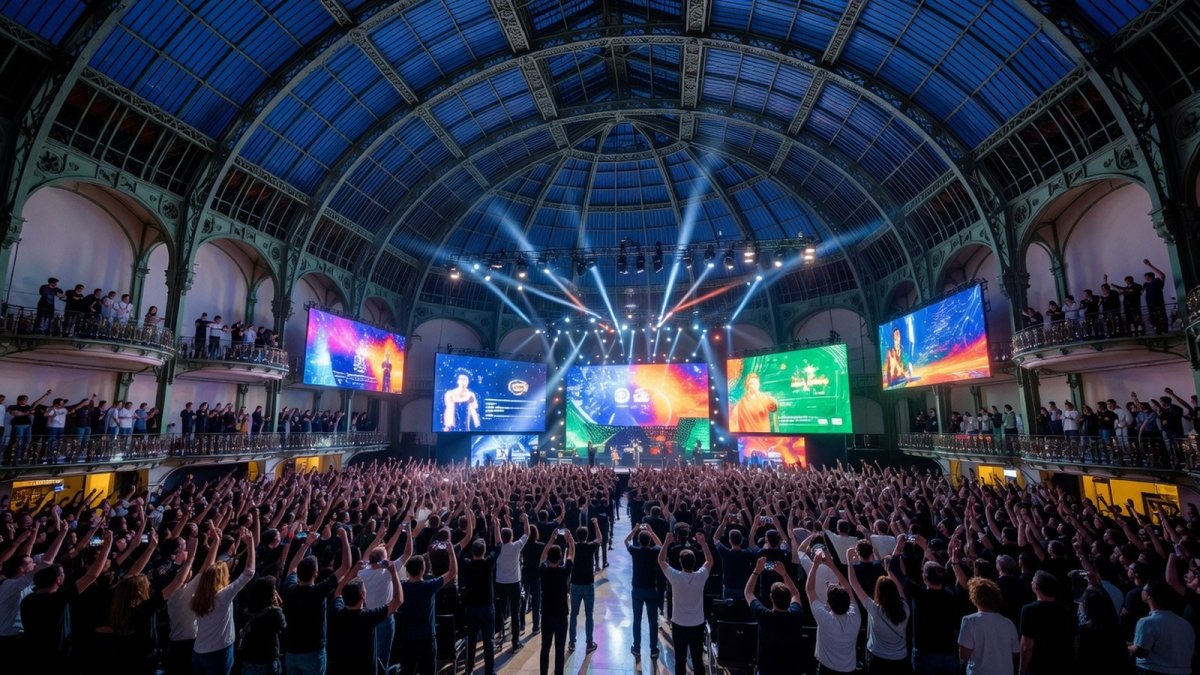
The choice of venue and timing is no accident. Saudi Arabia has invested heavily in esports as a pillar of its Vision 2030 diversification strategy, and the Crown Prince's presence at a Paris-hosted tournament sends a clear message: even amid war, the Kingdom's soft power ambitions remain intact. For France, hosting the EWC is an opportunity to position Paris as a global hub for digital entertainment — and to bind Saudi Arabia closer to European cultural and economic circuits at a time when Washington's regional alliances are under strain.
Hormuz Disruption and the Pipeline Calculus
The strategic heart of the visit, however, lies in energy infrastructure. The Strait of Hormuz has been largely disrupted amid the US-led war with Iran, and Gulf producers are scrambling for alternatives. Saudi Arabia's East-West Pipeline — known as Petroline — runs approximately 1,200 kilometers from the Eastern Province to the Red Sea port of Yanbu. It can transport up to 7 million barrels per day of crude, though effective exports are estimated around 4.5 million barrels per day. The UAE's Abu Dhabi Crude Oil Pipeline offers another bypass route, but Saudi capacity remains the linchpin of any Hormuz contingency plan.
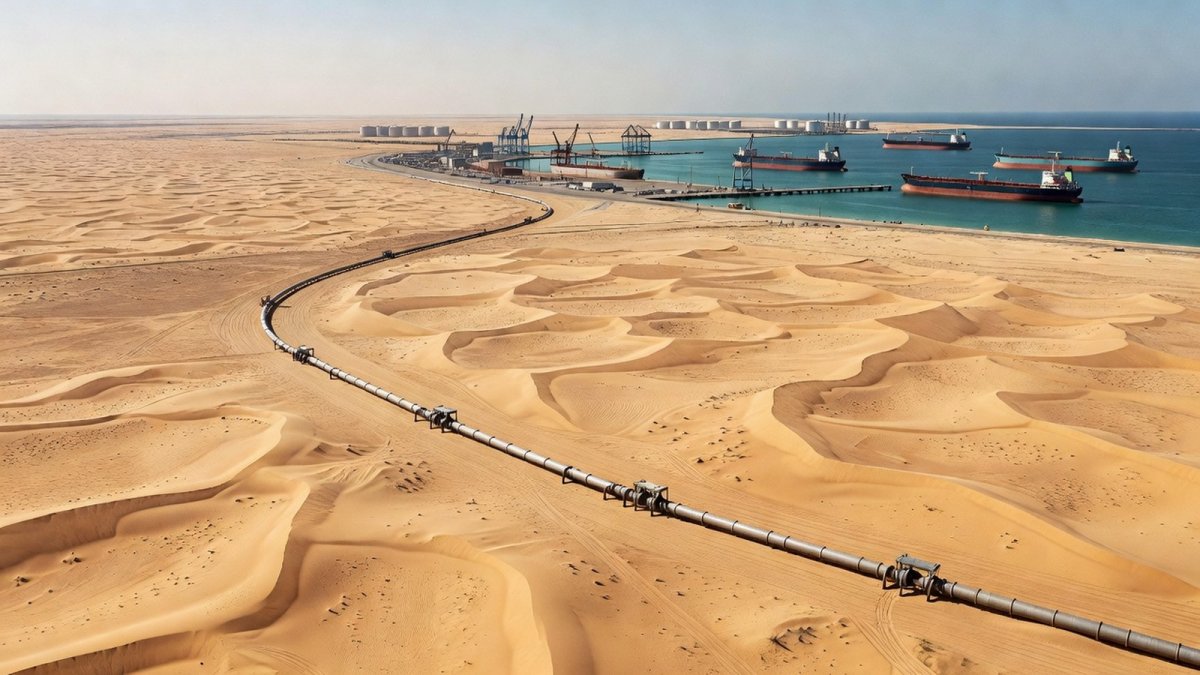
French and Saudi officials are expected to discuss expanding these existing pipelines, a move that would require significant investment in pumping stations, storage, and Red Sea port infrastructure. For France, this represents a strategic entry point into Gulf energy security architecture — a domain historically dominated by the United States. For Saudi Arabia, it offers a hedge: diversifying export routes reduces the Kingdom's vulnerability to any single chokepoint, even as the war with Iran continues to reshape regional energy flows.
The current crisis evokes historical precedents that underscore the stakes. The oil shocks of 1973-74 and 1979 demonstrated how disruptions in Gulf supply could trigger global stagflation, while the 1980s Tanker War during the Iran-Iraq conflict saw both sides attack shipping in the Gulf, leading to US naval reflagging operations and a dramatic expansion of the Saudi East-West Pipeline as a strategic alternative. Previous Hormuz threats in 2012 and 2019, though ultimately contained, prompted temporary spikes in insurance rates and a renewed focus on bypass capacity, but the current sustained disruption is unprecedented in its duration and severity, making the pipeline discussions in Paris not a theoretical exercise but an urgent operational necessity.
Alstom and the Transport Dimension
Beyond pipelines, the visit carries a substantial transport agenda. Mohammed Khalil, CEO of Alstom's MENA headquarters and managing director of Alstom in Saudi Arabia, has been vocal about the company's hopes from the visit. Alstom has operated in the Kingdom for more than 70 years — since the 1950s — and contributed significantly to the Riyadh Metro, whose performance since full launch has been a topic of discussion between the two governments.
The transport talks reflect a broader strategic calculus. Saudi Arabia's Vision 2030 envisions massive urban mobility projects, including new metro lines, high-speed rail, and integrated public transit systems across the Kingdom's emerging giga-projects. France, through Alstom, is positioning itself as the preferred European partner for these ambitions — a role that carries both commercial weight and geopolitical significance. For Riyadh, deepening transport ties with Paris reduces dependence on any single supplier and aligns with the Kingdom's broader strategy of diversifying its international partnerships beyond the traditional US-China binary.
Regional Dynamics: The War's Shadow
The backdrop of the Iran war looms over every conversation in Paris. The disruption of Hormuz has sent shockwaves through global energy markets, and Gulf states are acutely aware of their vulnerability. Saudi Arabia's strategic calculus involves not only securing its own export routes but also positioning itself as the guarantor of regional energy stability — a role that enhances its leverage vis-à-vis both Washington and Beijing.
For France, the visit is an opportunity to assert European relevance in Middle East security discussions. With the United States deeply engaged in the Iran conflict and China expanding its Gulf footprint, Paris is seeking to carve out a distinct role as a diplomatic and economic intermediary. The centenary of Saudi-French relations provides a convenient narrative framework: a century of ties, now being tested and deepened in wartime.
Beyond the bilateral frame, Saudi Arabia's leverage in this relationship is amplified by its centrality to global energy markets and its ability to influence production levels that directly impact European inflation and industrial competitiveness. France, for its part, brings substantial economic interests to the table, including major defense contracts, nuclear energy cooperation, and a significant stake in Gulf infrastructure projects, while European energy diversification efforts — accelerated by the Ukraine war — have made Gulf liquefied natural gas and hydrogen partnerships a strategic priority for Paris and Brussels alike. The Gulf sovereign wealth funds, particularly Saudi Arabia's Public Investment Fund with assets exceeding $900 billion, represent a critical source of capital for French technology, luxury, and green energy sectors, while France's defense industrial base offers Gulf states advanced capabilities that reduce their reliance on American systems, creating a mutually reinforcing dynamic that extends well beyond the current crisis.
What Each Side Wants
The strategic calculus on both sides is clear. Saudi Arabia seeks European investment in its diversification agenda, particularly in transport, energy infrastructure, and technology. It also wants diplomatic cover for its regional policies — including its stance on the Iran war and its ongoing normalization efforts with Israel. France, for its part, wants access to Gulf sovereign wealth — estimated at over US$3 trillion across the region — and a role in shaping the post-war regional order.
The agreements expected to be signed on Monday in health, transport, and energy are the tangible deliverables. But the deeper prize is strategic alignment: a Saudi-French axis that can serve as a counterweight to both US unilateralism and Chinese economic penetration. For MBS, the Paris visit is also a signal to domestic and regional audiences that the Kingdom remains diplomatically active and globally connected, even as war rages nearby.
France's economic interests are particularly concentrated in defense, where it has long been a supplier to Gulf states, and in civilian nuclear energy, where Saudi Arabia's ambitious reactor program presents a multi-billion-euro opportunity that Paris is keen to secure against Russian and South Korean competition. European energy diversification, accelerated by the need to reduce dependence on Russian gas, has elevated Gulf partnerships to a strategic imperative, with France positioning itself as the gateway for Saudi hydrogen and ammonia exports to European markets. Gulf sovereign wealth funds, meanwhile, are increasingly looking to Europe for stable, long-term returns, and France's technology sector — from artificial intelligence to fintech — offers attractive investment targets that align with the Kingdom's Vision 2030 goals of building a knowledge-based economy.
Regional Implications
The implications of this visit extend far beyond bilateral ties. For the Gulf Cooperation Council, it reinforces a trend of deepening European engagement — a diversification of partnerships that reduces the region's historical dependence on Washington. For Iran, it underscores the isolation Tehran faces as Gulf states strengthen ties with European powers. For Israel, it signals that Arab-Israeli normalization continues apace, even amid regional conflict, with France potentially playing a mediating role in broader security arrangements.
The visit also carries significant implications for the evolving Arab-Israeli normalization framework and Gulf security architecture. As the Abraham Accords expand to include new signatories, France is positioning itself as a European guarantor of these arrangements, offering security assurances and economic incentives that complement — and potentially rival — the US-brokered framework. The Saudi-French axis, in this context, becomes a parallel track to the US-led security architecture, providing Gulf states with additional options for defense cooperation, intelligence sharing, and crisis management that do not flow exclusively through Washington. This diversification of security partnerships, while not replacing the US umbrella, gives Gulf capitals greater autonomy in shaping their strategic environment and creates a more multipolar security order in the region — one where European powers like France play an increasingly consequential role in maintaining stability and managing the transition to a post-war arrangement.
The esports dimension, meanwhile, highlights a quieter but significant shift: Gulf states are using soft power to maintain global engagement even during wartime. The relocation of the EWC from Riyadh to Paris — and MBS's presence at its closing — demonstrates that Saudi Arabia's cultural and technological ambitions are not casualties of the Iran war. They are, instead, being adapted to new circumstances.
As the Crown Prince departs Paris, the concrete outcomes will be measured in signed agreements and pipeline expansions. But the strategic signal is unmistakable: in a region reshaped by war, Saudi Arabia and France are deepening their partnership — and the Gulf's energy future is being re-routed, both literally and figuratively, through Paris.
By Malik Hassan, Staff Writer
This article was produced with AI-assisted research and editorial support. Reporting is based on sources cited in the article.
What's Your Reaction?
 Like
0
Like
0
 Dislike
0
Dislike
0
 Love
0
Love
0
 Funny
0
Funny
0
 Wow
0
Wow
0
 Sad
0
Sad
0
 Angry
0
Angry
0
Middle East Correspondent at Global1.News. Based in Beirut, covering politics, conflict, energy, and society across the Middle East. Brings context and depth to a region often reduced to headlines.









Comments (0)