
President Lee Jae-myung Secures Landmark AI Semiconductor Commitments in San Francisco and Critical Minerals Agreements in South America
The San Francisco AI Summit and Its Strategic Framing President Lee Jae-myung convened a government-backed AI Summit in San Francisco on July 24, 2026, bringing together leading American technology executives and Korean chaebol leaders. The gathering underscored South Korea's determination to position itself as an indispensable node in the global AI supply chain amid intensifying competition between the United States and China. Lee described the outcome as establishing South Korea as a trusted
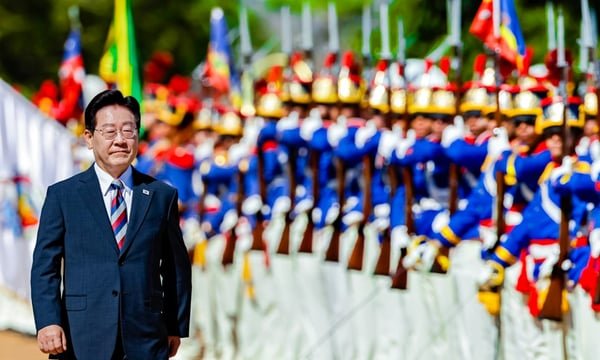
The San Francisco AI Summit and Its Strategic Framing
President Lee Jae-myung convened a government-backed AI Summit in San Francisco on July 24, 2026, bringing together leading American technology executives and Korean chaebol leaders. The gathering underscored South Korea's determination to position itself as an indispensable node in the global AI supply chain amid intensifying competition between the United States and China.
Lee described the outcome as establishing South Korea as a trusted AI semiconductor production base. The declaration emphasized long-term contracts rather than immediate production shifts, reflecting the cautious pace at which such industrial realignments typically unfold.
The summit convened Nvidia CEO Jensen Huang, OpenAI CEO Sam Altman, Broadcom CEO Hock Tan, and Anthropic, alongside Samsung Electronics Chairman Lee Jae-yong, SK Group Chairman Chey Tae-won, and Hyundai Motor Group Executive Chair Chung Euisun. Lee's "San Francisco AI Declaration" pledged Korea would become "a key player in the irreplaceable global AI supply chain."
On the evening of the summit, Lee shared fried chicken and beer with burgers and fish and chips alongside Jensen Huang, Lee Jae-yong, Chey Tae-won, and Chung Euisun in an informal setting that highlighted personal diplomacy. This approach built on Korea's tradition of using cultural exchanges to strengthen business ties with global technology leaders.
The event positioned Korean memory producers at the center of AI hardware development, as Samsung and SK Hynix remain the world's leading suppliers of high-bandwidth memory essential for modern AI accelerators. Such leverage allows Korea to deepen its role in the specialized components that power data centers worldwide.
Scale of Corporate Agreements Reached in California
Samsung Electronics concluded a memorandum of understanding valued at up to US$200 billion with Broadcom for advanced memory chips and foundry services over the next five years. SK Group finalized combined deals worth US$750 billion in long-term high-bandwidth memory supply partnerships with Nvidia and other firms across the same period.
These figures together reach US$950 billion. Presidential policy chief Kim Yong-beom stated at a briefing that the advance orders would support stable chip production at Korean facilities. Naver separately announced plans for a US$10 billion AI plant with participation from Nvidia and Brookfield, while Hyundai Motor Group and Nvidia agreed to establish a joint robot reference platform.
US$950 billion equates to roughly 1,375 trillion won, underscoring the scale of commitments that the ruling Democratic Party highlighted during domestic debates over the declaration. The opposition People Power Party questioned aspects of the agreements, yet both sides acknowledged the potential for sustained revenue streams in the semiconductor sector.
High-bandwidth memory remains the specialized component that powers modern AI accelerators, and the contracts reinforce Korea's position as a dominant supplier in this niche. Long-term visibility from these deals can enable Korean firms to plan capacity expansions with greater certainty amid volatile global demand.
Chaebol Dynamics and Export Model Implications
The agreements directly involve Samsung, SK, Hyundai, and Naver, illustrating how Korean conglomerates continue to anchor the country's export-driven economy through specialized semiconductor and AI-related output. Long-term contracts with American firms provide revenue visibility that can support further domestic plant expansion, as noted by Kim Hyeong-joon of the Next-Generation Intelligent Semiconductor Foundation.
Such arrangements reinforce Korea's historical pattern of leveraging chaebol scale to secure positions in high-value global chains, though they also expose the economy to fluctuations in U.S. technology demand and regulatory shifts.
Kim Hyeong-joon, head of the Next-Generation Intelligent Semiconductor Foundation, stated that long-term contracts can help Korean companies keep expanding semiconductor plants and raise the industry's sustainable growth potential. This perspective aligns with the chaebol model of coordinating large-scale investments across multiple business units to maintain technological leadership.
The deals also illustrate how Korean groups adapt their export strategies to AI-driven markets, where demand for advanced memory and foundry services continues to rise. By securing multi-year commitments, these firms reduce exposure to short-term cyclical downturns that have historically affected the semiconductor industry.
The South American Tour and Resource Diversification
Following the San Francisco meeting, Lee conducted a three-nation tour from July 26 to August 1, 2026, visiting Brazil, Chile, and Argentina. He framed the visits as moving Korea's relations with South America beyond simple resource-for-manufactured-goods exchanges toward innovation, investment, and technology cooperation.
In Brazil, discussions centered on rare earths and the possible resumption of Korea-Mercosur trade talks. In Chile, Lee met President Jose Antonio Kast on July 30 and agreed to pursue modernization of the 2004 Korea-Chile FTA to encompass digital trade, environmental standards, and critical minerals such as copper and lithium.
Brazil's rich deposits of rare earths and agricultural products formed a key focus, with Lee discussing resumption of Korea-Mercosur trade negotiations alongside Argentina as co-leaders of the bloc. Mercosur, launched in 1991, represents South America's largest economic bloc encompassing roughly 300 million people and offers expanded market access for Korean exports.
The Korea-Chile FTA, which entered into force in 2004 as South Korea's first-ever free trade agreement, provides the foundation for modernization talks covering digital trade, environmental cooperation, labor standards, gender equality, and innovation. These updates aim to align the agreement with contemporary priorities in technology and sustainability.
At the Korea-Chile Business Roundtable in Santiago on July 30, proposals emerged for expanded copper supply chain cooperation between LS and Chile's state copper company Codelco to meet AI data center demand, alongside initiatives from Hanwha Ocean on submarine and frigate cooperation and Naver on a full-stack AI ecosystem. Hyundai Motor advanced ideas on green hydrogen and eco-friendly mobility, with attendees including Ryu Jin of the FKI, Chang Jae-hoon of Hyundai, and other chaebol executives.
Argentina Engagement and Energy Supply Chain Prospects
The July 31 summit with President Javier Milei in Buenos Aires marked the first official visit by a South Korean president to Argentina in 22 years. Both sides committed to cooperation on lithium and shale gas from the Vaca Muerta formation, where Argentina holds the world's second-largest shale gas reserves.
Lee emphasized that shared values become more important amid global economic uncertainty, signaling government support for Korean firms entering new resource and energy projects in the region.
Argentina possesses the world's fourth-largest lithium reserves and ranks as the top exporter of soybean oil, with the Vaca Muerta shale formation often described as the "second Middle East." These attributes position the country as a strategic partner for Korea's battery and energy sectors seeking diversified inputs.
Lee told the Santiago roundtable that as uncertainty in the global economy increases, solidarity among countries that share common values becomes even more important, while pledging government support for Korean firms entering new markets. This stance reflects efforts to build resilient supply chains for strategic resources amid rising protectionism and geopolitical tensions.
Geopolitical Context and Northeast Asian Supply Chain Positioning
These moves occur against the backdrop of U.S.-China technology tensions and Korea's need to secure diversified inputs for its semiconductor and battery industries. The San Francisco pledges and South American mineral outreach together aim to reduce reliance on single-source suppliers while deepening ties with American technology leaders.
Domestic reactions in Seoul showed the ruling Democratic Party and opposition People Power Party clashing over the AI declaration, highlighting how foreign economic initiatives remain subject to partisan scrutiny at home. The overall effort reflects Korea's ongoing adaptation of its export model to emerging AI and critical minerals realities.
The trip underscores Korea's strategy to secure resilient supply chains for strategic resources amid heightened economic security risks, rising protectionism, geopolitical tensions, and AI-driven demand for critical minerals including rare earths, lithium, and copper used in semiconductors and batteries. Such diversification supports long-term stability for export-oriented industries.
By integrating these resource partnerships with AI semiconductor commitments, Korea seeks to mitigate vulnerabilities in Northeast Asian supply chains while reinforcing its role as a bridge between American technology platforms and global mineral sources. The approach aligns with broader efforts to navigate economic security challenges through targeted bilateral and multilateral engagements.
By Prof. David Park, Staff WriterThis article was produced with AI-assisted research and editorial support. Reporting is based on sources cited in the article.
What's Your Reaction?
 Like
0
Like
0
 Dislike
0
Dislike
0
 Love
0
Love
0
 Funny
0
Funny
0
 Wow
0
Wow
0
 Sad
0
Sad
0
 Angry
0
Angry
0
East Asia/Technology Correspondent at Global1.News. Seoul-based voice covering Korean politics, technology, business, and culture. Analyzes how technology and geopolitics intersect across East Asia.











Comments (0)