
Kosgei wins Great North Run but McColgan withdraws
Kenya’s Brigid Kosgei once again reminded the world of her half‑marathon mastery at the 45th Great North Run, crossing the finish line in a confident one hour, six minutes and fifteen seconds.
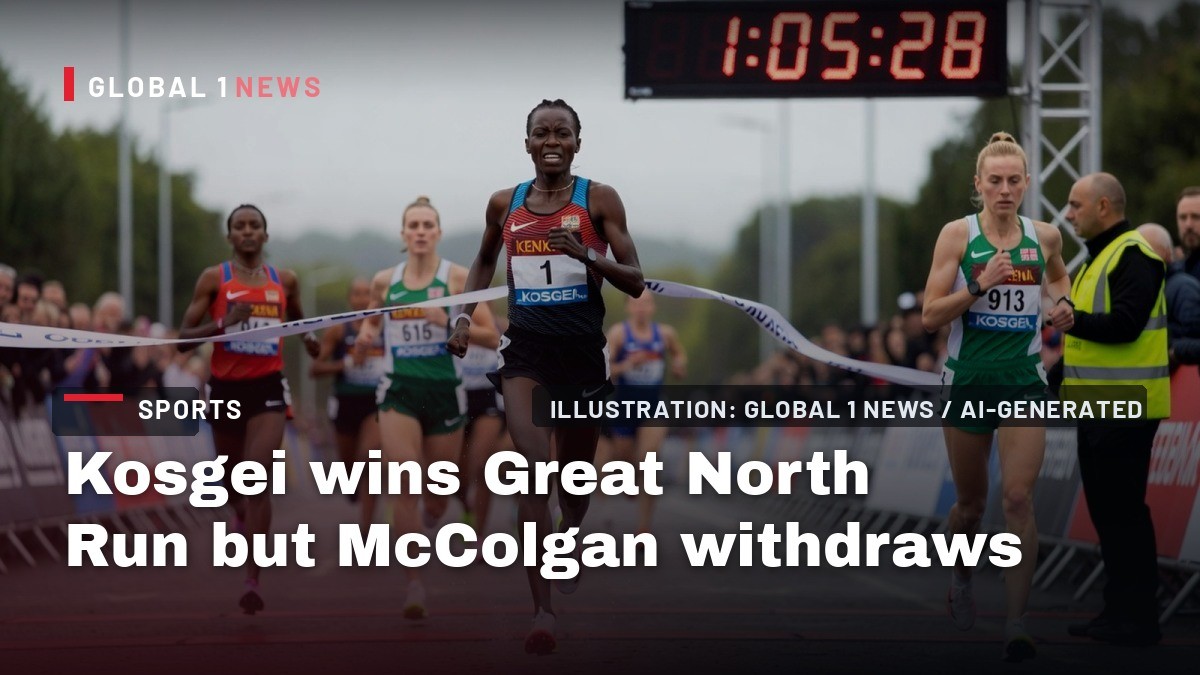
Kenya’s Brigid Kosgei once again reminded the world of her half‑marathon mastery at the 45th Great North Run, crossing the finish line in a confident one hour, six minutes and fifteen seconds. While her time fell short of the course record she set seven years ago, the 32‑year‑old Olympic silver medallist dominated the women’s field from start to finish, leaving a clear gap between herself and the rest of the pack. The race, held on 13 September 2026, also highlighted the fragile balance athletes must strike between ambition and injury, a reality starkly illustrated by the early withdrawal of Britain’s Eilish McColgan.
Kosgei’s commanding performance
From the gun, Kosgei set a steady, unrelenting pace that saw her quickly pull away from her rivals. She ran much of the 13.1‑mile distance alone, a testament to her confidence and conditioning. Her finishing time of one hour, six minutes and fifteen seconds, while slower than the 1:04:28 record she herself set in 2019, still placed her more than two minutes ahead of the next Kenyan, Sheila Chepkirui, who finished in second place. This margin underscored Kosgei’s experience and tactical acumen, qualities that have carried her from a London Marathon victory to the podium at the Olympic Games.
Beyond the raw numbers, Kosgei’s race was a narrative of resilience. Having navigated the pressures of being a former record‑holder and a national hero, she chose to run her own race, untroubled by the chase of a world‑class field. Her performance not only added another accolade to her illustrious career but also served as an inspiration for young Kenyan runners watching from home, reaffirming the nation’s deep pool of distance‑running talent.
Eilish McColgan’s untimely exit
Britain’s Eilish McColgan entered the half‑marathon with a story of comeback. At 35, she was still navigating the aftermath of a broken toe sustained during the London Marathon in April, where she had finished seventh and been the first British runner home. In the Great North Run, however, the foot injury resurfaced early in the race, forcing her to limp off the course. Blood seeped through her shoe as she crossed the line, a vivid image of the physical toll elite competition can exact.
McColgan’s withdrawal had immediate implications for her season. The injury forced her to miss the Commonwealth Games in July, a major multi‑sport event where she had hoped to represent Scotland. Though she had recently won the Big Half in London with a time of 1:10:54, she admitted after that victory that concerns about her fitness lingered. Her experience highlights the fine line athletes walk between pushing limits and preserving health, especially when returning from a serious injury.
The men’s race: Talbi’s decisive surge
While the women’s race was defined by Kosgei’s dominance, the men’s half‑marathon offered a thrilling duel. American Zouhair Talbi, aged 31, stayed side‑by‑side with defending champion Alex Mutiso for most of the course. In the final mile, Talbi unleashed a powerful kick, pulling ahead to finish in 59 minutes and 47 seconds. Though he fell just six seconds short of his personal best of 59 minutes and 41 seconds, the victory marked a significant milestone in his career, showcasing his ability to out‑pace a seasoned champion in a high‑pressure finish.
Yohei Ikeda of Japan secured third place, while Britain’s Marc Scott, the 2021 winner, was the first British finisher in eighth place. The men’s course record of 58 minutes and 56 seconds, set by Kenya’s Martin Mathathi in 2011, remains untouched, underscoring the depth of talent required to challenge such a benchmark.
British athletes: moments of promise amid challenges
Despite the setbacks for McColgan, British runners found reasons for optimism. Amy‑Eloise Neale finished fifth overall, emerging as the top British woman in the race. Her performance, placed behind Kosgei, Chepkirui and the rest of the elite field, demonstrated the growing depth of women’s distance running in the UK.
In the men’s division, Marc Scott’s eighth‑place finish reaffirmed his status as a consistent performer in the Great North Run, while David Weir claimed his tenth wheelchair title with a time of 43 minutes and six seconds. Melanie Woods also secured the women’s wheelchair victory in 50 minutes and 19 seconds, underscoring the strength of British athletes across categories.
The broader significance of the Great North Run
Beyond individual achievements, the Great North Run continues to be a cultural touchstone for the United Kingdom and the wider running community. This year’s edition attracted an estimated 63,000 participants, a figure that reflects the event’s enduring popularity and its role in promoting health, community spirit, and charitable giving. Among the crowd was Prime Minister Andy Burnham, whose presence highlighted the race’s national relevance.
The event’s longevity—now in its 45th year—mirrors the evolution of distance running on the continent. African athletes, particularly from Kenya, have become a dominant force, shaping race dynamics and inspiring a new generation of runners across Africa and beyond. Their successes on British soil illustrate the increasingly global nature of the sport.
Injury management and athlete welfare
McColgan’s experience brings to the fore the conversation around injury prevention and management in elite sport. Her foot injury, first incurred at the London Marathon, resurfaced at the Great North Run, prompting an early exit and a missed Commonwealth Games appearance. This sequence underscores the importance of comprehensive medical support and realistic recovery timelines for athletes returning from trauma.
Coaches and medical teams across the continent are taking note, emphasizing gradual return-to-competition plans and the integration of physiotherapy, strength training, and monitoring technologies. For African athletes, who often travel long distances to compete internationally, these considerations are vital to sustain performance and longevity in the sport.
Looking ahead: what the results mean for the season
As the 2026 racing calendar progresses, Kosgei’s victory positions her as a leading contender for upcoming major championships, where her experience and proven race tactics will be assets. Meanwhile, Talbi’s win in the men’s race signals his readiness to challenge the world’s elite in forthcoming events, potentially shaping the narrative of American distance running on the global stage.
For British athletes, the mixed outcomes provide both motivation and caution. The strong showing by Neale and the continued success of wheelchair athletes like Weir and Woods suggest a solid foundation to build upon. Yet, McColgan’s setback serves as a reminder that health must remain paramount. As the season unfolds, the interplay of triumph and adversity witnessed at the Great North Run will continue to inform the strategies of athletes, coaches, and federations across Africa and the wider world.
This article was produced with AI-assisted research and editorial support. Reporting is based on the source material cited below. Sources: BBC News Africa; bbc.co.uk; Global1.News (14 September 2026).
By Amara Diop, Staff Writer
What's Your Reaction?
 Like
0
Like
0
 Dislike
0
Dislike
0
 Love
0
Love
0
 Funny
0
Funny
0
 Wow
0
Wow
0
 Sad
0
Sad
0
 Angry
0
Angry
0

West Africa/Sahel Correspondent at Global1.News. Dakar-based journalist covering politics, security, climate, and development across Francophone and Anglophone West Africa. Tells the stories of a region undergoing profound transformation.












Comments (0)