
Iran says Arab foreign ministers to sign Hormuz navigation deal in Oman Monday
The announcement that Arab foreign ministers will convene in Muscat to sign a joint Iran‑Oman shipping corridor through the Strait of Hormuz marks a rare diplomatic overture in a region long dominated by tension over maritime access.
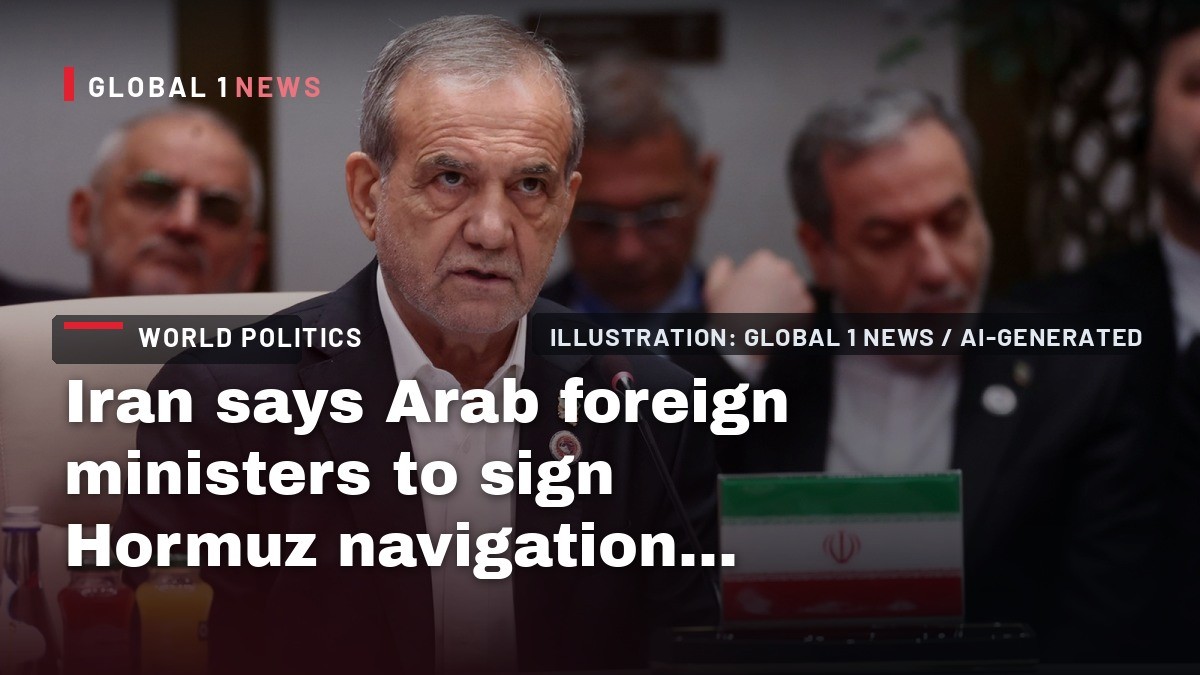
The announcement that Arab foreign ministers will convene in Muscat to sign a joint Iran‑Oman shipping corridor through the Strait of Hormuz marks a rare diplomatic overture in a region long dominated by tension over maritime access. Iranian President Masoud Pezeshkian, speaking to India Today, framed the meeting as a response to what he described as U.S. economic pressure and a naval blockade that have constrained Iran’s trade routes. The proposed corridor, if formalised, could reshape commercial navigation in the Gulf, but its broader significance lies in the way it underscores the human cost of a dispute that has already disrupted livelihoods across the region.
Background to the Muscat meeting
President Pezeshkian’s remarks come after weeks of diplomatic activity aimed at mitigating the impact of U.S. sanctions and naval operations on Iranian shipping. In an interview published on Saturday, he explained that the foreign ministers of Arab states would meet in Muscat on Monday to sign an agreement establishing a joint route between Oman and Iran in the Strait of Hormuz. He also indicated that the parties intend to notify the International Maritime Organization of the arrangement, signalling a desire for international legitimacy.
Iranian Foreign Ministry spokesman Esmaeil Baqaei confirmed that Oman would host a regional ministerial meeting with the participation of eight Gulf‑bordering states. The agenda, Baqaei said, would include discussions on “designating safe routes for commercial vessels” and the outcome of Iranian‑Omani talks on a new corridor. While Oman has not immediately confirmed the meeting, the diplomatic choreography suggests a coordinated effort to present a united front against what Tehran perceives as unlawful U.S. interference.
Iran’s narrative of resistance
President Pezeshkian framed the forthcoming agreement as part of a broader strategy to counter U.S. pressure. He asserted that Washington’s failure to achieve its objectives through direct military action has driven it to rely on “economic pressure.” By positioning the shipping corridor as a civilian, commercial initiative rather than a military one, Tehran seeks to portray itself as a victim of unjust sanctions while emphasizing resilience.
In the same interview, Pezeshkian stressed that Iran’s survival does not depend on any single maritime route. He said, “Maritime routes are certainly not something on which our survival depends, and they will not be able to achieve their objectives in this way either.” This statement seeks to downplay the strategic leverage that the U.S. naval presence in the Strait might hold, while simultaneously signalling that Iran will continue to pursue alternative pathways for trade.
The proposed corridor’s operational details
According to Secretary of Iran’s Supreme National Security Council Mohsen Rezaei, an agreement with Oman on a new corridor through the Strait of Hormuz would be signed within days. Rezaei specified that the entrance and exit of the corridor would be under Iranian control, suggesting a degree of sovereignty over the passage that could raise concerns among other Gulf states and international shipping interests.
The corridor is envisioned as a “joint Iran‑Oman shipping route,” implying shared management of navigation safety and possibly joint patrols. While the exact technical specifications were not disclosed, the reference to notifying the International Maritime Organization indicates an intention to align the corridor with global maritime standards, which could help legitise the route and reassure commercial operators wary of security risks.
Human implications of a blocked Strait
Beyond the diplomatic posturing, the blockade and the uncertainty surrounding safe navigation have tangible human consequences. The Strait of Hormuz is a lifeline for the economies of Iran, Oman, the United Arab Emirates, Saudi Arabia and other Gulf states. Disruptions to shipping have reverberated through the supply chains of essential goods, from foodstuffs to medical supplies, affecting ordinary citizens who already face inflation and shortages under sanctions.
Fishermen, dockworkers and small‑scale traders—who depend on the steady flow of vessels—have reported reduced incomes as vessels avoid the waterway or are delayed by heightened inspections. The prospect of a jointly managed corridor could, if implemented smoothly, restore a measure of predictability for these communities, allowing commercial vessels to transit with reduced risk of interception or delay.
International law and the blockade
Iran’s claim that the U.S. naval blockade is illegal under international law echoes longstanding disputes over freedom of navigation. Under the United Nations Convention on the Law of the Sea (UNCLOS), which Iran has not ratified but which remains a cornerstone of maritime law, warships may not impede the innocent passage of merchant vessels in international straits. Tehran argues that the U.S. presence constitutes an unlawful “military intervention” that jeopardises the safety of vessels.
By seeking to notify the International Maritime Organization of the new corridor, Iran and Oman appear to be attempting to anchor their arrangement within the framework of internationally recognised maritime governance. If the I.M.O. were to endorse the corridor, it could provide a legal shield against accusations of illicit navigation, while also obliging signatories to uphold safety standards.
Regional reactions and the broader geopolitical context
The statement that “the countries whose territories were used to launch attacks against us by the US will also attend this meeting” suggests that Iran expects participation from nations that have experienced U.S. military actions, possibly including Iraq or Afghanistan‑adjacent states. While the source does not list the attending countries, the inclusion of eight Gulf‑bordering states in Baqaei’s briefing points to a relatively broad regional coalition.
Such a coalition could signal a shift in Gulf politics, where economic pragmatism may outweigh sectarian divides. However, the lack of an immediate confirmation from Oman underscores the delicate balance Omani officials must maintain between fostering regional cooperation and avoiding direct confrontation with the United States, a key security partner.
Prospects for implementation and next steps
The success of the Muscat meeting will hinge on several practical considerations. First, the technical design of the corridor—its exact coordinates, depth, and navigational aids—must be agreed upon and communicated to shipping companies. Second, security arrangements, including the presence of patrol vessels or monitoring systems, will need to be transparent to reassure commercial operators that the route is safe from both Iranian and external threats.
Finally, the broader diplomatic environment will shape the corridor’s longevity. If the United States continues to apply economic pressure, Tehran may use the corridor as a bargaining chip in future negotiations. Conversely, a constructive engagement by the International Maritime Organization could embed the corridor within the global maritime system, reducing the risk of escalation.
This article was produced with AI-assisted research and editorial support. Reporting is based on the source material cited below. Sources: Middle East Monitor; middleeastmonitor.com; Global1.News (12 September 2026).
By Fatima Al-Rashid, Staff Writer
What's Your Reaction?
 Like
0
Like
0
 Dislike
0
Dislike
0
 Love
0
Love
0
 Funny
0
Funny
0
 Wow
0
Wow
0
 Sad
0
Sad
0
 Angry
0
Angry
0

Gulf/MENA Correspondent at Global1.News. Based in Doha, covering Gulf politics, energy markets, diplomacy, and development across the Middle East and North Africa. Tracks the economic transformation of the Gulf states.













Comments (0)