
Beyond China's Humanoid Spectacle, a Quieter Machine Revolution Reshapes the Factory Floor
The gleaming solar grids, the silent hum of electric vehicles, and the sprinting, boxing humanoid robots of the World Humanoid Games capture the world's imagination.
Beyond China's Humanoid Spectacle, a Quieter Machine Revolution Reshapes the Factory Floor
The gleaming solar grids, the silent hum of electric vehicles, and the sprinting, boxing humanoid robots of the World Humanoid Games capture the world's imagination. But beneath this spectacle lies a more profound, less visible transformation: the systematic robotisation of China's industrial heartland. As Beijing accelerates its drive for technological self-sufficiency, the deployment of over two million industrial robots is not merely an economic trend--it is a strategic imperative designed to counter demographic decline, outpace the United States in advanced manufacturing, and redefine the very nature of work in the world's factory floor. This is the quiet revolution that will determine whether Xi Jinping's vision of "new productive forces" becomes a global reality.
The Scale of the Machine Uptake: Two Million Robots and Counting
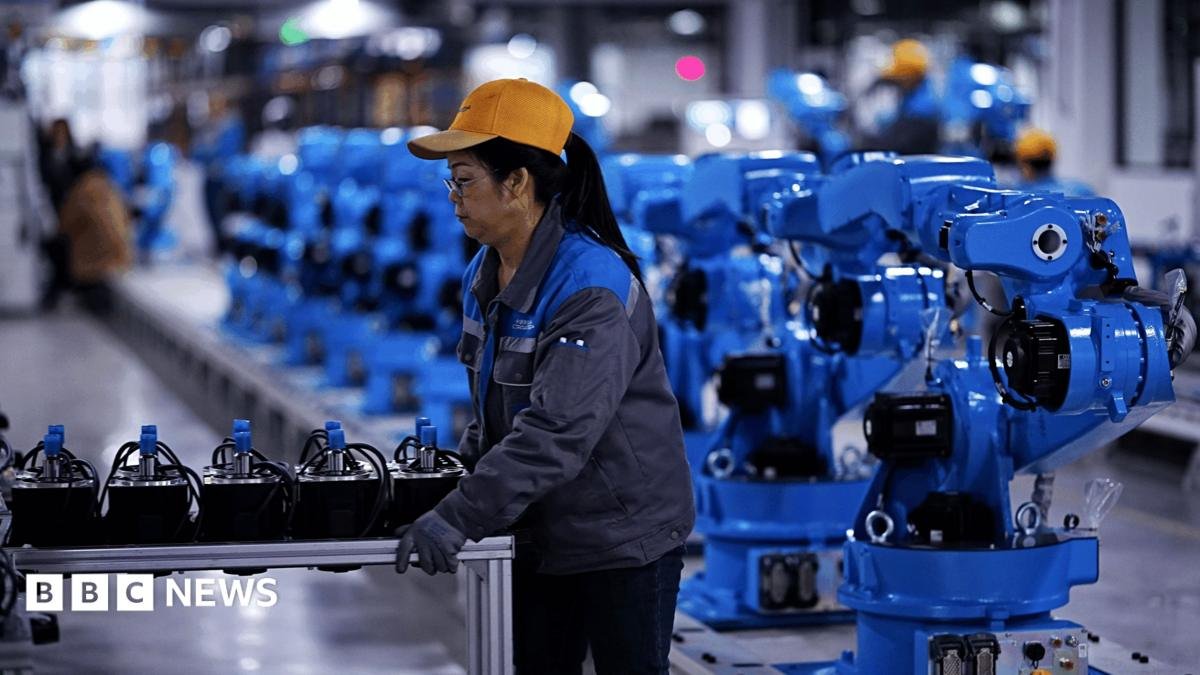
The numbers are staggering. According to reporting from the BBC, there are now more than two million robots working in China's factories--more than in any other country--and they are scaling up at extraordinary speed. This is not a marginal addition to the assembly line; it is a fundamental restructuring of production capacity. Crucially, China is not just deploying these machines; it is manufacturing them. More than half of the world's industrial robots are now made within China's borders, a statistic that signals a shift from being the world's workshop to being the world's robot builder. This dual role--as both the largest user and the largest producer of industrial automation--gives Beijing unprecedented leverage over the global supply chain for manufacturing technology. For the United States and other advanced economies, this concentration of robotic production capacity represents a strategic vulnerability, as access to these machines becomes intertwined with geopolitical tensions.Xi Jinping's $20bn Blueprint and the Doctrine of "New Productive Forces"
This industrial transformation is not an accident of market forces; it is the product of deliberate state policy. The source text identifies a $20bn (£14.7bn) plan personally associated with Xi Jinping, aimed at placing China at the forefront of innovation and in direct competition with the US. This initiative is the financial engine behind the "new productive forces" doctrine--a term the Chinese leader has used to describe a future economy driven by technology, data, and advanced manufacturing rather than traditional labour-intensive industries. The doctrine is not merely about economic growth; it is about national security and strategic autonomy. By controlling the means of production in the robotic age, Beijing seeks to insulate itself from foreign technology restrictions and to set the global standard for industrial automation. The $20bn figure, while substantial, likely represents only the seed capital for a broader ecosystem of provincial subsidies, state-backed venture funds, and preferential loans that are fuelling this machine revolution.The Vocational Pipeline: Forging the Human-Machine Interface
The future of this revolution depends not just on hardware but on human capital. The Hangzhou Technician Institute, a purpose-built vocational school on the outskirts of the former imperial capital, is at the forefront of this effort. Here, around 30 college students study code, programming lines of industrial robots and developing robotic medical instruments. The institute is one of several huge campuses designed to "churn out the next generation of tech-savvy engineers." The urgency is palpable in the words of 28-year-old instructor Chen Tianyu, who tells his students: "If you are not needed by the world of AI and robotics, then you'll definitely be among those eliminated." This is not hyperbole; it is a survival strategy. The Chinese state is retooling its education system to produce a workforce that can design, maintain, and supervise robotic systems rather than compete with them. The Hangzhou campus represents a microcosm of a national effort to bridge the gap between the country's vast labour pool and the high-skill demands of automated factories.Factory Floor Reality: CRP Technology and the Long Road to Autonomy
Away from the gleaming campuses, the reality of this transition is more incremental. In the southern city of Chengdu, the factory floor of CRP Technology offers a front-row seat to the old and new working side by side. An assembly line of around 30 middle-aged men and women screws, drills, and polishes the company's signature product: a robotic arm designed for industrial tasks. In the same room, four young engineers, including 31-year-old Pang Kai, are crowded around a console, trying to crack the code for a prototype robot that they hope will help build other robots. The contrast is stark: the human workforce is engaged in repetitive manual labour, while the engineers are attempting to create a machine that can replicate and eventually replace that labour. Pang Kai is candid about the limitations: "Maybe in another half year, it can do another task," he says, smiling wistfully. The prototype can currently only perform simple movements, such as scanning a QR code. This is a long road, and the team celebrates every small win. Yet the ambition is clear: "We want our new robot to be like human beings. We hope it can think by itself," Pang adds. The firm, which employs around 300 people, says a single arm can be programmed to perform more than 90% of repetitive tasks--a figure that underscores the potential for displacement.The Demographic Driver: An Ageing Workforce and a Shrinking Population
The urgency behind this robotisation is not purely technological; it is demographic. Pang Kai's observation that "maybe in 10 years, we won't have enough workers in China" is a stark summary of the country's looming labour crisis. The source text notes that by 2035, more than a third of China's population will be over 60. This ageing trajectory, combined with a shrinking population, means that the traditional model of labour-intensive manufacturing is no longer sustainable. Beijing is therefore in a hurry to revolutionise its factories not just to increase efficiency, but to maintain output in the face of a declining workforce. Robots are not a luxury; they are a necessity to fill the gaps left by retiring workers and a falling birth rate. This demographic pressure gives the automation drive a deterministic quality--China has no choice but to automate if it wishes to preserve its manufacturing dominance.Strategic Competition with the United States
This machine revolution is inextricably linked to the broader geopolitical contest with Washington. The $20bn plan is explicitly framed as placing China "in direct competition with the US." The race is not just about who builds the most advanced chip or the fastest supercomputer; it is about who controls the foundational technologies of the next industrial era. By dominating the production of industrial robots, China aims to set the standards for factory automation, making its systems the default choice for manufacturers in the Global South and beyond. For the US, this poses a dilemma: it can attempt to decouple from Chinese robotic technology, but doing so risks ceding the entire manufacturing value chain to Beijing. The second-order effects are profound--if China becomes the sole supplier of affordable, reliable industrial robots, it gains immense leverage over global supply chains, from electronics to electric vehicles to wind turbines.Implications for China's Workforce and the Global Manufacturing Order
The most profound question raised by this quiet revolution is the fate of China's human workforce. The source text explicitly asks: "What does this mean for China's human workforce, for instance?" The answer is uncertain. While the state is investing heavily in vocational training to create a new class of robot supervisors and engineers, the transition will inevitably displace millions of workers in repetitive roles. The middle-aged assembly line workers at CRP Technology are the human face of this disruption. The challenge for Beijing is to manage this transition without triggering social instability. The "new productive forces" doctrine implies a social contract: the state will provide retraining and social safety nets in exchange for the population's acceptance of rapid automation. Globally, the implications are equally significant. As China scales up its robotic workforce, it will become more competitive in manufacturing, potentially drawing production away from other low-cost centres in Southeast Asia and South Asia. The world is watching a transformation that will reshape not only China's economy but the entire architecture of global trade and production.Conclusion: A Leap Towards an Uncharted Future
The quiet machine revolution unfolding in China's factories is a strategic bet of historic proportions. It is a response to demographic decline, a tool for geopolitical competition, and a vision of a future where human labour is augmented--and sometimes replaced--by intelligent machines. The evidence is in the two million robots already at work, in the classrooms of Hangzhou, and on the factory floors of Chengdu. The path is long, and the prototype robots are still learning to scan QR codes. But the direction is unmistakable. As Chen Tianyu tells his students, the world is changing while they nap. For China, and for the global economy that depends on its factories, there is no turning back. The only question is whether this leap will lead to a new era of prosperity or to a social and economic chasm that even the most advanced robots cannot bridge.By Prof. Marcus Chen, Staff Writer
This article was produced with AI-assisted research and editorial support. Sources: BBC News.
What's Your Reaction?
 Like
0
Like
0
 Dislike
0
Dislike
0
 Love
0
Love
0
 Funny
0
Funny
0
 Wow
0
Wow
0
 Sad
0
Sad
0
 Angry
0
Angry
0

Marcus Chen
World Politics Analyst at Global1.News. Based in Beijing, covering US-China relations, global trade, and geopolitical strategy. Brings deep analytical perspective to the power dynamics shaping international affairs.














Comments (0)