
China Postponed Its Chang’e 7 Lunar Mission. What Does That Mean for Its Space Program?
China’s abrupt postponement of the Chang’e‑7 lunar mission on 23 August 2026 has sent ripples through the international space community. Background: The strategic role of Chang’e‑7 Chang’e‑7 occupies a pivotal position in China’s phased lunar exploration roadmap.
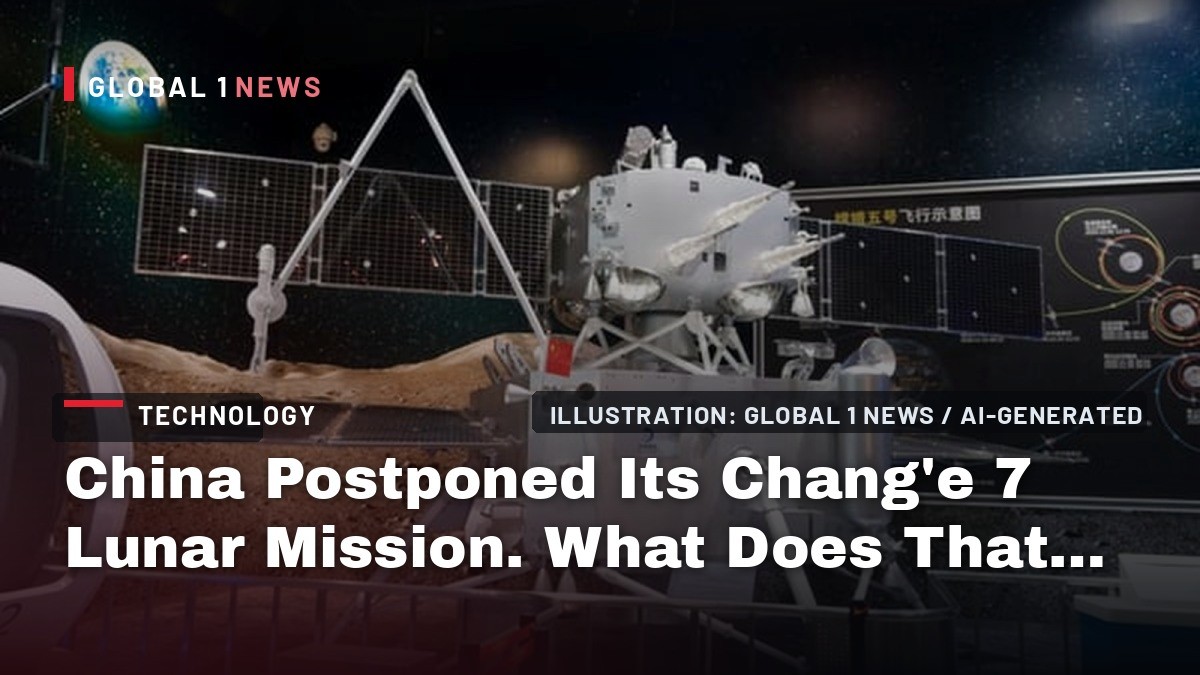
China’s abrupt postponement of the Chang’e‑7 lunar mission on 23 August 2026 has sent ripples through the international space community. The China Manned Space Agency (CMSA) offered only a terse statement that the probe “does not meet launch conditions,” without specifying the nature of the shortfall or providing a new launch window. In a programme where each phase builds directly on the previous one, the lack of a clear timetable raises questions about the technical hurdles China now faces as it moves from lunar exploration to resource utilisation and the establishment of a permanent research presence on the Moon.
Background: The strategic role of Chang’e‑7
Chang’e‑7 occupies a pivotal position in China’s phased lunar exploration roadmap. Earlier missions—Chang’e‑1 and ‑2 in orbit, Chang’e‑3 and ‑4 on soft landings, and Chang’e‑5’s sample‑return demonstration—established the basic capabilities of reaching, orbiting, landing and returning material from the Moon. Phase Four, launched by Chang’e‑6 in 2024, already demonstrated the ability to collect and return samples from the lunar south pole. Chang’e‑7 is intended to go further, shifting the focus from pure scientific inquiry to the assessment and utilisation of lunar resources.
The mission’s stated objectives include a “comprehensive detection approach” that combines orbiting, landing, roving and hopping to survey the south‑pole environment. This multi‑modal architecture is designed to map permanently shadowed regions, evaluate water‑ice deposits and test technologies that could underpin future in‑situ resource utilisation—an essential step toward the International Lunar Research Station (ILRS) slated for establishment by 2036.
The technical ambition of the orbiter‑lander‑rover‑hopper
Unlike earlier probes, Chang’e‑7 must integrate four distinct operational phases. After a lunar orbit insertion, the lander will touch down in a region of the south pole that is difficult to access due to extreme illumination conditions. From there, a rover will conduct surface traverses, while a separate hopper—an experimental vehicle capable of short‑range “mini‑flights” across crater rims—will test low‑gravity mobility and the ability to reach permanently shadowed craters that are otherwise inaccessible.
National Science Review highlighted that this “new type of probe” is central to China’s transition from exploration to prospecting. The complexity of coordinating orbital, landing, roving and hopping sequences, each with its own navigation and communication challenges, represents a marked escalation in technical difficulty compared with the relatively linear operations of previous phases.
Implications of the unexplained delay
The CMSA’s brief explanation that the probe “does not meet launch conditions” leaves the nature of the problem ambiguous. If weather had been the sole cause, a rescheduled date would likely have been announced promptly, as is common practice in other space agencies. The absence of any further detail suggests a deeper engineering issue, perhaps related to the integration of the novel hopper system, the lander’s thermal control for the extreme polar environment, or the precision required for a safe touchdown in a region with limited sunlight.
Such opacity is notable because Chinese space institutions have traditionally communicated launch delays with specific technical reasons, even when the issues are internal. The silence therefore points to a problem that may be more systemic, indicating that the technological leap required for Phase Four is proving harder to achieve within the original schedule.
Strategic timing and the broader lunar race
China’s lunar timetable is tightly linked to the ILRS concept, a multinational effort that China envisions leading. The ILRS, targeted for a 2036 operational baseline, depends on a series of precursor missions that gradually build the necessary infrastructure. Chang’e‑8, slated for launch in 2029, will follow Chang’e‑7 and is expected to lay the groundwork for a permanent scientific research station by scaling the lunar surface and conducting in‑situ resource utilisation experiments.
Delays in Chang’e‑7 therefore have a cascading effect on the overall schedule. While the CMSA has not ruled out a 2027 launch window, the lack of an official commitment means that subsequent missions may also face uncertainty, potentially allowing other spacefaring nations to narrow the gap in lunar capability development.
China’s geological groundwork
Parallel to the hardware challenges, China has been constructing a detailed geological knowledge base to inform site selection for future bases. In 2024, the Institute of Geology under the Chinese Academy of Geological Sciences, together with partners from the Chinese Academy of Sciences, Jilin University, Shandong University and China University of Geosciences, produced a 1:5,000,000‑scale lunar geological map. This map catalogues over 13,000 impact craters, dozens of impact basins, and a range of geological structures and rock types, providing a high‑resolution view of the lunar terrain.
The same year saw the release of a 1:2,500,000‑scale high‑precision lunar geological atlas, further refining the data needed to pinpoint locations rich in water‑ice or other exploitable resources. These cartographic products are essential for mission planning, especially for a probe like Chang’e‑7 that must navigate the treacherous terrain of the south pole while identifying scientifically and economically valuable sites.
Comparative perspective: Delays in other lunar programmes
Space programme delays are not unique to China. NASA’s Artemis programme, for example, has experienced multiple postponements of its Space Launch System due to technical and budgetary constraints. However, the United States typically provides detailed briefings on the nature of each setback, offering the international community insight into risk mitigation strategies.
China’s relative reticence in this instance contrasts with its usual practice of transparent technical updates. This difference may reflect internal pressures to maintain a narrative of uninterrupted progress, especially as the nation positions itself as a leader in lunar resource utilisation. The limited information therefore fuels speculation about the severity of the underlying issue.
Future outlook: What the postponement signals for China’s lunar ambitions
While the postponement of Chang’e‑7 does not diminish the strategic importance China places on lunar exploration, it does underscore the technical complexity of moving from demonstration missions to sustained operations. The integration of hopping technology, the need for precise landing in permanently shadowed regions, and the requirement to conduct in‑situ resource assessments all represent novel challenges that have yet to be fully mastered.
In the short term, the mission may be rescheduled for 2027, but the absence of an official timeline suggests that Chinese engineers are still addressing a critical hurdle. The outcome of this delay will likely influence the cadence of subsequent missions, including Chang’e‑8 in 2029, and by extension, the timeline for the ILRS. Stakeholders in the international lunar community will be watching closely, as any shift in China’s schedule could recalibrate the broader competitive and collaborative dynamics of lunar exploration in the coming decade.
This article was produced with AI-assisted research and editorial support. Reporting is based on the source material cited below. Sources: The Diplomat; thediplomat.com; Global1.News (15 September 2026).
By Kenji Tanaka, Staff Writer
What's Your Reaction?
 Like
0
Like
0
 Dislike
0
Dislike
0
 Love
0
Love
0
 Funny
0
Funny
0
 Wow
0
Wow
0
 Sad
0
Sad
0
 Angry
0
Angry
0

Japan Correspondent at Global1.News. Tokyo-based voice covering Japanese politics, technology, economy, and culture. Tracks the intersection of tradition and innovation in one of the world's most dynamic societies.















Comments (0)