
Bihar Forms 5-Member Panel for Exam Reforms After Paper Leaks
The Bihar government has formally constituted a five-member Expert Committee on Examination Reform, tasked with overhauling the state’s examination ecosystem within a strict three-month deadline. The notification, issued by the General Administration Department on August 23, 2026, comes after a decade of recurring paper-leak scandals that have eroded public confidence in everything from secondary school boards to the Bihar Public Service Commission (BPSC).
The Bihar government has formally constituted a five-member Expert Committee on Examination Reform, tasked with overhauling the state’s examination ecosystem within a strict three-month deadline. The notification, issued by the General Administration Department on August 23, 2026, comes after a decade of recurring paper-leak scandals that have eroded public confidence in everything from secondary school boards to the Bihar Public Service Commission (BPSC). With a mandate covering secondary, higher secondary, university, vocational, technical entrance, and competitive recruitment examinations, this is among the most comprehensive reform attempts by any Indian state to date.
Bihar’s Five-Member Exam Reform Panel: A Three-Month Deadline to Fix a Decade of Paper Leaks, Proxy Candidates, and Result Tampering
Patna, Bihar – August 23, 2026 — The Bihar government has issued an official notification creating a five-member 'Expert Committee on Examination Reform' (pariksha sudhar par ek visheshagya samiti), tasking it with delivering a complete overhaul of the state’s examination system within 90 days. The committee, formed under the aegis of the General Administration Department, will be chaired by a serving or retired judge, with a formal request to be made to the judiciary for the appointment. The move follows Chief Minister Samrat Choudhary’s August 9 announcement at the State-Level Pledge and Felicitation Ceremony in Patna, where he acknowledged that technology has made question papers vulnerable to a single compromised individual. The committee’s mandate is sweeping: eliminate question paper leaks, proxy candidates, mass cheating, answer-sheet tampering, and unauthorized interference in results, while ensuring timely exams and transparent declarations of results.

A Mandate That Covers Every Exam in Bihar
The notification’s scope is unprecedented in its breadth. The committee will review examinations conducted by the Bihar School Examination Board (BSEB), universities across the state, vocational and technical education institutions, entrance and eligibility tests, and all recruitment and competitive examinations. This includes the BPSC, which has been at the centre of controversy since the 2024 leak allegations that triggered widespread protests and exam cancellations. The committee is explicitly directed to respect the statutory and constitutional autonomy of examination and recruitment bodies, meaning its recommendations must work within existing legal frameworks rather than override them.
The core objectives, as outlined in the notification, include strengthening the reliability, integrity, and public trust of examinations; eliminating all forms of malpractice; ensuring timely conduct and result declaration; leveraging digital technology, data analytics, artificial intelligence (AI), and cyber security tools with human oversight; developing an independent quality assurance and audit system; and crucially, ensuring that reforms do not disadvantage students from rural, economically weaker, socially deprived, or digitally less-connected backgrounds. This last point is particularly significant in Bihar, where a substantial portion of aspirants hail from districts like Gopalganj, Sitamarhi, and Araria, where digital infrastructure remains patchy.
From Six-Layer Packaging to AI-Driven Security: The Technical Mandate
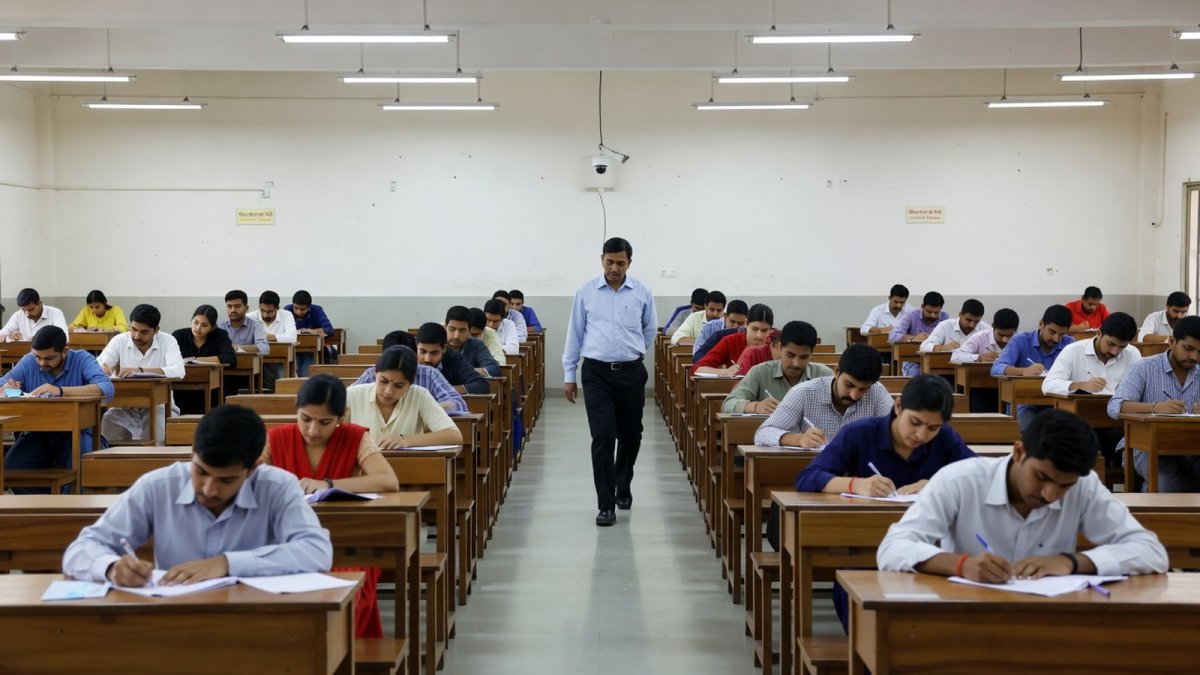
The committee’s terms of reference read like a checklist of every vulnerability exposed in past leaks. On question paper security, the panel will conduct a comprehensive security audit of paper setting, secure storage, transport, distribution, digital transmission, and access control. It will examine the feasibility of end-to-end digital tracking of exam material, tamper-proof packaging, encrypted transmission, multi-factor authentication, biometric verification, geo-tagging, geo-fencing, and cyber security audits. The notification specifically mentions CCTV surveillance and secure command centres as part of the proposed security architecture.
This technical mandate builds on the 22 reforms already introduced by the BPSC after the 2024 leaks, which included six-layer packaging, multi-set question papers, and GPS-tracked transport. The new committee, however, is tasked with scaling these measures across every examination body in the state. The panel will also review the existing legal and regulatory framework — including acts, rules, examination sub-rules, confidentiality provisions, and data security requirements — and recommend specific amendments to strengthen penalties and enforcement mechanisms.
What This Means for India
Bihar’s reform push arrives at a moment when paper leaks have become a national crisis. The Akhil Bharatiya Vidyarthi Parishad (ABVP) announced on August 3, 2026, that it would submit exam-reform recommendations to the Centre’s High-Powered Committee following recent leak controversies in Bihar, Jharkhand, Karnataka, and Punjab. The National Testing Agency (NTA), which conducts major entrance exams like NEET-UG and JEE, has faced its own credibility crises over the past two years. Bihar’s decision to create a dedicated, time-bound expert committee with a judicial chair could serve as a template for other states grappling with similar issues.
For Indian students and parents, the stakes are existential. A leaked paper does not merely delay an exam; it devalues the hard work of lakhs of honest candidates. In Bihar alone, over 15 lakh students appear for the BSEB Class 10 and 12 examinations annually, while the BPSC conducts recruitment for thousands of government posts each year. Every cancellation or re-exam imposes a double burden — financial and psychological — on families already stretched thin. The committee’s mandate to ensure timely results is therefore not just an administrative nicety but a matter of social justice.
The Political and Administrative Context
Chief Minister Samrat Choudhary’s August 9 remarks in Patna were blunt: “Because there are so many exams now, and with technology being so pervasive, if even one person compromises their integrity, the question paper ends up in the market.” He added, “The entire young generation shouldn't feel cheated. We must care about this.” These statements accompanied a broader package of student-centric reforms, including a state-level committee to improve education quality, the Sahyog portal for student complaints, and a commitment that if student issues are not resolved within 30 days, the Chief Minister will personally conduct a support camp once a month. The government has also established Student Welfare Directorates in departments linked with students — Higher Education, Education, Science and Technology, and ITI.
Critically, the state has already enacted a law allowing direct imprisonment of up to one year for those found involved in exam-related crimes. The new committee’s legal review will determine whether these provisions are sufficient or need strengthening, particularly in cases involving organized leak syndicates that operate across state borders.
Challenges Ahead: Autonomy, Digital Divide, and Implementation
While the committee’s mandate is comprehensive, implementation will face significant hurdles. First, the statutory autonomy of bodies like the BPSC and universities means that the committee’s recommendations cannot be imposed unilaterally; they will require legislative action and institutional buy-in. Second, the digital divide remains a pressing concern. The notification explicitly acknowledges this, directing the committee to ensure that technology-driven reforms do not harm students from rural or economically weaker backgrounds. This is not a trivial concern — in many parts of Bihar, reliable internet connectivity and electricity remain aspirational rather than guaranteed.
Third, the three-month timeline is ambitious. Conducting a comprehensive security audit of every examination body in the state, reviewing legal frameworks, and developing a state exam calendar with maximum time limits for each stage — from advertisement to final result — is a herculean task. The committee will need to prioritize its recommendations, perhaps focusing first on the highest-risk areas: question paper setting and transport, and result processing.
The Bottom Line
Bihar’s Expert Committee on Examination Reform represents a genuine attempt to break the cycle of leaks, cancellations, and re-exams that have plagued the state for over a decade. By combining a judicial chair, a technology-driven mandate, and an explicit commitment to protecting vulnerable students, the committee has the potential to deliver a blueprint that could be adopted nationally. The three-month deadline is tight, but the political will appears present — Chief Minister Choudhary has staked his credibility on this reform. For the lakhs of students in Patna, Gaya, Muzaffarpur, and beyond who have seen their futures delayed by paper leaks, the committee’s success cannot come soon enough. The nation will be watching Bihar’s experiment closely, as it may well define the future of examination integrity across India.
— By Dr. Raj Patel, Staff Writer
This article was produced with AI-assisted research and editorial support. Reporting is based on sources cited in the article.
What's Your Reaction?
 Like
0
Like
0
 Dislike
0
Dislike
0
 Love
0
Love
0
 Funny
0
Funny
0
 Wow
0
Wow
0
 Sad
0
Sad
0
 Angry
0
Angry
0

India/South Asia Correspondent at Global1.News. Analytical voice with a background in science and health journalism. Based in New Delhi, covering Indian politics, education, healthcare, technology, and policy. Breaks down complex data into clear, actionable reporting.















Comments (0)