
ASUU-TSU issues final 14-day ultimatum to Taraba govt over 2025 agreement
In the heart of Jalingo, the Academic Staff Union of Universities – Taraba State University branch (ASUU‑TSU) has once again taken the step of issuing a formal ultimatum to the state government.
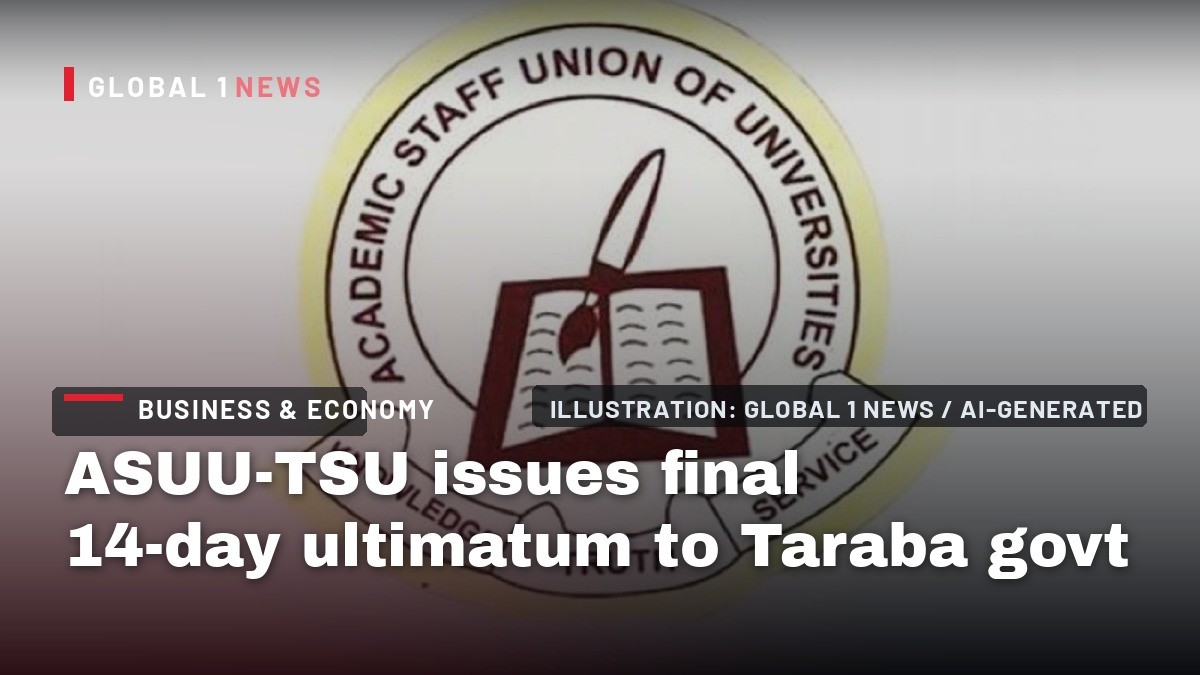
In the heart of Jalingo, the Academic Staff Union of Universities – Taraba State University branch (ASUU‑TSU) has once again taken the step of issuing a formal ultimatum to the state government. The latest notice, a final 14‑day deadline, runs from 14 September to 28 September 2026 and targets the implementation of key provisions of the Federal Government/ASUU 2025 Agreement that remain pending at the state level. The statement, signed by the union’s chairman, Dr Joshua Garba Mbave, underscores a growing tension between academic staff and the Taraba administration, while also reflecting a broader pattern of labour‑government negotiations across Nigeria’s higher‑education sector.
Background to the 2025 Agreement and its significance for Taraba State University
The Federal Government/ASUU 2025 Agreement, negotiated at the national level, set out a series of commitments aimed at improving funding, staff welfare, and academic infrastructure across public universities. For Taraba State University (TSU), the agreement promised concrete steps that would address long‑standing challenges such as delayed salary payments, inadequate laboratory equipment, and the need for expanded campus facilities. While the union acknowledges the state’s “commitment to industrial harmony and dialogue,” it stresses that several of these promised measures have yet to be realised, prompting the current ultimatum.
In its statement, ASUU‑TSU highlighted that “some key provisions of the Agreement remain outstanding and require urgent attention.” This language reflects a measured yet firm stance: the union recognises the government’s goodwill but insists that goodwill alone cannot substitute for actionable implementation. The pending items, though not enumerated in the source, are understood to be central to the university’s operational stability and the welfare of its academic staff.
The chronology of ultimatums: From August to September 2026
Earlier in the year, on 13 August 2026, ASUU‑TSU issued a first 14‑day ultimatum to Governor Agbu Kefas and the state administration, demanding full implementation of the 2025 Agreement or the prospect of industrial action. That deadline expired on 26 August without what the union described as “concrete and verifiable action” by the government. Despite the lack of tangible progress, the union refrained from striking, citing the university’s combined convocation ceremony scheduled within that period as a reason to maintain peace.
The decision to hold back on industrial action illustrates the union’s strategic calculus: maintaining academic continuity during pivotal events while applying pressure through formal notices. The August ultimatum set a precedent that the September notice now builds upon, signalling a “final” warning that the union hopes will compel the state to move from dialogue to decisive implementation.
Legal and procedural considerations behind the “lawful measures” warning
In the September statement, the union warned that, should the state fail to meet the deadline, it may consider “lawful measures to protect members’ interests.” This phrasing is deliberately cautious, indicating that any subsequent steps would be within the bounds of Nigerian labour law. By invoking legality, ASUU‑TSU seeks to preserve its legitimacy and public support, positioning any future action as a rightful defence of staff rights rather than an unlawful disruption.
Such a stance aligns with the broader trend among Nigerian academic unions, which have historically balanced the right to strike with the need to maintain public sympathy. The emphasis on “peaceful engagement and constructive dialogue” serves to reinforce the union’s image as a responsible stakeholder, while the conditional threat of lawful measures keeps the pressure on the government without alienating the wider community.
Stakeholder reactions and the call for broader support
The union’s statement also appealed to “all stakeholders” to back efforts aimed at preserving a stable and productive academic environment. By framing the issue as one of collective interest—encompassing students, staff, and the wider community—the union seeks to broaden the base of pressure on the state government. This outreach reflects an understanding that academic disruptions can have ripple effects on local economies, especially in a state where the university is a major employer and hub of intellectual activity.
While the source material does not detail specific reactions from the governor’s office or civil society groups, the union’s explicit request for stakeholder support suggests an anticipation of varied responses. In previous disputes across Nigeria, student bodies, parent associations, and even private sector actors have sometimes rallied behind academic staff, amplifying the call for government compliance.
Implications for industrial harmony in Nigeria’s higher education sector
The unfolding standoff in Taraba is emblematic of a larger national conversation about the sustainability of industrial peace in the university system. Since the 2025 Agreement, many state universities have grappled with the dual pressures of limited fiscal space and rising expectations from staff. The pattern of issuing ultimatums—first in August, now in September—highlights a growing impatience among unions when promised reforms stall.
If the Taraba State Government were to meet the union’s demands within the 14‑day window, it could set a constructive precedent for other states, demonstrating that timely implementation of federal agreements is both feasible and politically advantageous. Conversely, a failure to act could embolden other unions to adopt similar tactics, potentially increasing the frequency of industrial warnings and, in worst‑case scenarios, strikes that disrupt academic calendars nationwide.
Potential economic and social fallout for Taraba State
Taraba’s economy, like many Nigerian states, benefits significantly from the presence of a major public university. Disruptions to academic activities can affect local businesses that rely on student and staff patronage, from housing rentals to food vendors. Moreover, prolonged uncertainty over staff welfare may deter prospective faculty and students, affecting the university’s reputation and long‑term enrolment figures.
The union’s emphasis on “uninterrupted academic activities” underscores the stakes: a stable university contributes to human capital development, research output, and the broader socio‑economic health of the region. Any escalation that leads to industrial action could therefore have a cascading impact, not only on the campus but on the surrounding communities that depend on the institution’s vibrancy.
Looking ahead: What the next two weeks could mean for ASUU‑TSU and the state
As the final 14‑day deadline approaches, all eyes will be on Governor Agbu Kefas and his administration to see whether concrete steps will be taken to fulfil the outstanding provisions of the 2025 Agreement. The union’s statement leaves the door open for “lawful measures” but also reaffirms a willingness to maintain peace if progress is made. This delicate balance will test the government’s capacity to translate dialogue into action under a tight timeframe.
For the academic community in Jalingo, the period from 14 to 28 September will be a litmus test of the state’s commitment to its staff and to the broader promise of industrial harmony. A swift, transparent response could restore confidence and set the stage for a productive academic year, while a missed deadline may trigger a new chapter of negotiations, potentially reshaping the dynamics of university‑state relations in Taraba and beyond.
This article was produced with AI-assisted research and editorial support. Reporting is based on the source material cited below. Sources: Daily Post Nigeria; dailypost.ng; Global1.News (15 September 2026).
By Sarah Okafor, Staff Writer
What's Your Reaction?
 Like
0
Like
0
 Dislike
0
Dislike
0
 Love
0
Love
0
 Funny
0
Funny
0
 Wow
0
Wow
0
 Sad
0
Sad
0
 Angry
0
Angry
0

Africa Correspondent at Global1.News. Based in Lagos, covering politics, business, technology, and culture across the continent. Focused on telling African stories beyond the headlines — the innovation, entrepreneurs, and communities shaping the region's future.














Comments (0)