
Trump Tells Zelensky to Stop Hitting Russian Diesel - Hours After Ukraine Blows Up Two Refineries 1,200 Kilometres Inside Russia
President Donald Trump told Ukraine to stop striking Russian diesel infrastructure on Sunday, hours after Ukrainian drones hit two refineries 1,200 km inside Russia and killed two civilians in Tatarstan.

Donald Trump stood on the grass of his own golf course in Ireland on Sunday and told Ukraine to stop blowing up Russian diesel. Not to stop the war. Not to stop the drones raining on Odesa. To stop hitting the fuel. Folks, that is the whole ballgame in one sentence, and everything else in this story flows from it.
Trump Tells Zelensky to Stop Hitting Russian Diesel - Hours After Ukraine Blows Up Two Refineries 1,200 Kilometres Inside Russia
Dublin, Ireland — The American president made his demand on the sidelines of the Irish Open at Trump International Golf Links in Doonbeg, a course his family owns, and he made it in the plainest language he had. "Mr. Zelenskyy has to do one thing. He has to stop knocking out diesel fuel in Russia," Trump said, according to the Associated Press and Reuters. He added: "There are plenty of other targets. Don't hit diesel fuel, because that's hurting, that's hurting the world."
Trump's One Demand: Stop Hitting Diesel
Understand what was asked and what was not. Trump was asked whether he had spoken with Vladimir Putin following their recent conversation, and he answered by turning the spotlight on Ukraine. "Let him go after targets, but not diesel, because he's causing a shortage of diesel," he said, in the version carried by Euronews. To the New York Post he framed the cause of the price spike this way: "This isn't done by the Middle East, this is done by what's happening with Russia and Ukraine."
That is a direct claim of causation, and it deserves testing against the record. Euronews noted that Trump "appeared to blame Ukraine's war efforts in targeting Russia as the main reason for spiralling energy prices, despite experts pointing to his and Israel's war on Iran and the closure of the Strait of Hormuz, from which 20% of the world's oil typically flows, as the main culprit."

Anadolu reported that Ukrainian officials had not issued an immediate response. Reuters noted the counterargument from Kyiv: Ukraine, which absorbs regular Russian attacks on its own energy infrastructure, says refineries are legitimate military targets. Anadolu added that Washington raised the matter directly with the Ukrainian leader and does not want Kyiv targeting refineries. So the president of the United States, standing in Ireland, told a country that is being invaded to stop striking the refineries that fuel the invasion, because the price at the pump in Ohio is too high.
Diesel Just Broke a Record It Had Never Reached
Start with the number, because the number is real and it is ugly. GasBuddy announced on Thursday 10 September that the US average price of diesel had climbed to $6.00 a gallon for the first time in history. "It is a level diesel has never reached," GasBuddy said, "and it comes less than a week after prices set a fresh all-time record of $5.85."
AAA confirmed the trajectory: average US diesel at $6.0556 a gallon as of 11 September, with other reports putting it at $6.06. A week earlier it was $5.8500; a month earlier, $5.3213; a year earlier, $3.7053. That is roughly $2.30 a gallon added in twelve months, 63.3% above the $3.71 of a year before. The previous record was $5.82, set in June 2022 after Russia's full-scale invasion began. GasBuddy live data showed fresh all-time highs in 28 states, and gasoline rose to an average of $4.29 a gallon.
Patrick De Haan, head of petroleum analysis at GasBuddy, did not soften it. "Record diesel prices will impact every cargo, shipment, every delivery Americans are taking, and are likely to reignite inflation up and down the supply chain," he said. "I suggest Americans anticipate a costlier holiday season."
The timing is brutal. The increase began at the start of the fall harvest season. The Energy Information Administration put US diesel inventories at 106.3 million barrels, about 13% under the five-year average. CNBC, via the New York Post, reported an 8% drop in diesel supply worldwide, with US refineries already running at 98% capacity. And since the war between the United States and Iran began, higher diesel prices have cost Americans more than $46 billion - roughly $350 per household. Bloomberg noted the politics: the squeeze could bite hardest in Maine, which has the highest share of households using home heating oil, and in Ohio, Kansas and Iowa, farm states heading into harvest. All are Senate battlegrounds, and fuel prices are weighing on voters ahead of November's midterms.
The International Energy Agency Names the Culprit
The International Energy Agency published a report on Friday 11 September, and it does not say what the president said. According to the IEA, net exports of diesel and gasoil from the Gulf countries in August stood at "just over a quarter" of what they were before the war on Iran began in February. Then the agency added the line that matters: "Disruptions to Russia's refining system and a near-halt to product exports following intensified Ukrainian attacks have compounded these losses."
Read that word again. Compounded. Not caused. The IEA's baseline is the Gulf collapse. In February, combined net exports of diesel and gasoil from the Gulf and Russia "accounted for almost 45% of global seaborne trade." When the Gulf share falls to a quarter of its former level, you do not need a second culprit to explain a global shortage. You have one. Ukraine's campaign made a catastrophic situation worse.
Separate IEA reporting put hard numbers on the supply side: global oil supply fell by 1.6 million barrels per day in August, to 100.1 million bpd, citing attacks on tanker traffic and energy infrastructure in the Strait of Hormuz and the Red Sea. Saudi Arabia's crude supply fell to 6 million bpd, its lowest in more than 30 years. Moscow made its own contribution too, banning diesel exports in July and extending the curbs through September - a move that removed Russian product from the market by Russia's own choice. Russia is now importing fuel from South Korea and Turkey because of Ukrainian drone strikes, according to a Kyiv Independent report on 10 September.
Two Refineries, 1,200 Kilometres, One Night
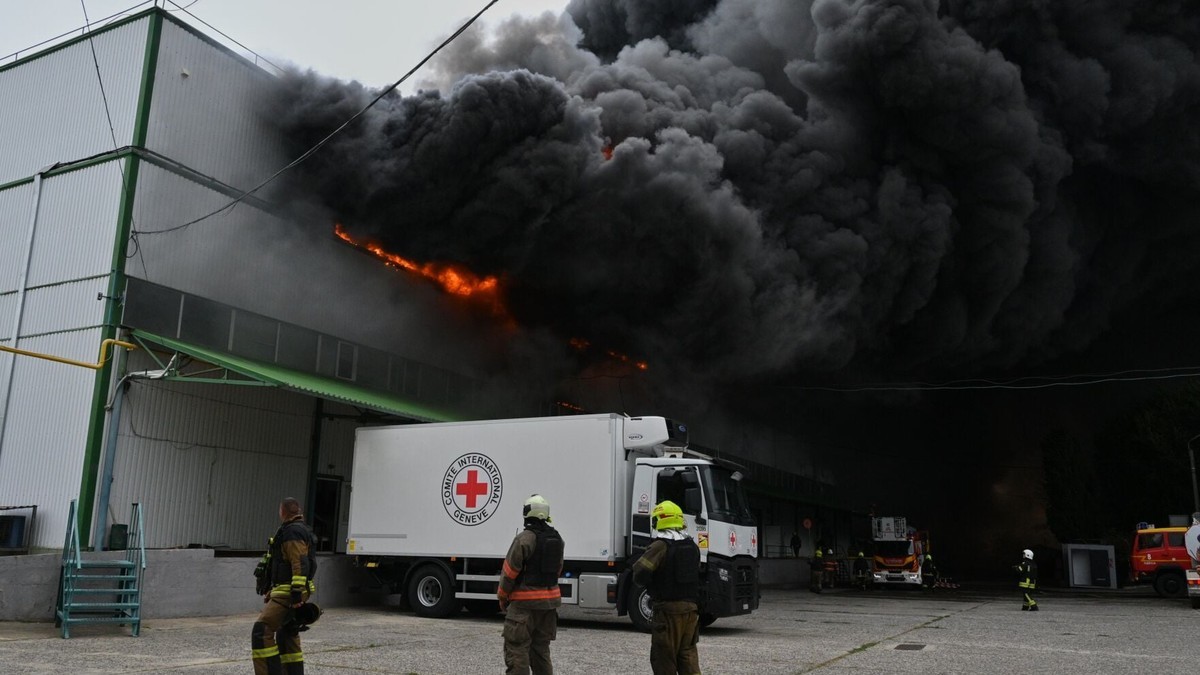
So what did Ukraine actually do on the night Trump was talking about? On the night of 12-13 September, units of Ukraine's Defence Forces struck the "Slavyansky" oil refinery in Slavyansk-on-Kuban, Krasnodar Krai, with a fire reported on the plant's premises. They struck the "TANECO" oil refinery in Nizhnekamsk, Republic of Tatarstan, with a fire reported in one of the plant's storage tanks. They hit a facility in Millerovo, Rostov Oblast, used for the storage, preparation and launch of Russian attack UAVs, and Russian command posts, per the General Staff and Ukrinform.
Ukraine's Defence Intelligence, the DIU, gave its own account: on 13 September, operators of its Active Operations and Unmanned Systems departments, as part of a joint deep-strike operation, hit the "Slavyansk-EKO" refinery's key oil-processing unit and its tank farm. Thick smoke and the glow from the massive fire could be seen dozens of kilometres away.
The Slavyansk refinery is operated by Sloviansk ECO LLC, also rendered Slavyansk-EKO. It is one of the largest independent refineries in southern Russia, with annual crude processing capacity of about 5.2 million metric tons. Ukraine's General Staff claimed it supplies the Russian Armed Forces - a claim that should be labelled as exactly that. The plant sits roughly 70 km northwest of Krasnodar, and drones have hit it repeatedly before, including in January and June of this year.
TANECO is the bigger prize. Part of Tatneft, one of Russia's largest oil companies, it processes more than 16 million metric tons of oil annually - 16.2 million in 2022, according to Tatarstan authorities - making gasoline, diesel and aviation kerosene. It sits roughly 1,200 km from Ukraine. This is not a border raid. This is a drone flying the distance from London to Rome. On 20 August, Reuters reported Ukraine's military hit the refinery as well as the Tamanneftegaz oil terminal in the Krasnodar region, and after a 12 June attack two industry sources told Reuters TANECO suspended crude processing, prompting Tatneft to cap purchases nationwide at its fuel stations.
The General Staff also established retrospectively that the 11 September strike on the Saratov Oil Refinery damaged the ELOU-AVT-6 primary crude distillation unit and a section of the main oil pipeline.
What Ukraine Says It Hit
Be precise about who is claiming what, because this is where spin lives. The strikes on both refineries are Ukrainian claims, confirmed by Ukraine's own General Staff and the DIU. Russian authorities confirmed a fire at an unspecified "enterprise" in both cities but did not confirm the refineries were the targets in Slavyansk-on-Kuban. Russia's Defence Ministry claimed its air defences intercepted and destroyed 389 Ukrainian drones overnight, including over Tatarstan and Russian-occupied Crimea - a claim the Kyiv Independent could not independently verify, and neither should you treat it as settled.
What is not in dispute is the pattern. Ukraine's attacks on refineries had doubled since the start of 2026, leading to full or partial shutdowns of oil processing, according to official data, social media and Reuters calculations from mid-2026. Long lines of motorists queueing in Russian-controlled Crimea and the southern Krasnodar region underscore the domestic fallout, and the campaign has caused fuel rationing across Russia, despite the country being a key oil and gas exporter. Kyiv's stated logic is straightforward: Russia's oil industry both funds and directly fuels Moscow's more than four-year-old invasion of Ukraine, which began on 24 February 2022.
Two Civilians Died Near a Tree in Nizhnekamsk
This is the part that does not fit neatly into a talking point on either side, and you should sit with it. In Nizhnekamsk, two people were killed and 12 injured, according to the office of regional head Rustam Minnikhanov. The two civilians died after a drone slammed into a tree near their parked car, the statement said. Note the discrepancy in the wires: AP's first dispatch and the Kyiv Independent say two killed and 12 injured, while later AP copies carried by PBS and The Journal put the wounded count at 14. Attribute it to Minnikhanov's office and hold both figures.
Nizhnekamsk Mayor Radmir Belyaev said a fire had broken out at an unspecified "enterprise", without giving detail. Russian authorities did not identify the facility hit or disclose the extent of the damage, and Russia's aviation authority temporarily imposed flight restrictions at the airports in Nizhnekamsk, Kazan and Bugulma overnight.
In Slavyansk-on-Kuban, Krasnodar authorities said the strike on "an enterprise" injured three people, damaged an oil pipeline and started a blaze. They did not directly confirm Ukraine's claim about the refinery, and the Krasnodar Krai operational headquarters said falling drone debris damaged a gas pipeline in a residential area.
Two dead civilians near a tree. Three injured. A damaged gas line in a residential neighbourhood. That is what a deep-strike campaign looks like on the ground, and no amount of strategic justification makes a parked car disappear.
The Same Night, Russia Hit Odesa and the Polish Border
Trump's demand only makes sense if you look at one half of that night. At least nine people were injured in a "massive" Russian nighttime attack on Odesa, according to Serhii Lysak, who heads the city's military administration. Odesa is home to Ukraine's main Black Sea port, and Kyiv accuses Moscow of trying to choke off its exports.
The night before, a Russian drone attack on Saturday 12 September struck a residential high-rise in Odesa, killing two people and injuring 26 others, Ukrainian officials said. The building's upper floors were completely destroyed, according to regional head Oleh Kiper. Ukrainian tennis player Yastremska said a Russian missile destroyed her family's apartment there. "The only thing that survived was a Roland Garros towel," she wrote on Instagram.
Russian strikes also pounded western Ukraine, and one drone set fire to a gas station near the Yahodyn-Dorohusk border crossing with Poland. Ukrainian Foreign Minister Andrii Sybiha wrote on X: "This is Putin's terror 'knocking' directly on the doors of the EU and NATO. Russian barbarians are at your gate, dear partners." Those crossings carry much of the military and humanitarian aid sent by Western allies. Earlier in the week, two people died when Russian drones hit the Starokozache crossing with Moldova.
Ukraine's air force said its defences shot down or suppressed 409 Russian drones overnight, including a newer jet-powered version that is faster and harder to intercept, and that Russia attacked with 453 drones in total - Ukrainian military claims that should be labelled as such. Russia has ramped up its air campaign in recent weeks, targeting the power grid ahead of winter in what officials say is meant to demoralise civilians. Zelensky said on 12 September that Russia launched nearly 500 strike drones at Ukraine during the day. On the EU considering lifting sanctions on Russian oligarchs, he said: "Five hundred Shahed drones per day is certainly not the right time to even begin a discussion about easing sanctions."
The Campaign That Made This Argument Possible
None of this started on Sunday. Ukraine has spent months building a deep-strike campaign that reaches further into Russia, and that campaign is precisely what made Trump's demand possible to utter. On 10 September, Zelensky said Ukrainian units hit eight military-supporting facilities within 24 hours, including an oil refinery in the Yamalo-Nenets region and a seaport in Dagestan. Strikes also targeted the Novorossiysk naval base and oil terminal on 9 September, and processing complexes across Ryazan, Perm and Tatarstan on 7 September. On 12 September Ukrainian forces struck facilities near the Beriev aviation complex in Taganrog, which services A-50 surveillance aircraft and Tu-95 strategic bombers.
The tempo is staggering. The Odessa Journal reported on 13 September that Russia launched 2,100 drones and 78 missiles at Ukraine in one week, and that Defence Intelligence says Kyiv is Russia's primary target for ballistic attacks. The Kyiv Independent reported that the next Ukraine-US-Russia peace talks may take place in October, according to Budanov, while Russian Foreign Minister Sergei Lavrov says Russia refuses to stop attacking Ukraine during negotiations.
Who Is Actually Driving the Diesel Price
So let us do the accounting honestly. What does the documented evidence say is driving the diesel price?
One: the war on Iran and the closure of the Strait of Hormuz, from which 20% of the world's oil typically flows. The IEA says Gulf net exports of diesel and gasoil in August were just over a quarter of pre-war levels, Saudi crude supply is at its lowest in more than 30 years, and global oil supply fell 1.6 million bpd in August.
Two: Russia's own export ban, imposed in July and extended through September. Three: US inventories 13% below the five-year average, refineries at 98% capacity. Four: Ukraine's deep-strike campaign, which the IEA says "compounded these losses" and which has caused fuel rationing inside Russia itself.
Four factors. Trump named one - and not the largest, not the earliest, and not the one his own administration's war helped create. Euronews put it plainly: experts point to the Iran war and the Hormuz closure as the main culprit. The IEA's language points the same direction. The president's version requires you to ignore the Gulf, ignore the Russian export ban, ignore the inventory data, and land entirely on the country that is being invaded.
The Question Nobody in Washington Is Answering
Here is the question that follows, and it is not a trick. If diesel at $6.00 a gallon is the emergency, and if the emergency is caused by strikes on Russian refining capacity, then what is the plan for the other three factors? What is the plan for the Strait of Hormuz? What is the plan for the export ban Moscow extended through September? What is the plan for 106.3 million barrels of inventory against a five-year average 13% higher?
Because if the answer is "Ukraine should stop," then you have not solved the diesel price. You have solved one input into it, by asking the invaded country to spare the refineries that, in Kyiv's assessment, fuel the invasion. Russia's Defence Ministry says it shot down 389 drones. Minnikhanov's office says two civilians died near a tree. All of that can be true at once, and none of it changes the arithmetic at the pump.
Trump said there are "plenty of other targets." Maybe so. But the refineries are the ones that turn crude into the diesel that moves Russian armour, and the ones that turn a profit that funds the war. Ukraine has spent 2026 proving it can reach them, 1,200 kilometres out, night after night. That will not disappear because a president said so on a golf course in Doonbeg.
Folks, do not let anyone hand you a single-cause story about a four-cause price. When you hear that diesel is at $6.00 because of one country, go look at the IEA report, the EIA inventory numbers, the Strait of Hormuz, Moscow's own export ban. The receipts are public. Then ask your representatives the question they keep dodging: what is the actual plan for the other three? Because a demand is not a plan, and a golf course is not a strategy.
By Jessica Ali, Staff Writer
This article was produced with AI-assisted research and editorial support. Sources: Associated Press, Reuters, PBS NewsHour, Euronews, Al Arabiya, Anadolu Agency, Ukrinform, Ukrainska Pravda, UNN, Kyiv Independent, UNITED24 Media, Odessa Journal, The Journal, Washington Examiner, New York Post, GasBuddy, AAA, US Energy Information Administration, International Energy Agency.
What's Your Reaction?
 Like
0
Like
0
 Dislike
0
Dislike
0
 Love
0
Love
0
 Funny
0
Funny
0
 Wow
0
Wow
0
 Sad
0
Sad
0
 Angry
0
Angry
0

Editor-in-Chief at Global1.News. Atlanta-based journalist who cuts through the BS and tells it like it is. Lead anchor, host, and the voice you hear when the spin stops and the truth starts.















Comments (0)