
Protesters in Hyderabad demand CEC Gyanesh Kumar’s resignation, scrapping of SIR
Background to the Special Intensive Revision The Special Intensive Revision (SIR) is a nationwide exercise aimed at updating the electoral rolls ahead of upcoming elections.
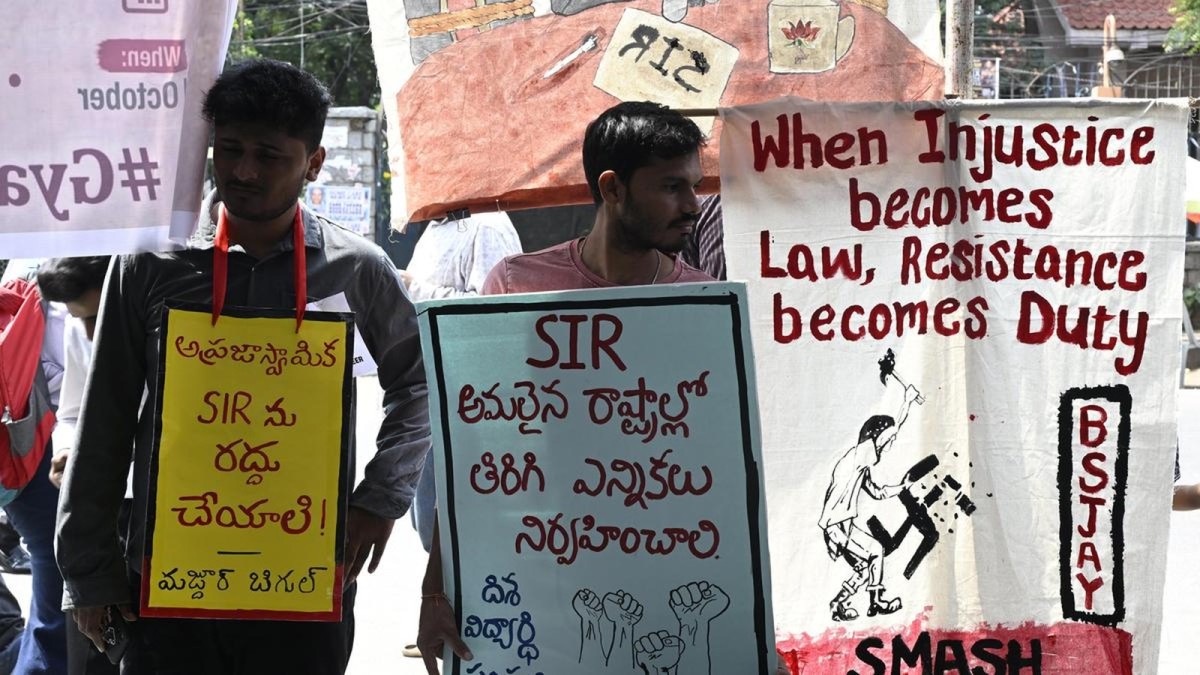
On Saturday, October 3, 2026, a crowd of roughly a hundred demonstrators gathered at Dharna Chowk in Indira Park, Hyderabad, to demand the resignation of Chief Election Commissioner (CEC) Gyanesh Kumar and to call for the immediate scrapping of the Special Intensive Revision (SIR) of electoral rolls. The protest, organised by a coalition of twelve groups—including the Telangana unit of the Cockroach Janta Party (CJP) and the Telangana People’s Front (TPF)—opened with a Hindi rendition of the Italian anti‑resistance anthem “Bella Ciao,” with participants dubbing the SIR “Special Intensive Resistance.” The gathering, though modest in size, reflected a broader national anxiety about the integrity of voter registration processes and the potential exclusion of millions of citizens from the franchise.
Background to the Special Intensive Revision
The Special Intensive Revision (SIR) is a nationwide exercise aimed at updating the electoral rolls ahead of upcoming elections. While the Election Commission presents the SIR as a mechanism to improve voter enrolment, protestors argue that it is being used to purge names from the rolls. Speakers at the Hyderabad rally alleged that the SIR functions as a “back‑door” version of the National Register of Citizens (NRC), linking it to concerns about database integration and identity verification that have already sparked public debate.
According to the demonstrators, the draft rolls released after the latest revision already show the exclusion of 13 crore names across states and Union Territories. M.V. Reddy, a member of the Telangana People’s Front, described this scale of deletion as unprecedented, noting that previous electoral revisions had never resulted in such a massive removal of voters. The protesters contend that the SIR’s methodology lacks transparency and disproportionately affects those without the resources to navigate the complex verification process.
Demands and Proposed Reforms
The protest articulated three core demands. First, the resignation of CEC Gyanesh Kumar, whom the demonstrators hold responsible for overseeing a process they deem undemocratic. Second, a reform of the appointment mechanism for the CEC, calling for a selection process that includes the Chief Justice of India (CJI) to ensure greater judicial oversight and independence. Third, the outright cancellation of the SIR exercise until a transparent, inclusive, and technically robust alternative can be devised.
These demands echo longstanding concerns about the Election Commission’s autonomy. Kancha Ilaiah, a Dalit rights activist and former political science professor at Osmania University, reminded the crowd of the Commission’s historical independence during the Emergency, citing the subsequent election of the Janata Party as evidence that a free electoral process can survive even under authoritarian pressure. Ilaiah’s remarks underscored the protest’s framing of the SIR not merely as a technical exercise but as a potential threat to democratic safeguards.
Linkage to Broader Civic Movements
The SIR protest drew parallels with other recent civic mobilisations. Sameer of the Students’ Federation of India (SFI) compared the current demonstration to the massive student protests that erupted over the NEET question‑paper leak, highlighting the capacity of Generation Z to galvanise public opinion through sustained pressure. Sunita Regunta of the National Alliance of People’s Movements noted that her organisation has been monitoring the SIR since its inception in Bihar, observing that the process appears to target vulnerable populations who lack the means to contest deletions.
These connections suggest a growing convergence of student, civil‑rights, and regional political groups around a shared narrative: that state‑driven data initiatives, when opaque, risk marginalising large sections of the electorate. The protest in Hyderabad therefore serves as a microcosm of a national debate about the balance between technological efficiency in voter management and the preservation of inclusive democratic participation.
Technical Concerns Over Database Integration
Cyber‑security activist Srinivas Kodali raised specific technical objections to the SIR’s methodology. He questioned the reliability of linking voter identities to Aadhaar, noting that the biometric database has not been uniformly created for every citizen. Kodali warned that such linkage could pave the way for an NRC‑style exercise, where the state uses integrated databases to determine citizenship status. This concern resonates with broader apprehensions about the centralisation of personal data and the potential for misuse in political contexts.
Kodali also highlighted the upcoming Census as a critical juncture. He argued that any movement against the SIR must persist beyond the resignation of the CEC, because the underlying issue—linking citizens’ lives and identities to expansive government databases—remains unresolved. The protest’s emphasis on data integrity thus intersects with ongoing policy discussions about privacy, data protection, and the role of technology in public administration.
Implications for Electoral Policy and Governance
If the SIR were to proceed unchecked, the exclusion of 13 crore names could have profound implications for electoral outcomes, particularly in tightly contested states. The removal of large voter segments may skew demographic representation, potentially advantaging parties that can mobilise alternative voter bases. Moreover, the perception of an opaque roll‑cleaning exercise could erode public confidence in the Election Commission, a body whose legitimacy rests on the fairness of its processes.
From a policy perspective, the protest underscores the need for a robust, multi‑stakeholder framework governing electoral roll revisions. Incorporating judicial oversight, as demanded by the demonstrators, could provide an additional check against arbitrary deletions. Likewise, establishing clear, publicly auditable criteria for name removal would align the SIR with principles of transparency and accountability that are central to India’s democratic architecture.
Potential Path Forward and Government Response
While the Hyderabad demonstration was relatively small, its symbolic weight lies in its articulation of a broader civil‑society critique. The coalition of twelve organisations, spanning regional parties, student bodies, and civil‑rights groups, signals a coordinated effort to pressure the Election Commission and the central government. The inclusion of former education commissioner Akunuri Murali reading the Constitution’s preamble at the protest further anchored the rally in constitutional values.
Going forward, the government’s response will likely hinge on balancing the technical imperatives of maintaining accurate electoral rolls with the political cost of perceived disenfranchisement. If the Election Commission adopts a more inclusive revision process—perhaps by integrating judicial participation in the CEC’s appointment and by providing clearer avenues for aggrieved voters to appeal deletions—it may defuse some of the protest’s momentum. Conversely, a hardline continuation of the SIR without addressing the raised concerns could fuel larger demonstrations, especially as Generation Z continues to demonstrate its capacity for rapid mobilisation.
This article was produced with AI-assisted research and editorial support. Reporting is based on the source material cited below. Sources: The Hindu; thehindu.com; Global1.News (04 October 2026).
By Dr. Raj Patel, Staff Writer
What's Your Reaction?
 Like
0
Like
0
 Dislike
0
Dislike
0
 Love
0
Love
0
 Funny
0
Funny
0
 Wow
0
Wow
0
 Sad
0
Sad
0
 Angry
0
Angry
0

India/South Asia Correspondent at Global1.News. Analytical voice with a background in science and health journalism. Based in New Delhi, covering Indian politics, education, healthcare, technology, and policy. Breaks down complex data into clear, actionable reporting.














Comments (0)