
Far-Right Israeli Lawmaker Smashes Palestinian Memorial Under Army Protection
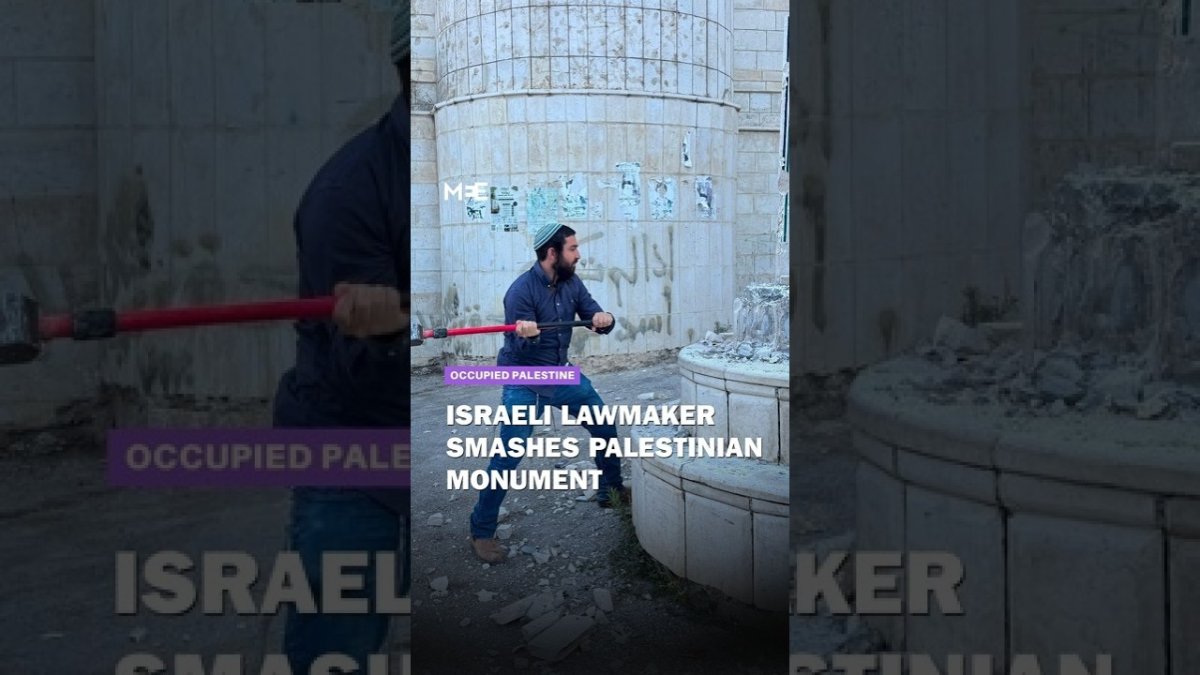
In a report released on Tuesday, Middle East Eye documented the moment far-right Israeli Knesset member Zvi Yedidia Sukkot swung a sledgehammer at a Palestinian memorial in the village of Madama, south of Nablus, while Israeli soldiers and border police stood nearby without intervening.
In a report released on Tuesday, Middle East Eye documented the moment far-right Israeli Knesset member Zvi Yedidia Sukkot swung a sledgehammer at a Palestinian memorial in the village of Madama, south of Nablus, while Israeli soldiers and border police stood nearby without intervening. The video, published 25 August 2026, shows the Religious Zionism party lawmaker — a settler from the nearby Yitzhar outpost — striking the stone monument that commemorates Palestinians killed over decades, as a military vehicle remained parked close by and a soldier stood visibly within arm's reach.
Far-Right MK Smashes Palestinian Memorial Under Army Watch
Madama, Occupied West Bank – 25 August 2026 — The destruction of the Martyrs' Monument in this small village south of Nablus was not a spontaneous act of vandalism. It was a carefully staged political performance, filmed by the perpetrator himself, carried out under the protection of Israeli forces, and defended afterward by the military's own framing of what constitutes "incitement" in the occupied West Bank.
The Video: A Monument Smashed Under Army Watch
The Middle East Eye footage captures Sukkot, 35, dressed in civilian clothes, raising a sledgehammer above his head and bringing it down repeatedly on the stone structure. Members of his staff accompanied him, recording the act. What makes the video particularly striking is not just the violence of the act itself, but the stillness of the soldiers around him. Witness footage shows Israeli troops watching without interrupting, a military vehicle parked close by, and at least one soldier standing near Sukkot as he continued his work.
Sukkot recorded his own video of the event, in which he said the monument honours "terrorists" responsible for the death of Jewish people and that he "must take it down." On social media, he elaborated: "Every child who sees a giant monument every day that glorifies Jewish murderers, dreams of being a terrorist." The monument in Madama, like many similar structures across the West Bank, commemorates Palestinians killed over decades of occupation — figures that include civilians, farmers, and children, as well as those who took up arms.
For the residents of Madama, the memorial is not an abstraction. It is a daily presence in their village, a place where families gather to remember loved ones lost. Its destruction, carried out in broad daylight with military approval implied by the soldiers' presence, sends a clear message about whose memory is permitted to exist in the occupied territories.

A Lawmaker With a History of Confrontation
Sukkot is not a fringe figure operating outside the political mainstream. He is a member of the Religious Zionism party, led by Finance Minister Bezalel Smotrich, who holds significant authority over civilian affairs in the West Bank. Before entering politics, Sukkot was arrested on allegations of firebombing a mosque. In 2024, he was among right-wing politicians who encouraged supporters to storm the Sde Teiman detention facility after nine IDF reservists were arrested over the alleged brutal rape of a Palestinian detainee.
His pattern of provocative actions has escalated in recent months. In July 2026, he tore down the sign of the Dar Al-Aytam School, an orphanage school in Jerusalem's Old City, and his office subsequently said it would seek the school's closure. Earlier in August 2026, Sukkot posted a video demanding the destruction of the Madama memorial and similar structures in other Palestinian villages. He also toured the villages of Madama and Burin, south of Nablus, apparently scouting locations for future actions.
This is not the behaviour of a rogue actor, but of a politician using his platform to push the boundaries of what is acceptable in the occupied territories — and testing how far the military will go to accommodate him. His position within Smotrich's party gives him institutional backing, even when his actions draw official condemnation.
The Army's Account — and What It Leaves Out
The Israeli military (IDF) responded to the incident with a statement that focused less on the vandalism itself and more on the misuse of its resources. The IDF said it had received an application for protection from Sukkot earlier in August for a tour of three West Bank villages. In its statement, the military accused the participants of acting "deceptively and manipulatively, without authorisation, departing entirely from the approved framework," and said soldiers reported the incident to commanders who ordered the activity stopped. The participants were quickly escorted out, the IDF said.
The military's criticism centred on the diversion of soldiers from operational missions "while the IDF is operating under significant operational strain." Notably, the IDF did not condemn the destruction of the monument itself. Instead, it said it "regularly dismantles symbols of incitement, subject to all required approvals and in coordination with the Civil Administration," calling such activities "an important component of the fight against terrorism and incitement to terrorism."
This framing is significant. The army's objection is not to the act of destroying Palestinian memorials, but to the fact that Sukkot did it without proper coordination. The military's statement effectively endorses the practice of dismantling what it deems "symbols of incitement" — a category that, in practice, includes memorials honouring Palestinians killed in the conflict. Sukkot, for his part, insisted the operation had been fully coordinated with military authorities, a claim the military disputed.
Prime Minister Benjamin Netanyahu condemned the incident, saying: "The IDF is the sovereign in Judea and Samaria and is responsible for implementing the decisions of the political echelon. Taking the law into its own hands, especially by public figures, is wrong and prevents the IDF from focusing on its missions against terrorism and incitement."
But the prime minister's statement, like the army's, carefully avoids addressing the underlying question: whether the destruction of Palestinian memorials is itself an act of incitement, and whether the military's routine dismantling of such structures constitutes a violation of international law.
Occupied Land, Contested Memory
The Madama monument is one of many across the West Bank that Palestinians have erected to honour those killed since the beginning of the occupation in 1967. These memorials serve multiple purposes: they are sites of mourning, places of collective memory, and markers of a presence that Israeli authorities often seek to erase. The International Court of Justice, in its 2024 advisory opinion, deemed Israel's occupation of the West Bank unlawful — a ruling that has not changed the reality on the ground but has provided legal grounding for Palestinian claims that such actions constitute violations of international humanitarian law.
The destruction of memorials is part of a broader pattern of erasure that Palestinians have documented for decades. In villages across the West Bank, olive groves are uprooted, homes are demolished, and now, monuments are being smashed. Each act of erasure is designed to assert control over the land and its narrative. When a sitting Knesset member can destroy a memorial under military protection, the message is clear: Palestinian memory itself is considered a threat.
For the people of Madama, the monument was not merely a structure of stone. It was a testament to their history, a place where the names of the dead are spoken aloud, where families gather on anniversaries and holidays. Its destruction is a wound that will not heal quickly, particularly when the perpetrators face no meaningful consequences.
Local Tensions in Madama and Beyond
The incident comes at a time of heightened tension in the area around Madama. In recent weeks, a deadly shooting in the nearby village of Tell killed two Israeli settlers and four Palestinians. The two communities offer sharply divergent accounts of what happened: Israelis accused the Palestinians of turning on them, while Palestinians said the settlers were armed and aggressive. The shooting has left the region on edge, with settlers and villagers alike bracing for further violence.
In this volatile context, Sukkot's actions in Madama are more than provocation — they are a deliberate attempt to inflame tensions. By choosing to destroy the monument now, in the aftermath of the Tell shooting, he is exploiting a moment of grief and anger to advance a political agenda. The fact that he did so with military protection, even if the army claims it was not aware of his intentions, will be read by Palestinians as further evidence that the occupation operates with impunity.
Local residents in Madama expressed shock and anger at the incident, though figures on the damage were not immediately available. The village, like many in the Nablus area, has lived under the shadow of nearby settlements, including Yitzhar, where Sukkot resides. The relationship between the settlement and the surrounding villages has long been marked by tension, with settlers frequently accused of attacking Palestinian farmers and property.
Analysis and Implications
The Madama incident reveals the contradictions at the heart of Israel's policy in the occupied West Bank. On one hand, the military and the prime minister publicly distance themselves from Sukkot's actions, calling them unauthorised and wrong. On the other hand, the military itself routinely dismantles what it calls "symbols of incitement" — a category that Palestinians say is applied arbitrarily to erase their presence and history.
Sukkot's position within Smotrich's party, and Smotrich's own authority over civilian affairs in the West Bank, complicates the picture further. The finance minister has long advocated for greater settlement expansion and tighter control over Palestinian life in the territories. While Netanyahu condemned the specific incident, he did not address the broader policy context that makes such actions possible — nor did he suggest any consequences for Sukkot.
The incident also raises questions about the military's role in protecting politicians who engage in provocative actions. The IDF's statement acknowledged that soldiers were diverted from operational missions to protect Sukkot's tour, and that the participants acted "deceptively." But the fact that a Knesset member could secure military protection for a tour of Palestinian villages, and then use that protection to destroy property, suggests a systemic failure that goes beyond one individual's actions.
For Palestinians, the message is unmistakable: their memorials, their history, and their presence are under threat, and the institutions that are supposed to maintain order are either unwilling or unable to protect them. The International Court of Justice's 2024 advisory opinion declaring the occupation unlawful has not translated into changed behaviour on the ground. Instead, incidents like this one demonstrate the widening gap between international law and the reality of daily life under occupation.
As the sun set over Madama on Tuesday, residents gathered near the damaged monument, assessing the destruction and beginning to plan their response. Some spoke of rebuilding, of erecting a new memorial that would be even more prominent. Others expressed exhaustion, wondering how many times they would have to rebuild what has been destroyed. The monument will likely be repaired, but the deeper damage — to trust, to security, to the sense that their presence is recognised and respected — will take far longer to heal.
In the coming weeks, the focus will shift to whether any action is taken against Sukkot, and whether the military's policy of dismantling Palestinian memorials will continue. For the people of Madama, the question is simpler: will they be allowed to remember their dead in peace, or will every act of memory be met with a sledgehammer?
By Fatima Al-Rashid, Staff Writer
This article was produced with AI-assisted research and editorial support. Reporting is based on sources cited in the article.
What's Your Reaction?
 Like
0
Like
0
 Dislike
0
Dislike
0
 Love
0
Love
0
 Funny
0
Funny
0
 Wow
0
Wow
0
 Sad
0
Sad
0
 Angry
0
Angry
0

Gulf/MENA Correspondent at Global1.News. Based in Doha, covering Gulf politics, energy markets, diplomacy, and development across the Middle East and North Africa. Tracks the economic transformation of the Gulf states.













Comments (0)