
Erdogan and Saudi Crown Prince Discuss Gaza Peace Plan Adherence
Turkish President Recep Tayyip Erdogan spoke by phone with Saudi Crown Prince Mohammed bin Salman on August 3, 2026. The call addressed Turkey-Saudi Arabia relations alongside regional and global developments, according to Turkey's Communications Directorate.
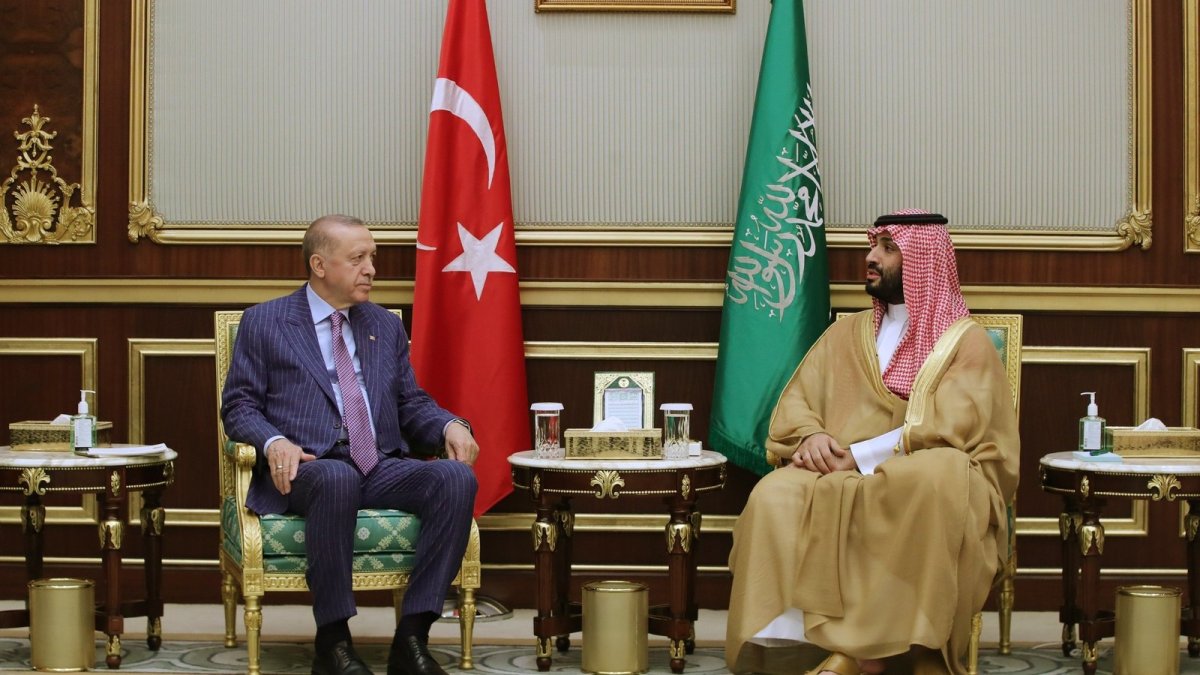
The Erdogan-MBS Phone Conversation
Turkish President Recep Tayyip Erdogan spoke by phone with Saudi Crown Prince Mohammed bin Salman on August 3, 2026. The call addressed Turkey-Saudi Arabia relations alongside regional and global developments, according to Turkey's Communications Directorate. The leaders reviewed ongoing cooperation and exchanged views on current events in the Middle East.
Erdogan expressed sorrow over recent attacks targeting Saudi Arabia and reaffirmed Turkey's commitment to lasting peace and stability. The conversation occurred against the backdrop of the Gaza Peace Plan's second phase, which focuses on demilitarization, technocratic governance, and reconstruction.
Turkey and Saudi Arabia functioned as regional rivals throughout much of the 2010s, clashing over the Qatar blockade, the Khashoggi crisis, and disputes involving the Muslim Brotherhood. A reconciliation process that began in 2021 has since transformed the relationship, allowing Erdogan and MBS to build personal rapport and coordinate on shared priorities. This August 3 call reflects that matured alignment, with both leaders now treating Gaza governance as a platform for joint influence rather than a source of friction.
Emphasis on Israel's Compliance with Phase Two
During the call, Erdogan stressed that Israel's full adherence to the roadmap for the second phase of the Gaza Peace Plan remains essential for the initiative's success. He noted that Turkey continues to monitor implementation closely and supports efforts to secure a lasting ceasefire. The plan, announced in September 2025 under US President Donald Trump, includes hostage returns, prisoner exchanges, and deployment of the International Stabilization Force.
Phase one concluded with the release of 20 living hostages in October 2025 in exchange for 2,000 Palestinian prisoners. Phase two began in January 2026 with the formation of the National Committee for the Administration of Gaza, yet progress on disarmament has stalled.
Saudi Arabia has repeatedly conditioned any normalization with Israel on a credible path toward Palestinian statehood, which elevates the stakes of phase two for Riyadh. Recent US-Iran strikes and attacks on US facilities in Jordan have prompted Gulf states to prioritize de-escalation, making steady progress on the Gaza track a strategic necessity for Saudi security. Riyadh therefore views Israeli compliance not only as a humanitarian requirement but as a safeguard against broader regional spillover that could threaten Vision 2030 projects.
Turkey-Saudi Diplomatic Alignment
The call signals growing coordination between Ankara and Riyadh on Middle East issues. Both countries participate in the Board of Peace, established in January 2026 and chaired by Trump, with 18 founding nations including Egypt, Qatar, the UAE, Indonesia, and Pakistan. Turkish and Saudi officials seek to shape transitional governance in Gaza while advancing their own economic diversification goals.
Saudi Arabia aims to protect its energy infrastructure and maintain stability for Vision 2030 projects. Turkey seeks expanded influence through the Board of Peace and the International Stabilization Force, leveraging its position in Sunni geopolitical competition.
The Board of Peace, whose charter was ratified at Davos on January 22, 2026, includes Turkish and Qatari representatives—an arrangement that initially drew Israeli objections before those concerns were addressed in January. The International Stabilization Force operates under UN Security Council Resolution 2803, adopted November 17, 2025, with a two-year mandate. Joint Turkish-Saudi engagement inside these structures allows both capitals to steer reconstruction funding and security arrangements without ceding ground to Iranian-backed networks.
Challenges Facing the Gaza Peace Plan
Implementation of phase two remains uneven. Israeli forces killed at least 19 Palestinians in Gaza on August 2, 2026, bringing the post-ceasefire total to 1,222 killed and 4,053 injured. Gaza health authorities reported 152 deaths in July alone. Hamas rejected a March 2026 disarmament plan presented by the Board of Peace, describing the demands as unacceptable.
Israeli officials have stated they will not advance without verifiable Hamas disarmament. The Board of Peace and the International Stabilization Force announced an agreement on July 31, 2026, yet Palestinians describe the truce as an illusion due to continued strikes and aid restrictions.
Hamas resigned its civil administration on July 6, 2026, leaving a governance vacuum that has intensified the disarmament deadlock. From the Palestinian perspective, the 1,222 deaths since the October 2025 ceasefire, including 152 in July alone, combined with persistent aid restrictions, have eroded trust in the process. These realities complicate the technocratic governance model envisioned for phase two and raise questions about whether local institutions can absorb reconstruction aid without renewed political contestation.
Additional Diplomatic Channels
On the same day, Turkish Foreign Minister Hakan Fidan held his first call with newly appointed British Foreign Secretary Ed Miliband. The ministers discussed Gaza, the wider Middle East, and the Russia-Ukraine war. Fidan congratulated Miliband on his appointment and exchanged views on efforts to end regional conflicts.
These parallel conversations illustrate Turkey's active diplomatic outreach to both Gulf partners and European actors as the Gaza plan enters its critical second stage.
Fidan's outreach to London complements the Erdogan-MBS discussion by broadening the coalition of states invested in phase-two enforcement. European involvement could supply technical expertise for reconstruction monitoring and help offset US domestic political volatility, thereby giving the Board of Peace additional diplomatic ballast at a moment when implementation momentum has slowed.
Strategic Calculations of Key Actors
Turkey wants a seat at the table in Gaza governance and reconstruction to counterbalance Iranian influence and strengthen Sunni coordination. Saudi Arabia seeks to prevent further attacks on its territory while positioning itself as a constructive partner in US-led initiatives. Israel aims to maintain security control without full withdrawal until Hamas disarms, using leverage from its military operations.
The United States under Trump pushes for rapid demilitarization and technocratic rule, threatening consequences if Hamas fails to comply. Hamas seeks to retain influence through its civil structures while rejecting outright disarmament. Second-order effects include potential strain on Abraham Accords normalization if civilian casualties continue and renewed opportunities for Iran to exploit regional divisions.
Turkey's desire to limit Iranian proxy expansion dovetails with Saudi caution following recent cross-border threats. Both governments calculate that successful phase-two delivery would reduce Tehran's ability to portray itself as the sole defender of Palestinian rights. Conversely, prolonged deadlock risks allowing Iran to reinsert influence through Gaza's fragmented political landscape.
Regional Implications
The Erdogan-MBS exchange underscores a pragmatic alignment between Turkey and Saudi Arabia that could reshape Sunni coordination on Palestinian issues. Successful phase-two implementation would facilitate reconstruction funded by Gulf states and supervised by the Board of Peace, yet persistent Israeli strikes risk undermining the entire framework.
Failure to advance could draw in additional actors, including Egypt and Qatar, while affecting energy markets through heightened Gulf tensions. Broader stability hinges on whether the International Stabilization Force can enforce disarmament commitments without triggering renewed escalation involving Iran and its proxies.
Continued civilian casualties could also pressure Abraham Accords signatories to reassess the pace of normalization, particularly if Riyadh withholds further steps absent tangible statehood progress. Energy markets remain sensitive to any widening of Gulf insecurity, as OPEC+ producers weigh production decisions against the risk of renewed conflict that might disrupt shipping lanes and investor confidence in diversification projects.
By Malik Hassan, Staff WriterThis article was produced with AI-assisted research and editorial support. Reporting is based on sources cited in the article.
What's Your Reaction?
 Like
0
Like
0
 Dislike
0
Dislike
0
 Love
0
Love
0
 Funny
0
Funny
0
 Wow
0
Wow
0
 Sad
0
Sad
0
 Angry
0
Angry
0

Middle East Correspondent at Global1.News. Based in Beirut, covering politics, conflict, energy, and society across the Middle East. Brings context and depth to a region often reduced to headlines.









Comments (0)