
Communist Party Leader in Komi Republic Arrested for ‘Justifying Terrorism’
Former State Duma deputy Oleg Mikhailov, the long‑time head of the Communist Party in the Komi Republic, was taken into custody at a Moscow airport on Thursday, according to the regional party’s official VKontakte statement.
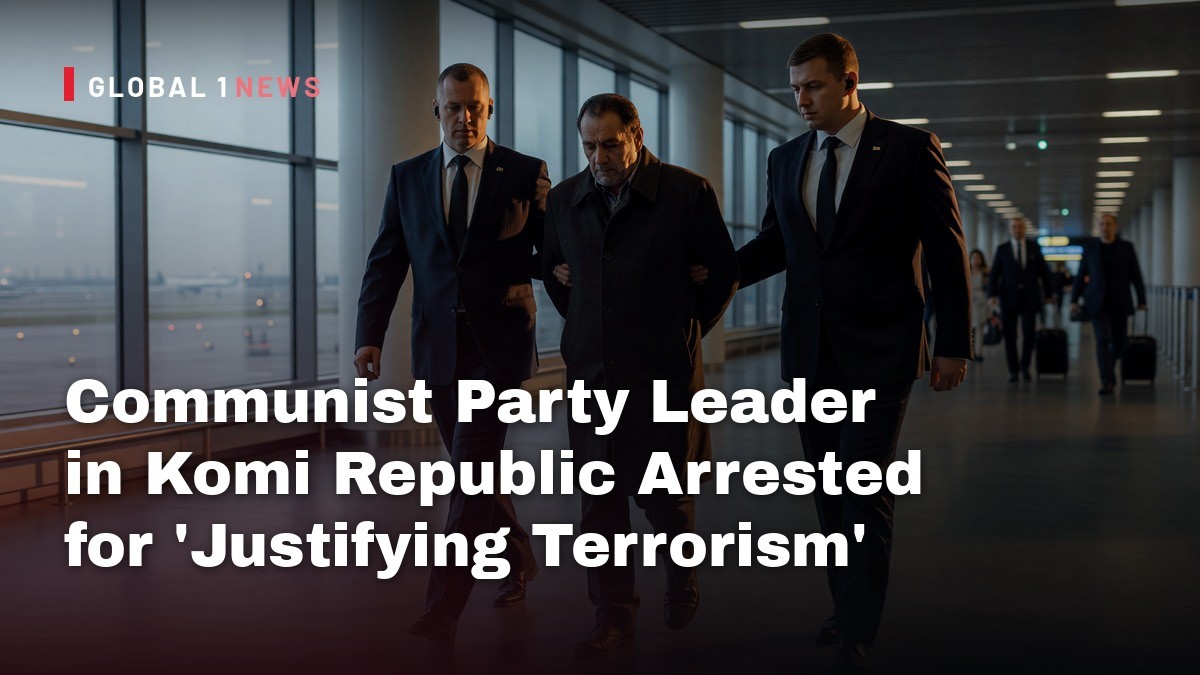
Former State Duma deputy Oleg Mikhailov, the long‑time head of the Communist Party in the Komi Republic, was taken into custody at a Moscow airport on Thursday, according to the regional party’s official VKontakte statement. The arrest, announced on 22 October 2026, adds to a growing pattern of prosecutions targeting Communist officials and opposition figures on charges of “justifying terrorism” or “extremism.”
Background on Mikhailov’s political career
Oleg Mikhailov has led the Komi branch of the Communist Party since 2014, a tenure that saw him rise from regional organizer to national legislator. He served as a State Duma member from 2021 until September 2026, when he lost his seat in the most recent parliamentary elections to a United Russia candidate. His defeat marked the end of a five‑year stint in the federal legislature and coincided with an increasingly hostile environment for opposition politicians.
During his time in the Duma, Mikhailov was known for vocal criticism of the Kremlin’s handling of regional development and for defending the rights of workers in the resource‑rich north. His profile, however, made him a target for authorities seeking to curtail dissent, especially as the Communist Party’s regional branches have become more assertive in confronting United Russia’s dominance.
The charges and their legal basis
Law enforcement officials have charged Mikhailov with “publicly justifying terrorism,” a serious accusation that carries a potential prison term of up to seven years if he is convicted. The charge stems from a series of older social‑media posts in which Mikhailov allegedly expressed support for jailed sociologist Boris Kagarlitsky and left‑wing activist Sergei Udaltsov. Both figures have been designated as extremist or terrorist sympathizers by Russian authorities, making any public endorsement a prosecutable offense under the current legal framework.
According to the party’s statement, the case will be heard by a judge on Thursday, who will decide whether to place Mikhailov in pre‑trial detention. The prosecution’s reliance on historical online activity mirrors a broader trend of retroactive investigations, where authorities revisit past statements to construct charges that align with current political objectives.
Political context: accusations of revenge
The Komi Communist Party framed the arrest as retaliation by regional authorities, specifically naming Rostislav Goldshtein, the head of the Komi administration, and United Russia. In its VKontakte post, the party asserted that the charges represent “revenge by Goldshtein and United Russia.” This accusation reflects a perception among opposition circles that the Kremlin is using the legal system to punish political adversaries who challenge its hegemony, especially after electoral defeats.
Goldshtein, as the regional governor, has overseen a series of initiatives aimed at consolidating United Russia’s control over local institutions. The timing of Mikhailov’s arrest—shortly after his loss in the parliamentary race—suggests a possible link between electoral outcomes and subsequent legal actions, a pattern observed in other recent cases involving opposition figures.
Parallel cases: a wave of prosecutions
Mikhailov’s detention follows the August arrest of Nikolai Bondarenko, a well‑known Communist firebrand from the Saratov region. Bondarenko faced “extremism” charges over an old social‑media post that featured a photograph of the late opposition activist Alexei Navalny. Both cases illustrate a coordinated approach by law‑enforcement agencies to target Communist activists on the basis of historical online content, effectively weaponizing the “justifying terrorism” and “extremism” statutes.
The similarity between the two cases underscores a broader strategy: to suppress dissent by criminalizing past expressions of solidarity with opposition figures. By linking Communist Party members to individuals already labeled as extremist, authorities create a legal pretext to remove them from public life and deter others from similar activism.
Implications for the Communist Party’s regional structures
The arrests of Mikhailov and Bondarenko send a clear signal to regional Communist branches that alignment with United Russia’s narrative is now a prerequisite for political survival. The party’s central leadership, which has historically maintained a delicate balance between opposition and cooperation with the Kremlin, may face internal pressure to distance itself from outspoken regional leaders.
If the prosecutions succeed, they could lead to a chilling effect across the party’s grassroots network, discouraging local officials from publicly supporting controversial figures or challenging United Russia’s policies. This dynamic risks weakening the Communist Party’s capacity to act as a genuine opposition force, reducing it to a controlled “systemic opposition” that merely legitimizes the regime’s electoral façade.
The role of independent media and the “undesirable” label
The Moscow Times, which reported on Mikhailov’s arrest, has recently been designated an “undesirable” organization by the Prosecutor General’s Office, a status that criminalizes its operations and threatens its staff with prosecution. The outlet’s statement highlights the broader crackdown on independent journalism, noting that the “undesirable” label follows an earlier “foreign agent” designation.
These designations are part of a systematic effort to silence reporting that contradicts official narratives. By branding independent outlets as threats to state security, the Kremlin can justify legal action against journalists while simultaneously framing the crackdown as a defense of national interests. The Moscow Times’ experience illustrates the heightened risk for media entities that continue to document and analyze politically sensitive cases such as Mikhailov’s.
Potential outcomes and future trajectories
If the court decides to place Mikhailov in pre‑trial detention, he could remain incarcerated for an extended period while the case proceeds, given the severity of the charge. A conviction could result in a prison term of up to seven years, effectively removing a senior Communist figure from the political arena and serving as a deterrent to other regional leaders.
Beyond the immediate legal ramifications, the case may influence upcoming regional elections and the Kremlin’s broader strategy toward managed opposition. Should the authorities succeed in neutralizing Mikhailov and similar figures, United Russia may consolidate its dominance in the North, while the Communist Party could be forced to adopt a more conciliatory stance. Conversely, a legal defeat for the prosecution—if the court finds the evidence insufficient—could embolden opposition activists and expose the limits of the state’s repressive apparatus.
In any scenario, the arrest underscores the Kremlin’s reliance on the legal system as a tool of political control, a trend that has accelerated since the early 2020s. Observers will be watching the Thursday hearing closely, as its outcome may set a precedent for how far authorities are willing to push the “justifying terrorism” statute against political opponents.
This article was produced with AI-assisted research and editorial support. Reporting is based on the source material cited below. Sources: The Moscow Times; themoscowtimes.com; Global1.News (25 October 2026).
By Irina Volkov, Staff Writer
What's Your Reaction?
 Like
0
 Dislike
0
 Love
0
 Funny
0
 Wow
0
 Sad
0
 Angry
0
Russia/Eastern Europe Correspondent at Global1.News. Covering Russian politics, energy, security, and the shifting dynamics of the post-Soviet space. Provides clear-eyed analysis on one of the world's most opaque regions.












Comments (0)