
Clayrocksu's Street Valentine Movement: Nigerian Rock Star Brings Love to Lagos Streets
In the relentless hustle of Lagos — a city of more than 20 million where love can easily get lost in the daily grind — musician Bianca "Clayrocksu" Okorocha has carved out a different kind of stage: the pavement itself.
In the relentless hustle of Lagos — a city of more than 20 million where love can easily get lost in the daily grind — musician Bianca "Clayrocksu" Okorocha has carved out a different kind of stage: the pavement itself. Armed with romance, a rock singer's voice, and single-stem roses, she turned busy streets into scenes of unexpected joy, serenading startled commuters and reminding a city in motion to pause, feel, and connect. The gesture, rooted in Nigeria's growing Afro-rock movement, became one of the continent's most heart-warming music moments of the year.
Clayrocksu's Street Valentine Movement: Nigerian Rock Star Brings Love to Lagos Streets
Lagos, Nigeria — In February, the self-described "Goddessa" of Nigerian rock took her mission beyond the stage, transforming rush-hour corners into intimate concert spaces where strangers received love songs and roses. What began as a simple act of kindness has grown into a symbol of how music can soften even the hardest city rhythms — and how a rock scene long overshadowed by Afrobeats is finding its voice.
A Stage Made of Pavement: Love in the Lagos Hustle
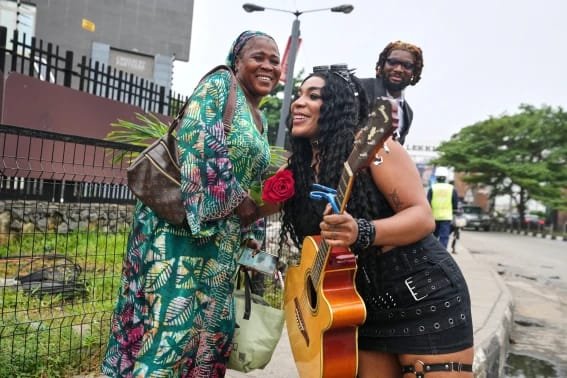
The Street Valentine Movement took shape when Bianca "Clayrocksu" Okorocha and her partner Daniel Onyemachi-Chiweolu, known as Machigold, stepped onto Lagos streets on Tuesday, February 10, 2026, carrying single-stem roses and ready voices. They chose busy intersections where commuters hurried past danfo buses and okada motorcycles, turning ordinary pavement into an impromptu stage for surprise serenades.
Clayrocksu told The Associated Press that the idea came naturally: "I'm a musician, and we just thought it was a special and nice thing to do for people." She and Machigold approached strangers without warning, offering a rose and a short love song before moving on to the next corner in the city's relentless flow.
She explained the deeper purpose behind the gesture, saying she wanted to "do something to uplift people and put smiles on their faces" at a time when difficult news dominates headlines across Nigeria. The performances stood out against the backdrop of Lagos traffic, where horns and exhaust fumes usually drown out quieter human moments.
In a city of over 20 million residents, daily routines leave little space for romance or unexpected kindness. Clayrocksu and Machigold deliberately chose rush-hour spots to interrupt that grind, creating brief islands of connection amid the chaos of markets and motorways.
The movement's name captured its spirit of taking Valentine's gestures directly to the public rather than confining them to restaurants or private homes. Each rose and song served as a small reminder that music belongs on the streets as much as on festival stages.
Clayrocksu: The Goddessa of Nigerian Rock
Bianca "Clayrocksu" Okorocha stands as Nigeria's award-winning rock star who proudly calls herself a non-conformist "Goddessa." Her stage presence blends raw rock energy with local rhythms, creating a sound that refuses to fit neatly into any single category.
She fuses rock with Afrobeats and African rhythms to form Afro-rock, singing in English, Igbo and Pidgin to reach listeners across different communities. This multilingual approach lets her lyrics land directly with audiences in Lagos markets and beyond.
Her EP "Hate It Here" features the track "The One" with Johnny Drille, showcasing her ability to merge rock structures with Nigerian vocal traditions. She also released a rock reinterpretation of Ayra Starr's "Hot Body," transforming the original into a heavier, guitar-driven statement.
Clayrocksu joined the Recording Academy's 2025 New Member Class, earning the right to vote in the Grammys and bringing Nigerian rock perspectives into global music conversations. Her inclusion signals growing recognition for alternative sounds from the continent.
The Guardian in the UK featured her discussing rock music, faith and the experiences of misfits in Nigeria, highlighting how her work challenges expectations placed on female artists in the industry. These conversations position her as both performer and cultural voice.
Beyond her recorded work, Clayrocksu champions the live circuit, organizing and promoting shows that keep Lagos rock visible. As part of the Afrorockstars collective, she has become a mentor figure in a scene she describes as a family of misfits, regularly sharing videos of emerging bands and urging fans to support live performances. Her activism for the genre echoes the way Senegalese icons like Youssou N'Dour built platforms for younger mbalax artists — creating space for the next generation to experiment and grow.
From Shock to Smiles: The Encounters That Mattered
The encounters unfolded spontaneously as Clayrocksu and Machigold approached people mid-stride. Recipients often froze at the sight of a stranger launching into a love song, only to break into broad smiles once the rose changed hands.
Barbara Lulu was caught off guard during one performance, exclaiming "I never expected it... All I can say is yay!" Her reaction captured the surprise element that defined the Street Valentine Movement across multiple Lagos locations.
Olufemi Oyeyemi described feeling "special" and "blessed" after receiving a rose and song. The moment stood out because it interrupted his usual commute through crowded streets where personal interactions rarely happen.
The gesture remained inclusive throughout, with roses given to both men and women without distinction. Clayrocksu emphasized that love knows no gender, allowing the movement to reach a wider cross-section of commuters than traditional Valentine's events.
These soft moments contrasted sharply with the surrounding Lagos traffic chaos of honking vehicles and hurried pedestrians. Each brief performance created a pocket of calm where human connection took precedence over the city's usual pace.
Love Beyond Romance: A Message for the Whole City
Clayrocksu believes "Valentine is really just about sharing love—to the less privileged, to people around you." This view guided the Street Valentine Movement to focus on public acts rather than couple-only celebrations.
The performances challenged the common notion that Valentine's Day belongs exclusively to romantic partners. By including strangers from all walks of life, the movement expanded the holiday into a broader expression of community care.
Economic pressures facing Nigeria make such acts of kindness especially meaningful. In a climate of rising costs and daily uncertainties, the simple gift of a song and rose offered emotional relief that resonated beyond the moment itself.
African artists increasingly use public spaces for cultural expression, and Clayrocksu's street work fits this pattern. The viral spread of videos from the performances drew international media attention, including coverage from The Associated Press and an africanews report by Dominic Wabwireh.
The movement's reach extended through social media clips that showed commuters pausing amid their routines. This visibility helped highlight how small gestures can ripple outward in a city as large as Lagos.
The Lagos Rock Scene: A Legacy Reborn
Lagos holds a rich rock legacy dating back to the 1960s and 1970s. Bands like Ofege, made up of 16-year-old high school students, recorded a psychedelic afro-funk rock album in 1973 that still influences today's players.
Historic groups such as BLO and The Hykkers performed at venues like Crystal Gardens, building an early foundation for rock in Nigeria. These performances laid groundwork that current artists continue to build upon despite shifting musical trends.
The contemporary scene blends rock, metal and funk with West African rhythms through collectives like Afrorockstars. This mixing creates fresh sounds that honor older traditions while speaking to new generations.
The May 23, 2026 "Danfo on the Beach" event showcased rock performances at a Lagos beach, drawing crowds to experience live sets in an open setting. Such gatherings keep the DIY spirit alive amid larger commercial music events.
Other Lagos rock artists including LoveSick, DrunkGiantBird and Jvngleage contribute to this growing community. Their work keeps rock as a passionate, independent space even as Afrobeats dominates mainstream airwaves and charts.
The rediscovery of Nigeria's rock pioneers continues today, as fans and archivists unearth recordings by Ofege, BLO and other 1970s outfits that were never widely documented. Their psychedelic experiments, recorded by teenagers with little studio infrastructure, have become touchstones for a new generation of musicians seeking roots beyond Afrobeats. This lineage gives today's Afro-rock movement a sense of continuity — proof that rock in Nigeria is not an import but a homegrown tradition reborn.
What to Watch For: Rock's Rising Tide in West Africa
The forward momentum of African rock continues through artists like Clayrocksu who promote live performances across the region. She often states that "everything is in Lagos," pointing to the thriving rock undercurrent that persists beneath more visible genres.
International press coverage of African alternative music has increased in recent months, bringing wider attention to sounds that once stayed local. This visibility helps connect Nigerian rock with audiences in Europe and beyond.
Senegal's own music scene offers a parallel example of genre diversity, from Youssou N'Dour's mbalax to the annual Saint-Louis Jazz Festival that draws performers from across West Africa. These events demonstrate how the continent supports multiple musical paths simultaneously.
African artists are crossing genres and claiming global space with increasing confidence. Clayrocksu's work with the Recording Academy and international features shows one path for this expansion.
Fans can expect the Street Valentine Movement to continue alongside new releases from the Afro-rock community. The combination of street-level connection and recorded work keeps the scene grounded while reaching outward.
The lesson for African creatives is one of genre fluidity: artists no longer need to choose between global sounds and local identity. Clayrocksu's journey from Lagos streets to Grammy voting membership shows that boundary-pushing pays off, and her Street Valentine Movement proves that music's most powerful moments often happen far from festival stages. As the Afro-rock community grows, audiences across the continent can expect more of this fearless experimentation.
By Amara Diop, Staff Writer
This article was produced with AI-assisted research and editorial support. Reporting is based on sources cited in the article.
What's Your Reaction?
 Like
0
Like
0
 Dislike
0
Dislike
0
 Love
0
Love
0
 Funny
0
Funny
0
 Wow
0
Wow
0
 Sad
0
Sad
0
 Angry
0
Angry
0

West Africa/Sahel Correspondent at Global1.News. Dakar-based journalist covering politics, security, climate, and development across Francophone and Anglophone West Africa. Tells the stories of a region undergoing profound transformation.












Comments (0)