
Mistral AI Releases Timestral: A 209M Forecasting Model Family That Outperforms Google’s TimesFM-3
Mistral AI just dropped Timestral, a family of four time‑series foundation models that promise zero‑shot forecasting on a standard server CPU. That’s a concrete latency figure you can plug into capacity planning, not a vague “fast enough” claim.
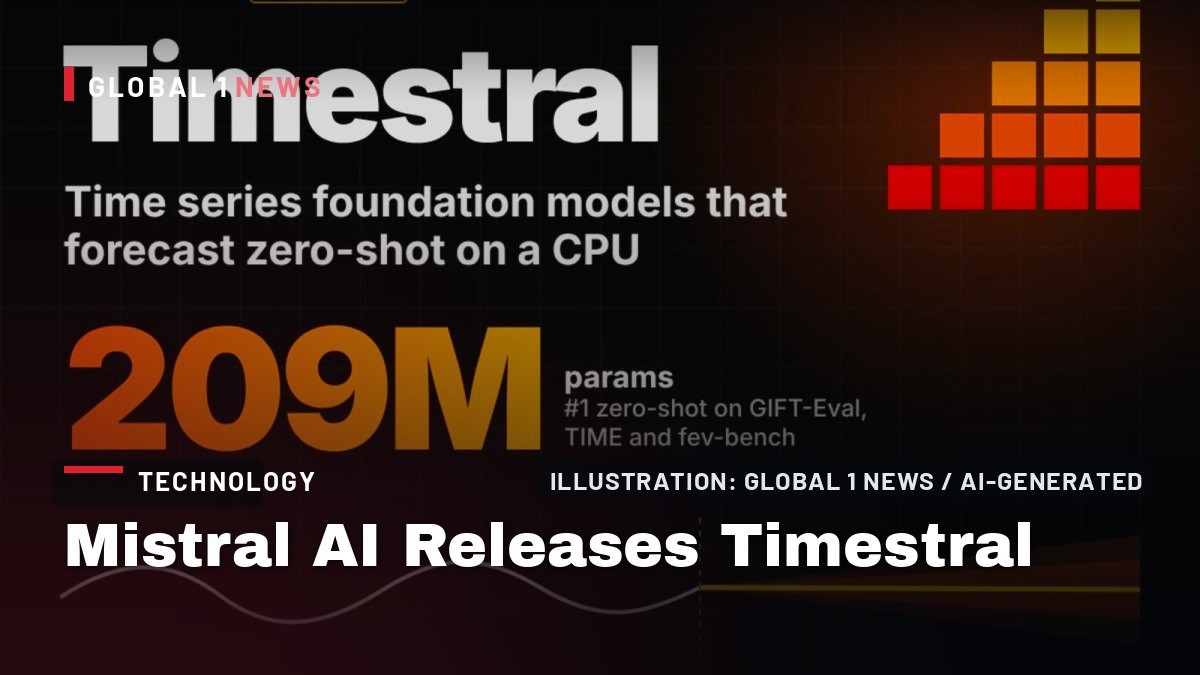
Mistral AI just dropped Timestral, a family of four time‑series foundation models that promise zero‑shot forecasting on a standard server CPU. As a founder who has spent a decade wrestling with production workloads, I’m instantly skeptical of any hype that claims “state‑of‑the‑art” without showing the cost side. The good news here is that the largest model, a 209‑million‑parameter checkpoint, actually runs on an 8‑thread CPU in about 140 ms for a one‑day‑ahead forecast from three weeks of 15‑minute data. That’s a concrete latency figure you can plug into capacity planning, not a vague “fast enough” claim.
What Timestral Is and Why It Matters
Timestral is positioned as a time‑series foundation model (TSFM). Unlike classical ARIMA, which fits one series at a time, or deep models like PatchTST that need to be trained from scratch on each dataset, Timestral is pretrained on a massive, synthetic‑plus‑real corpus and then applied zero‑shot to any new series. The model outputs 21 quantiles per step, handles multivariate targets jointly, and accepts past‑only, known‑future, and categorical covariates. For an independent hosting provider, that means you can offer probabilistic forecasts as a service without the overhead of per‑customer model training.
The architecture is a causal, patch‑based transformer with time attention and variate attention. The 209M version uses 24 layers, an embedding dimension of 768, and patches of 32 time steps. A single forward pass can forecast up to 1,024 steps, and longer horizons are handled block‑by‑block, feeding each block’s median back as context. Those design choices keep the compute graph shallow enough for CPU inference while still capturing cross‑series dependencies.
Benchmark Performance – The Numbers
All performance figures are zero‑shot, from a single checkpoint with no ensembling. On the GIFT‑Eval benchmark Timestral‑209M posts a MASE of 0.658 and a CRPS of 0.446, edging out the next best model by a hair. On the TIME benchmark it records a MASE of 0.626 and a CRPS of 0.522. The fev‑bench SQL skill score lands at 50.39, beating Google’s TimesFM‑3 (48.99) and Chronos‑2 (47.28). The gap between the 209M and the 123M model is negligible – the 123M scores 0.659 MASE on GIFT‑Eval, just 0.001 higher, while delivering roughly three‑quarters of the latency.
The 28M model is noteworthy because Mistral claims it beats Chronos‑2 on both GIFT‑Eval and TIME, despite Chronos‑2 being about four times larger. That tells us the scaling curve flattens at the top; you don’t need a 2.5‑billion‑parameter beast to get competitive accuracy, which is a relief for anyone watching hyperscaler price tags.
CPU‑Only Inference – A Real‑World Cost Saver
The latency tests on a standard 8‑thread CPU are the most practical metric for us. The 5M model delivers a forecast in 10 ms, the 28M model is five times faster than the 209M, and the 123M model hits within 0.2 % of the top score at three‑quarters of the latency. In a production environment where you might be serving thousands of forecasts per minute, those numbers translate directly into hardware cost. You can run Timestral on existing x86 servers without adding GPUs, which sidesteps the premium pricing and power draw that come with NVIDIA’s latest cards.
For a hosting provider with a fleet of standard CPUs, the 140 ms latency of the 209M model means you can comfortably handle dozens of concurrent forecasts per core. Scale out with more cores or nodes, and you have a predictable, linear cost model – something you rarely see with the “GPU‑only” roadmaps of many AI startups.
Licensing and Deployment Flexibility
Timestral’s weights are released under a Modified MIT licence, which is far less restrictive than the non‑commercial licence Google applied to TimesFM‑3. That means you can embed the model in a commercial SaaS offering without worrying about downstream licensing cliffs. The code and weights are hosted on Hugging Face, with download sizes of 21 MB for the 5M model, 111 MB for the 28M, and 490 MB for the 123M. The 209M checkpoint is 837 MB in fp32, a size that fits comfortably on a typical SSD.
Installation is a simple pip command pointing to the GitHub repo, and the package requires Python 3.10+ and torch 2.4+. Dependencies are limited to PyTorch, NumPy, safetensors, and huggingface_hub – all staples in any ML stack. Mistral also offers a “Forge” fine‑tuning pipeline for proprietary data, and the whole stack can be deployed on‑prem, in a VPC, or even in an air‑gapped environment. That level of deployment flexibility is rare among the big‑cloud players who push you into their managed services.
Business‑Risk Implications for Independent Providers
From a risk perspective, Timestral reduces two major pain points: compute cost and vendor lock‑in. By delivering competitive accuracy on CPU‑only hardware, you avoid the capital expense spikes tied to GPU upgrades. The open‑weight licence eliminates the legal risk of inadvertently violating a non‑commercial clause, which can be a nightmare when you’re trying to monetize a forecasting API.
However, the model’s reliance on synthetic pre‑training data means you still need to validate its performance on your specific domain. Zero‑shot results look impressive on public benchmarks, but production data can have quirks – regime shifts, missing covariates, or extreme outliers. A prudent approach is to run a shadow test against your existing forecasting pipeline and measure business metrics like inventory holding cost or demand‑supply mismatch before fully committing.
Actionable Takeaways for Founders
First, benchmark Timestral against your current solution on a representative slice of data. Use the 5M or 28M model to gauge latency and accuracy trade‑offs before scaling to the 209M version. Second, factor the CPU‑only inference cost into your pricing model – you can under‑price competitors who rely on GPU‑based services while still maintaining healthy margins. Third, leverage the Modified MIT licence to embed the model in a proprietary product without legal friction.
Finally, keep an eye on the broader landscape. Timestral shows that a modest‑size model can beat hyperscaler behemoths on standard benchmarks, but the race is far from over. Stay agile, keep your infrastructure stack simple, and let the numbers – not the hype – drive your roadmap.
— Allan Ali, Founder
This article was produced with AI-assisted research and editorial support. Reporting is based on the source material cited below. Sources: MarkTechPost; marktechpost.com; Global1.News (20 October 2026).
By Allan Ali, Global1.News
What's Your Reaction?
 Like
0
 Dislike
0
 Love
0
 Funny
0
 Wow
0
 Sad
0
 Angry
0

Publisher of Global1.News. Automation architect, systems builder, and the guy making sure the truth gets published.












Comments (0)