
Google Open-Sources Harness2, a Recursive Agent Harnessing Framework
Google just dropped an open‑source framework called Harness² that claims to make your AI agents smarter without touching the model weights. Each component lives in a separate file that the framework can rewrite on the fly.
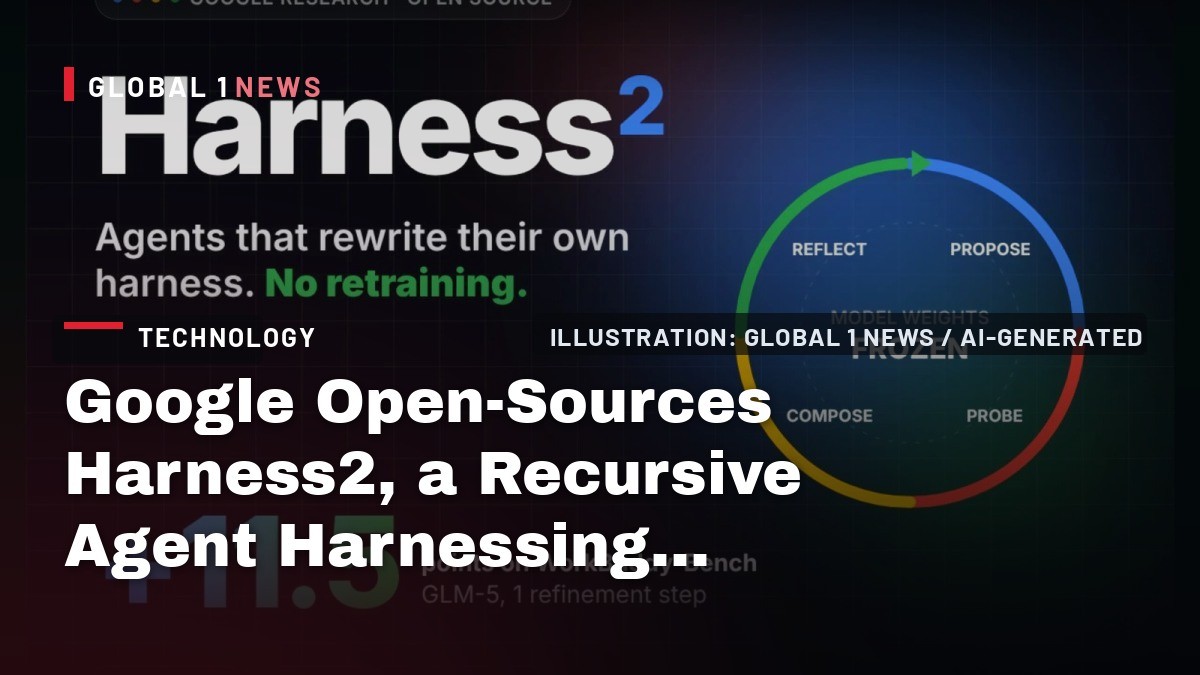
Google just dropped an open‑source framework called Harness² that claims to make your AI agents smarter without touching the model weights. As someone who runs a dozen production stacks across the Caribbean and the US, I’m not impressed by the hype – I’m looking at the hard numbers, the operational overhead, and what this actually means for independent hosting outfits that can’t afford a hyperscaler safety net.
What Harness² actually does
At its core, Harness² is a plug‑and‑play system that lets you edit eight “harness” components – things like the system prompt, guardrails, memory, tool guidance, sub‑agents, skills, scripts and plugins. Each component lives in a separate file that the framework can rewrite on the fly. The model itself stays frozen; only the surrounding code changes. In theory that’s a neat way to get incremental gains without the cost of re‑training a giant model.
The framework runs a two‑level recursion. First, it executes the task with the base harness (H0) to get a reference run. Then an editor proposes two candidate edits – an invariant one that tackles generic failures (planning, tool use) and a domain‑specific one that adds knowledge for the current task. Both candidates are probed on the same task, and a composer merges any beneficial changes back into the harness. After each task, a reflector logs the adopted harness and an EXPERIENCE.md file of lessons, which feeds future proposals. The search budget “k” controls how many candidates are explored in parallel or sequential mode.
Benchmarks and the numbers that matter
The paper tested three professional benchmarks – WorkBuddy‑Bench, JobBench and a LAB suite – using two executors: Gemini 3.5 Flash and GLM‑5, each run under the OpenCode and Codex toolsets. The default editor was Claude Opus 4.8. Scores are averages over three runs.
When running a single refinement step (k = 1), GLM‑5 under OpenCode jumped from 64.2 to 75.7 on WorkBuddy‑Bench, an 11.5‑point lift – the biggest gain reported. The same GLM‑5 under Codex moved from 64.4 to 75.3, also a sizable jump. Gemini 3.5 Flash under OpenCode rose from 72.4 to 77.5, while under Codex it went from 74.5 to 77.5. JobBench saw more modest lifts: Gemini 3.5 Flash under OpenCode climbed from 31.5 to 36.0, and under Codex from 33.9 to 35.3. The LAB partial benchmark showed Gemini 3.5 Flash moving from 79.9 to 81.9, and under Codex from 71.6 to 75.6.
Parallel recursion with a larger budget (k = 5) pushed Gemini 3.5 Flash under OpenCode up to 80.8 on WorkBuddy‑Bench, indicating that more search steps can extract extra performance. Interestingly, the number of steps per task fell for three of the four setups, with Gemini under OpenCode dropping from 25.4 to 21.9 steps, suggesting some efficiency gains.
How this stacks up against other harness methods
Compared to other approaches like Meta‑Harness, ReasoningBank, or Harness Scaling, Harness² is the only one that rewrites the full eight‑component harness per task and learns across tasks via the lessons library. It does not require a separate training split, unlike Meta‑Harness, and it deploys a single best harness rather than a memory‑based system. The licensing is Apache‑2.0, which is friendlier for commercial use than the MIT‑licensed alternatives.
Performance-wise, Harness² edges out the other methods on the reported benchmarks. For WorkBuddy‑Bench with Gemini/OpenCode, Harness² (k = 1) scored 77.5 versus 76.4 for Meta‑Harness and 73.4 for ReasoningBank. On JobBench, Harness² posted 36.0 against 35.8 for Meta‑Harness and 30.8 for ReasoningBank. The LAB partial scores also favor Harness² (75.6) over ReasoningBank (74.8) and Harness Scaling (67.9). The gains are modest but consistent, especially for weaker executors, which is where many of our customers sit.
Operational impact – what you’ll actually have to do
Running Harness² isn’t a plug‑and‑play miracle. The README targets Linux with Python 3.12 (or 3.13) and the uv toolchain. You need to set up a virtual environment, install the package in editable mode, and invoke the demo with a --k flag to control recursion depth. For real model‑backed runs you also need Node.js 20+, the Google Cloud CLI, and a Vertex AI project – essentially a mini‑cloud stack on top of your existing infra.
Additional dependencies include Docker for the WorkBuddy‑Bench benchmark, and Pandoc plus Poppler for the LAB suite. The framework adds extra runs per task: at k = 1 you get one reference run, two probe runs and a final composed run – four executions instead of one. That multiplies compute costs, even if you stay on the same hardware. For small‑scale providers, that overhead can be a deal‑breaker unless you can amortize it across high‑value workloads.
Risk considerations for independent hosting providers
From a business‑risk perspective, Harness² introduces a new attack surface. The harness files are editable at runtime, meaning a compromised editor could inject malicious scripts or alter tool guidance. You’ll need sandboxing and strict file‑system permissions to prevent privilege escalation. Moreover, the reliance on Google Vertex AI for model calls ties you back into the hyperscaler ecosystem – the very thing many of us are trying to avoid.
Another risk is the “black‑box” nature of the improvement loop. The composer decides which edits to keep based on behavioral contrasts, but there’s no guarantee the resulting harness won’t produce hallucinations or unsafe actions in edge cases. Without a verifier, you’re trusting the framework’s internal heuristics, which may not align with your compliance requirements.
Practical advice – should you adopt Harness²?
If you’re already deep in the Google Cloud stack and can afford the extra compute cycles, Harness² offers a modest performance bump, especially for weaker executors. The open‑source license and the ability to run a local demo without model credentials make it attractive for experimentation. However, for truly independent providers, the added complexity, extra runtime cost, and reliance on Google services may outweigh the gains.
My recommendation: run a pilot on a non‑production sandbox. Use the demo mode to test the eight harness components on a representative task set, measure the step‑count reduction, and verify that the edited harness files don’t open security holes. If the performance lift justifies the extra compute budget and you can enforce strict sandboxing, roll it out gradually. Otherwise, focus on proven, low‑overhead improvements like better prompt engineering, caching, and tool integration – the old‑school tricks that have kept my own infrastructure humming for a decade.
Bottom line – hype vs. hard reality
Google’s Harness² is a clever piece of research that shows you can squeeze out performance without touching model weights. The numbers speak for themselves: single‑step gains of up to eleven points on a benchmark, and further lifts with deeper recursion. Yet the framework adds runtime overhead, extra dependencies, and a reliance on Google’s cloud services – all of which translate into cost and risk for independent hosting firms.
In the end, the decision comes down to a cost‑benefit analysis. If you can absorb the extra compute and manage the security implications, Harness² could be a useful tool in your AI‑ops toolbox. If not, stick to the basics and keep your infrastructure lean. Either way, don’t let the buzzwords distract you from the fundamentals that keep your servers up and your customers happy.
— Allan Ali, Founder
This article was produced with AI-assisted research and editorial support. Reporting is based on the source material cited below. Sources: MarkTechPost; marktechpost.com; Global1.News (20 October 2026).
By Allan Ali, Global1.News
What's Your Reaction?
 Like
0
 Dislike
0
 Love
0
 Funny
0
 Wow
0
 Sad
0
 Angry
0

Publisher of Global1.News. Automation architect, systems builder, and the guy making sure the truth gets published.














Comments (0)