
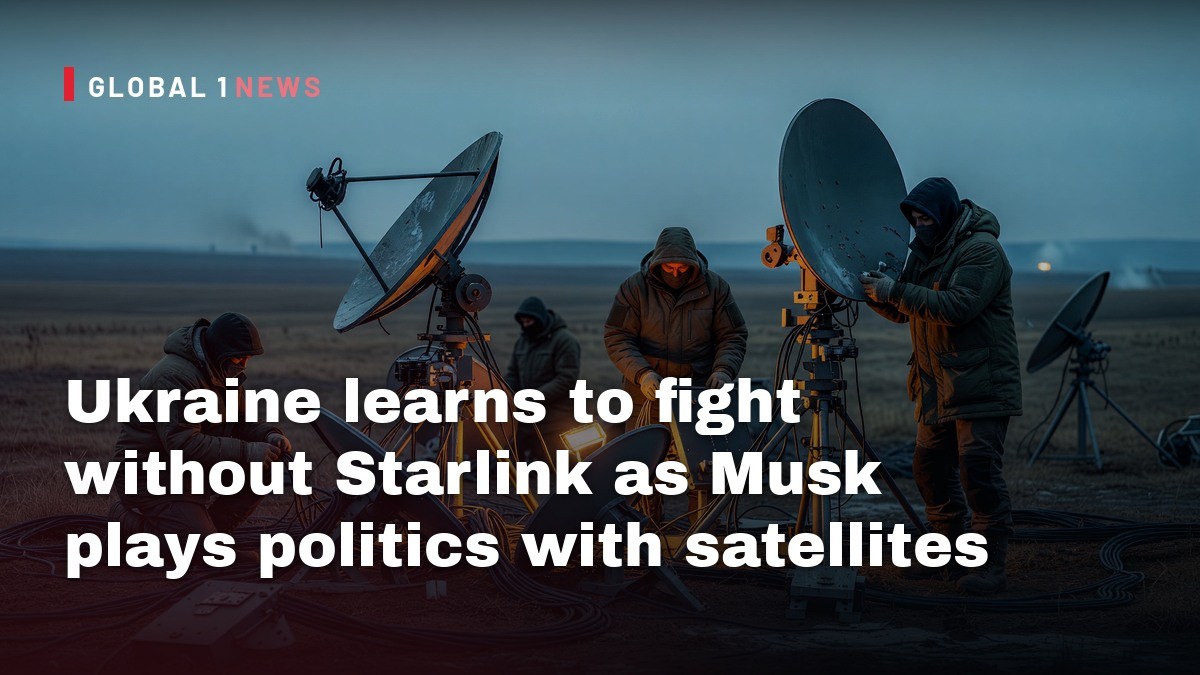
Ukraine learns to fight without Starlink as Musk plays politics with satellites
When I first saw the headlines about Musk’s satellite network wobbling under political pressure, I thought it was just another hype‑cycle story. Musk’s public statements about not allowing “long‑range drone strikes” hinted that the service could become a bargaining chip.
When I first saw the headlines about Musk’s satellite network wobbling under political pressure, I thought it was just another hype‑cycle story. But the reality on the ground in Ukraine shows why relying on a single, privately‑run “best‑in‑class” service is a recipe for disaster for any independent operator or founder trying to build resilient infrastructure. The latest Starlink throttling, the February whitelist shutdown, and the ongoing jamming campaigns are not just geopolitical footnotes – they are hard lessons about the fragility of a model that puts a single vendor’s whims above your business continuity.
Starlink’s tactical edge – and why it mattered
SpaceX’s Starlink has been the workhorse of Ukraine’s communications since the early days of the invasion. A compact terminal can hook up a ground robot, a drone boat on the Black Sea, or a fast‑moving vehicle and deliver high‑speed internet that the Ukrainian military has used for everything from civilian broadband to remote control of air‑defence drones. As the head of hardware R&D at BlueBird Tech, a Ukrainian defence firm, put it, Starlink offers “some of the best satellite coverage available” when you weigh cost, availability and ease of use together.
That coverage translated into real battlefield capability: Ukrainian forces could command drones that intercept Russian attack drones, guide strike drones into enemy logistics hubs, and keep frontline units supplied with live video feeds. Even Russian units were caught up in the scramble, using smuggled terminals until SpaceX cut off any non‑whitelisted device in February 2026, which temporarily crippled Russian drone operations.
The first warning signs – politics entering the link
The first crack in the façade appeared in February 2023, when SpaceX’s president confirmed that the company was moving to block Ukraine’s military use of Starlink for drones. Musk’s public statements about not allowing “long‑range drone strikes” hinted that the service could become a bargaining chip. That was a red flag for anyone who thought a private satellite constellation could be treated as a utility.
Fast‑forward to October 2026, and the situation turned from a policy debate into a hard‑stop. On October 13, SpaceX throttled the military‑grade Starlink service for terminals moving faster than about 99 mph (160 km/h). The restriction leaked into the field at night, catching drone operators off guard and forcing them to slow to roughly 80 mph (130 km/h) before the link became unstable, according to Michael Kofman of the Carnegie Endowment.
The impact on Ukraine’s drone‑centric warfare
The throttling wasn’t a minor inconvenience; it knocked out critical missions. Ukrainian supply drones, reconnaissance platforms, and mid‑range strike drones all rely on a stable, high‑bandwidth link to receive commands and transmit sensor data. When the speed cap kicked in, those drones lost telemetry, forcing pilots to abort missions or revert to line‑of‑sight control, which is impossible on the fluid frontlines.
Even the air‑defence network felt the pinch. Fast‑moving interceptor drones that chase down Russian one‑way attack drones need a low‑latency feed; the imposed speed limit disrupted that feed, according to President Zelenskyy. The timing was especially cruel, coinciding with a massive Russian drone and missile barrage on Ukrainian cities, while Russia also deployed jamming rigs to carve out dead zones in occupied territories.
Why the “no single vendor” rule matters
BlueBird Tech’s representative made a point of saying they “don’t tie our products to any single technology.” Their product mix includes a “small percentage” of systems that integrate Starlink, but the bulk of their lineup uses alternative links. That diversification is the only sane strategy when a provider can unilaterally throttle or cut service on a whim.
In the hosting world, we see the same pattern: hyperscalers offering cheap bandwidth only to yank it when they need to, or VC‑backed startups promising “best‑in‑class” SaaS that vanish when a funding round dries up. The Ukrainian case is a stark illustration that even a massive constellation can be weaponised against its own customers.
The economics of reliance on a monopoly
Europe and the United States poured money into buying tens of thousands of Starlink terminals and covering subscription fees for Ukraine. Those costs are justified only if the service remains stable and apolitical. The sudden throttling forced governments to scramble for alternatives, a costly pivot that could have been mitigated with a multi‑vendor strategy from the start.
For independent hosting providers, the lesson is clear: never let a single supplier dictate your cost structure or service level. Build redundancy with terrestrial fiber, microwave links, or regional satellite constellations that you can control or at least negotiate with on more equal terms. The price of a backup link is a fraction of the revenue loss when a provider decides to “play politics.”
What the industry can learn – practical steps
First, audit every critical path for single‑point‑of‑failure dependencies. If a terminal, a cloud API, or a CDN node is the only way you reach customers, you’re sitting on a ticking time bomb. Second, negotiate service‑level agreements that include explicit clauses for political or strategic interference – something most providers shy away from, but it’s a non‑negotiable for any serious operation.
Third, diversify your hardware stack. In my own data centres, we run a mix of satellite, microwave, and fiber backbones, each capable of handling at least 30 % of traffic on its own. That mix has saved us during regional outages and during the recent ransomware attacks that crippled several Tier‑1 ISPs. Finally, keep a close eye on regulatory and geopolitical developments that could affect your providers. The Starlink episode shows that a single tweet or a diplomatic spat can cascade into a service outage that hits the battlefield – and your bottom line – in minutes.
Looking ahead – a post‑Starlink Ukraine and the broader market
Ukraine’s defence industry is already shifting. BlueBird Tech and other firms are building drones that can operate with reduced reliance on satellite links, using line‑of‑sight radio, mesh networks, or even autonomous AI that can execute missions with limited external commands. That trend will spill over into civilian sectors, where customers will demand equipment that can fallback to local networks when the satellite pipe goes down.
For the hosting world, the takeaway is that the era of “one‑vendor solves all” is over. The market is moving toward modular, interoperable solutions that can survive the whims of a billionaire or a geopolitical crisis. If you’re still betting everything on a single provider, you’re courting risk the same way a small ISP that relies solely on a single upstream ISP does – and you’ll feel the pain when that upstream decides to throttle your traffic.
In short, the Starlink saga is a cautionary tale wrapped in a high‑stakes war story. It tells founders and operators that resilience is built, not bought, and that the cheapest, easiest‑to‑use solution is often the most vulnerable. Build redundancy, diversify your tech stack, and keep your eyes on the political horizon – that’s how you survive when the satellite monopoly decides to play politics.
— Allan Ali, Founder
This article was produced with AI-assisted research and editorial support. Reporting is based on the source material cited below. Sources: Ars Technica; arstechnica.com; Global1.News (24 October 2026).
By Allan Ali, Global1.News
What's Your Reaction?
 Like
0
 Dislike
0
 Love
0
 Funny
0
 Wow
0
 Sad
0
 Angry
0

Publisher of Global1.News. Automation architect, systems builder, and the guy making sure the truth gets published.















Comments (0)