
Putin’s Daughter Says Fear of Death Will Drive Advances Against Aging
Maria Vorontsova, the Kremlin‑linked endocrinologist who heads Moscow State University’s Medical Research and Education Institute, used a recent forum to outline Russia’s emerging agenda on life‑extension.
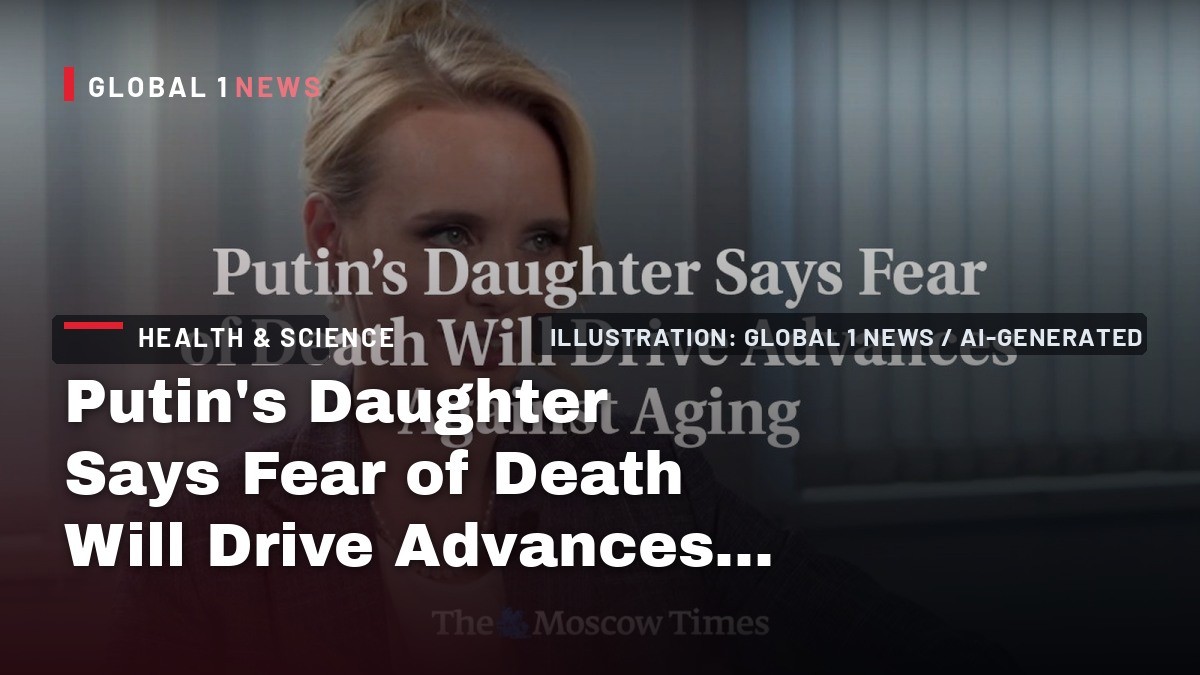
Maria Vorontsova, the Kremlin‑linked endocrinologist who heads Moscow State University’s Medical Research and Education Institute, used a recent forum to outline Russia’s emerging agenda on life‑extension. Speaking at the launch of a new laboratory within the Skolkovo Moscow School of Management, Vorontsova framed the pursuit of longer lifespans as a matter of “universal human fear of death” and positioned it as a strategic priority for the state. Her remarks, reported by Vedomosti and echoed in this article, reveal how a tightly‑controlled scientific initiative is being woven into the broader fabric of Russian public policy, economic planning and the Kremlin’s own personal preoccupations.
State‑backed research and the political patronage network
Vorontsova’s presentation was not an isolated academic exercise; it was part of the national project “New Health Preservation Technologies,” launched in 2025 at President Vladimir Putin’s direction. The project is funded with more than 2 trillion rubles—a figure confirmed by the source material—as part of a parallel initiative called “Long and Active Life.” Both programmes are embedded within a larger Kremlin‑driven vision to raise Russian life expectancy to 78 years by 2030 and 81 years by 2036, up from a reported 74.2 years.
The involvement of senior officials underscores the political weight behind the effort. Deputy Science and Higher Education Minister Denis Sekirinsky has publicly spoken about a “vaccine against aging” that targets a gene linked to cellular age‑related changes. Deputy Prime Minister Tatyana Golikova announced plans to begin production of an anti‑aging drug between 2028 and 2030. These statements, attributed to the officials, illustrate a coordinated push from the highest echelons of government to translate laboratory breakthroughs into marketable therapeutics.
Personal motivations within the inner circle
Beyond official policy, the source material points to a personal obsession with longevity among Putin’s close associates. An unidentified source close to the Kremlin told Meduza in 2024 that the initiative stemmed from “an obsession with eternal life” on the part of Mikhail Kovalchuk, a longtime Putin confidant who heads the Kurchatov Institute. Kovalchuk oversees a federal program supporting Russian genetics research, a program in which Vorontsova also participates. This nexus of personal ambition and state sponsorship suggests that the drive to “cheat God or nature,” as Vorontsova phrased it, is as much about preserving elite power as it is about scientific curiosity.
Putin himself, now 74, has long been reported to have a personal interest in rejuvenation treatments. During a 2025 visit to Beijing, he was overheard discussing the prospect of achieving immortality through medical technology and organ transplants with President Xi Jinping. While the president has never publicly acknowledged his daughters—Maria Vorontsova and Katerina Tikhonova—their involvement in high‑profile scientific projects indicates a discreet channel through which personal and familial interests intersect with state policy.
Scientific framing and regulatory hurdles
Vorontsova divided the quest for extended life into two distinct stages. The first stage, she said, aims to bring the average human lifespan to its “natural” limit of 85 to 90 years through childhood health habits, proper nutrition and regular medical check‑ups. This aligns with conventional public‑health strategies and provides a politically palatable narrative of improving overall health without challenging existing medical paradigms.
The second stage, described as an attempt to “cheat God or nature,” targets life beyond the natural ceiling. Vorontsova acknowledged that scientific progress in this area remains limited, and she highlighted a key regulatory obstacle: aging is not classified as a disease. This classification gap complicates drug development because it hinders the establishment of clear diagnoses and the design of clinical trials—a point she made explicitly. The implication is that Russian scientists will need to navigate or reshape regulatory frameworks if they hope to commercialise anti‑aging interventions.
Economic implications of a longer‑living workforce
The forum’s focus on how longer lifespans affect public policy, the economy and the labor market signals a forward‑looking assessment of demographic trends. Extending healthy life expectancy could mitigate Russia’s chronic labor shortages and offset the economic drag of a shrinking working‑age population. By pushing the average retirement age upward, the state hopes to sustain productivity and tax revenues.
However, Vorontsova’s own remarks suggest that the benefits are contingent on the successful transition from “healthy aging” to “life extension” technologies. The development of a vaccine or drug that truly delays senescence would create new markets for biotech firms, attract foreign investment, and potentially reposition Russia as a leader in a lucrative global anti‑aging industry. The projected production timeline for an anti‑aging drug—between 2028 and 2030—indicates that the government is preparing for a commercial rollout that could reshape domestic pharmaceutical priorities.
International dimension and strategic signaling
The mention of Putin’s discussion with Xi Jinping about immortality underscores the geopolitical dimension of life‑extension research. By aligning with China on the pursuit of “eternal life” technologies, Russia signals a willingness to cooperate on high‑risk, high‑reward scientific frontiers that sit outside the mainstream Western research ecosystem. This partnership may facilitate joint funding, shared expertise, and cross‑border clinical trials, thereby accelerating progress while circumventing sanctions that limit access to Western biotech platforms.
Moreover, the public articulation of a national agenda to extend life can serve as a soft‑power tool. Showcasing breakthroughs in anti‑aging medicine could enhance Russia’s prestige, attract scientific talent, and portray the Kremlin as a forward‑thinking patron of cutting‑edge health technologies. This narrative dovetails with broader efforts to portray Russia as a sovereign innovator capable of competing with the West on strategic scientific fronts.
Societal and ethical considerations
Vorontsova’s candid admission that the second stage of life‑extension would involve “cheating God or nature” raises profound ethical questions. The classification of aging as a non‑disease blurs the line between therapeutic intervention and enhancement. If the state succeeds in producing an anti‑aging drug, issues of equitable access will emerge. Given Russia’s existing health‑care disparities, a premium anti‑aging treatment could become a privilege of the political and economic elite, reinforcing existing power structures.
Furthermore, the Kremlin’s tight control over information about Vorontsova and her sister Katerina Tikhonova suggests a broader strategy of secrecy surrounding the personal stakes of the leadership. By keeping the family’s involvement out of the public eye, the regime can pursue controversial scientific agendas without inviting domestic scrutiny or international criticism. The recent designation of The Moscow Times as an “undesirable” organization, coupled with the outlet’s own warnings about repression, illustrates the narrowing space for independent reporting on these sensitive topics.
Future trajectory and potential flashpoints
Looking ahead, the next decade will be decisive for Russia’s anti‑aging programme. The announced timeline—advances within the next 10 to 20 years driven by “universal human fear of death”—places a concrete deadline on research milestones. If a viable vaccine or drug emerges by 2030, the state will face the challenge of integrating it into the health system, managing public expectations, and navigating the ethical terrain of life extension.
Potential flashpoints include the regulatory reclassification of aging, the allocation of the 2 trillion‑ruble budget across competing health priorities, and the geopolitical ramifications of a Russia‑China partnership in this domain. Moreover, any perceived favoritism toward elite circles could spark public dissent, especially if life‑extension technologies remain out of reach for the broader population. The Kremlin’s ability to balance scientific ambition with social stability will be a key indicator of how this agenda reshapes Russian society and its place on the world stage.
This article was produced with AI-assisted research and editorial support. Reporting is based on the source material cited below. Sources: The Moscow Times; themoscowtimes.com; Global1.News (21 October 2026).
By Irina Volkov, Staff Writer
What's Your Reaction?
 Like
0
 Dislike
0
 Love
0
 Funny
0
 Wow
0
 Sad
0
 Angry
0
Russia/Eastern Europe Correspondent at Global1.News. Covering Russian politics, energy, security, and the shifting dynamics of the post-Soviet space. Provides clear-eyed analysis on one of the world's most opaque regions.













Comments (0)