
Gunmen Open Fire on a Funeral at a Karak Church, Killing Seven and Wounding 34
Gunmen opened fire during a funeral at a Greek Orthodox church in Humud, in Jordan's Karak governorate, killing seven people and wounding 34, the Public Security Directorate said. No group has claimed responsibility and a prosecutor has barred Jordanian media from publishing case details.
The funeral was already under way when the shooting started. Witnesses described two men getting out of a vehicle outside a Greek Orthodox church in the village of Humud, in Jordan's Karak governorate, before opening fire on the mourners, in accounts given to state television and described by Jordan's Public Security Directorate. By evening the kingdom's public security director put the toll at seven dead and 34 wounded. No one has claimed the attack.
Gunmen Open Fire on a Funeral at a Karak Church, Killing Seven and Wounding 34
KARAK, Jordan — Jordanian officials are hunting an unidentified group they describe as extremists after an attack on a funeral that the kingdom's interior minister called "unparalleled in the history of the Hashemite Kingdom of Jordan," and a prosecutor has forbidden the country's media from reporting the details of the investigation.
A Funeral Interrupted by Gunfire
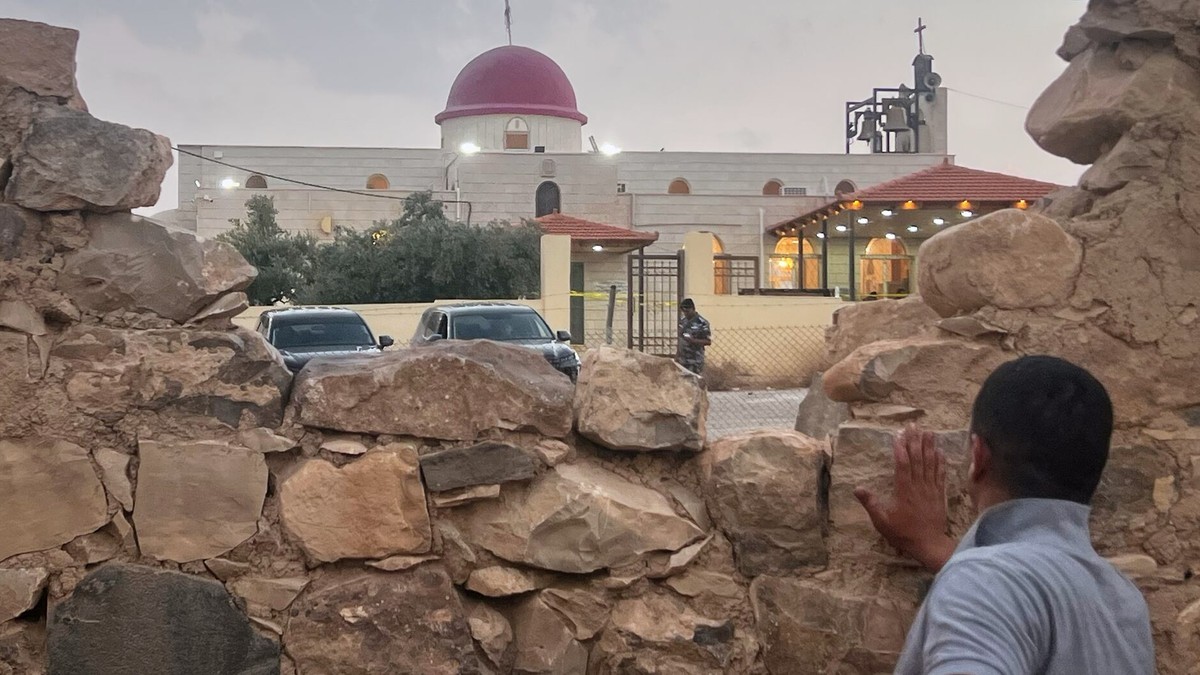
The attack struck on Friday 23 October, in the middle of a funeral service at a Greek Orthodox church in Humud, a village in Karak governorate. Coverage names the church as St George's Greek Orthodox Church; the state news agency Petra refers to the site as Hamoud Church and to the village as Humud. CNN describes the town as predominantly Christian, in the northern part of the governorate.
The gunmen arrived by car and opened fire during the funeral procession. Government spokesperson Mohammad Al-Momani called it a "heinous attack" and said on X that security forces were following up on the incident, while a government statement described the assailants as "unknown" and said "investigations are underway at full speed."
The Public Security Directorate's first public word came through Petra at 15:10 local time, with a statement from the government communication minister confirming that security agencies were working the scene. Two minutes later the directorate warned the public against circulating any information about the shooting and urged reliance on official statements only.
The Toll Moved Through the Afternoon
The official casualty figures did not stay fixed. At 17:13 local time, a Public Security Directorate spokesperson announced that "six people were killed and 28 others injured in an incident that occurred during a funeral in Karak Governorate." Three hours later, at a joint press conference at the Karak governorate headquarters with Interior Minister Mazen Al-Faraya, PSD Director Maj. Gen. Obaidullah Al-Maaytah said seven people had been killed and 34 others wounded.
The BBC traced the same zig-zag: initial reports of seven dead, then a government spokesperson saying six, then officials revising back to seven. The 27 seriously wounded were still being treated in hospital on Friday evening, Al-Maaytah said.
Jordanian officials have not published the names, ages or nationalities of the dead. The count of the wounded also moved, from 28 to 34, as casualties reached hospitals in Karak.
Two Gunmen, or Three
The most detailed accounts suggest more attackers than the first statements described. The Associated Press, citing footage broadcast on Jordanian state television, reported two gunmen who appeared to be holding pistols approaching the church and firing, followed by a third man who appeared to be carrying a semiautomatic rifle and also opened fire. All three then ran toward the church.
The BBC said the CCTV footage it verified appears to show three gunmen moving from a road toward the church: two approaching what appears to be a vehicle entrance, retreating briefly, and returning with a third man, all apparently armed with handguns.
France 24, describing video aired by the state-owned Al-Mamlaka station that appeared to come from a camera mounted on the church, reported three people firing at the building from a sidewalk and hiding behind trees and a low wall before running toward the entrance. Witnesses described two assailants getting out of a vehicle.
Inside the Church
The numbers inside the building explain the casualty count. A witness told Jordanian state media that between 150 and 200 people were in the church when the shooting began. Eyewitness Tamer Halsa told Al-Mamlaka: "We were more than 150 people inside and outside the church." He said: "Some guys were standing outside the church before two people got out of a vehicle and started shooting."
A funeral attendee, Khaled Burqan, told the same broadcaster that one of the assailants carried a pistol and the other a rifle. Another witness told Al-Mamlaka that one attacker carried an AK-47 Kalashnikov and that the firing went on for several minutes.
A witness interviewed by AFP described the moment the procession came under fire: "I heard something as if a war had just started. I thought it was an electrical short circuit. I looked, people lying on the ground, wounded." He added: "The scene was catastrophic."
The Manhunt, and a Gag Order
No group has claimed responsibility, and officials have not said whether any attacker has been arrested or killed. Al-Maaytah pledged at the evening press conference that "the perpetrators will be caught and our national unity will not be hit," and said legal measures would be taken against those responsible.
According to the Jordanian outlet Roya News, Interior Minister Al-Faraya said the authorities already hold the names of suspects but would not disclose them publicly.
Reporting on the case itself has been restricted. Amman Prosecutor General Hassan Al-Abdallat issued a gag order on the investigation, citing Article 39 of the Publications and Publishing Law and Article 225 of the Penal Code. It requires audiovisual, print and digital outlets, and social media platforms, to refrain from publishing anything about the case, the investigation, or even the circulation of information about the ban. Official government media supervised by the Ministry of Government Communication are exempt.
The King's Vow of the Harshest Penalties
King Abdullah II responded within hours. In a post on X he said Jordan "will confront the terrorist act that targeted Karak with the harshest penalties," and offered his "deepest condolences to the families of the martyrs, and our wishes for recovery to the wounded."
Other renderings of the same statement, carried by Al Jazeera and DW, have him saying: "The blood of Jordanians is precious, and we will strike with an iron fist against anyone who overreaches against this country." And: "Those who delude themselves into thinking that they can divide Jordanians with their bullets have no chance in the face of our unity."
Security was tightened ahead of the king's visit to a Karak hospital where the wounded were being treated. Roads around the hospital were closed, and families parked and walked in. The BBC reported a tense atmosphere there, with some residents voicing frustration at what they described as a failure to take a tougher approach towards terrorists.
Who the Christians of Karak Are
Christians number about 300,000 in Jordan, a minority within a population of roughly 11.5 million. The kingdom is home to biblical sites that draw Christian pilgrims from around the world, and the Hashemite monarchy has built part of its international standing on the guardianship of Muslim and Christian holy sites in Jerusalem.
Karak has a sizeable Christian community. Taylor Luck, senior Middle East correspondent at the Christian Science Monitor, told Al Jazeera that Karak is home to "Christians and Muslims who have lived side by side for generations," and that "This community prides themselves on its interfaith solidarity and coexistence." If the attack was meant to create divisions, he said, "we are likely to see this community come back even stronger."
Political analyst Xavier Abu Eid told Al Jazeera the shooting matters beyond Jordan's Christian minority, because it strikes at Amman's "public diplomacy" as custodian of holy sites. "This is something that goes totally against the message that Jordan wants to give to the world," he said.
Karak Has Been Here Before
This is not the first attack of its kind in the governorate. In 2016, gunmen ambushed police in a series of assaults in Karak, including at a Crusader castle popular with tourists, killing 10 people, seven of them officers, and wounding dozens. Jordanian security forces killed those gunmen after a long standoff.
Al Jazeera described that 2016 assault as an ISIL attack in which fighters holed up in the Crusader-era castle and killed 10 people, including security officers and a Canadian tourist, before being shot dead by Jordanian forces.
Such violence is rare in Jordan, but deadly attacks have been carried out before, and the comparison to 2016 was being drawn by Jordanians on Friday as the casualty figures rose. The difference is the target: a funeral, inside a church, in a village rather than a tourist fortress.
The Condemnations
UN Secretary-General Antonio Guterres strongly condemned the attack, his spokesman Stephane Dujarric told reporters: "It goes without saying that an attack not only on a place of worship but during a funeral procession is especially heinous."
US Ambassador to the UN Mike Waltz said the news was "devastating," adding: "Praying for the victims, their families and all those affected by this depraved and brutal attack on a house of worship." He added that "attacks on Christians continue to escalate worldwide and must be stopped."
Lebanon's President Joseph Aoun, a Christian head of state, condemned the "heinous terrorist attack" and said it "violated the sanctity of death and funeral mourners, contradicts all religious and humanitarian values." Egypt's grand imam of Al-Azhar, Ahmed al-Tayeb, called it a "heinous terrorist attack." Iraq's foreign minister telephoned his Jordanian counterpart to affirm solidarity, and Syria, Oman, the United Arab Emirates and the Palestinian leadership also condemned the killings, as did Jordan's Senate speaker and press association.
The Questions Jordan Will Not Answer Yet
Five things remain unanswered. Who carried out the attack. What they wanted. Whether they belong to any organised group inside or outside Jordan. How many of them there were. And whether anyone has been detained.
Interior Minister Al-Faraya said it was too early to tell whether the attackers had links to known groups. He described them as a "group of extremists," a group with "no relationship to humanity," and called the attack "painful and horrific" and "unparalleled in the history of the Hashemite Kingdom of Jordan." He also said: "This country will never be dragged into terrorism and violence."
The gag order means the Jordanian press cannot fill those gaps even if it learns the answers. For now the record rests on official statements, a handful of witness accounts to state television, and CCTV that appears to show three armed men walking toward a village church on a Friday afternoon.
By Jessica Ali, Staff Writer
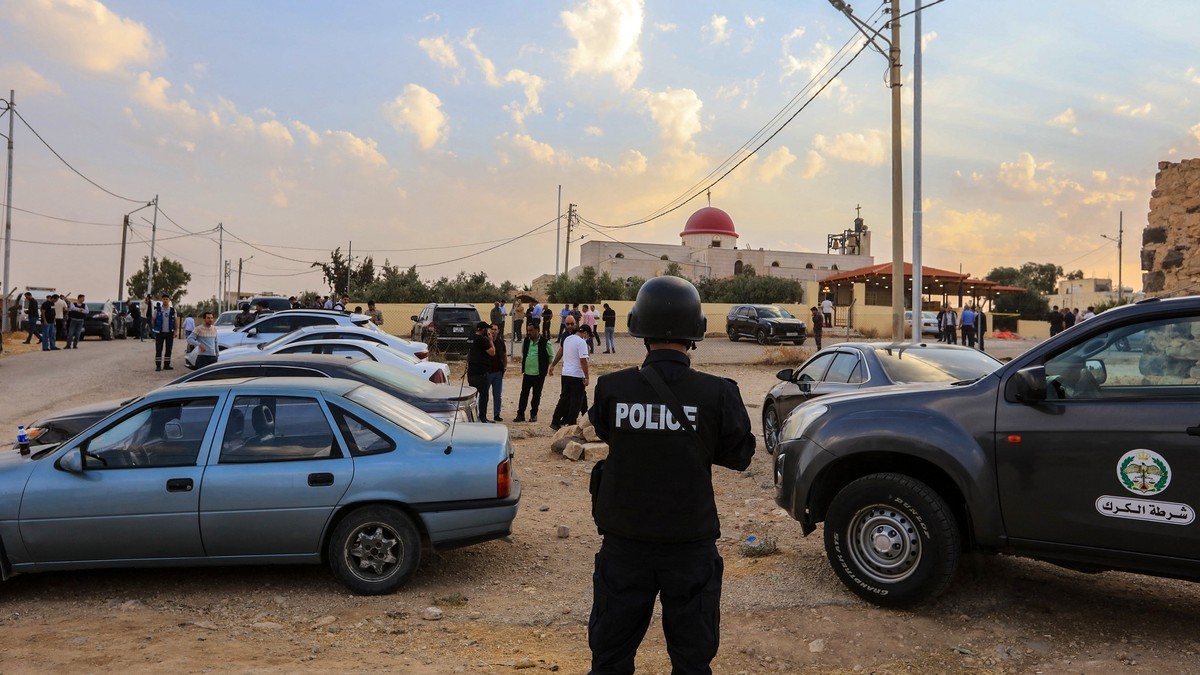
This article was produced with AI-assisted research and editorial support. Sources: BBC, Al Jazeera/Reuters, Associated Press, CBS News, CNN, DW, France 24, Vatican News, Petra (Jordan News Agency), Roya News. Photographs: AFP (mourners outside the church), AP (a man looking toward the church), AFP (police outside the church).
What's Your Reaction?
 Like
0
 Dislike
0
 Love
0
 Funny
0
 Wow
0
 Sad
0
 Angry
0

Editor-in-Chief at Global1.News. Atlanta-based journalist who cuts through the BS and tells it like it is. Lead anchor, host, and the voice you hear when the spin stops and the truth starts.










Comments (0)