
Toronto Votes Monday With Four Polls and No Clear Favourite
Toronto votes Monday, Oct. 26, after a record 222,550 advance ballots and a final debate that turned on water, taxes and housing. Four polls give four different answers on Olivia Chow and Brad Bradford.
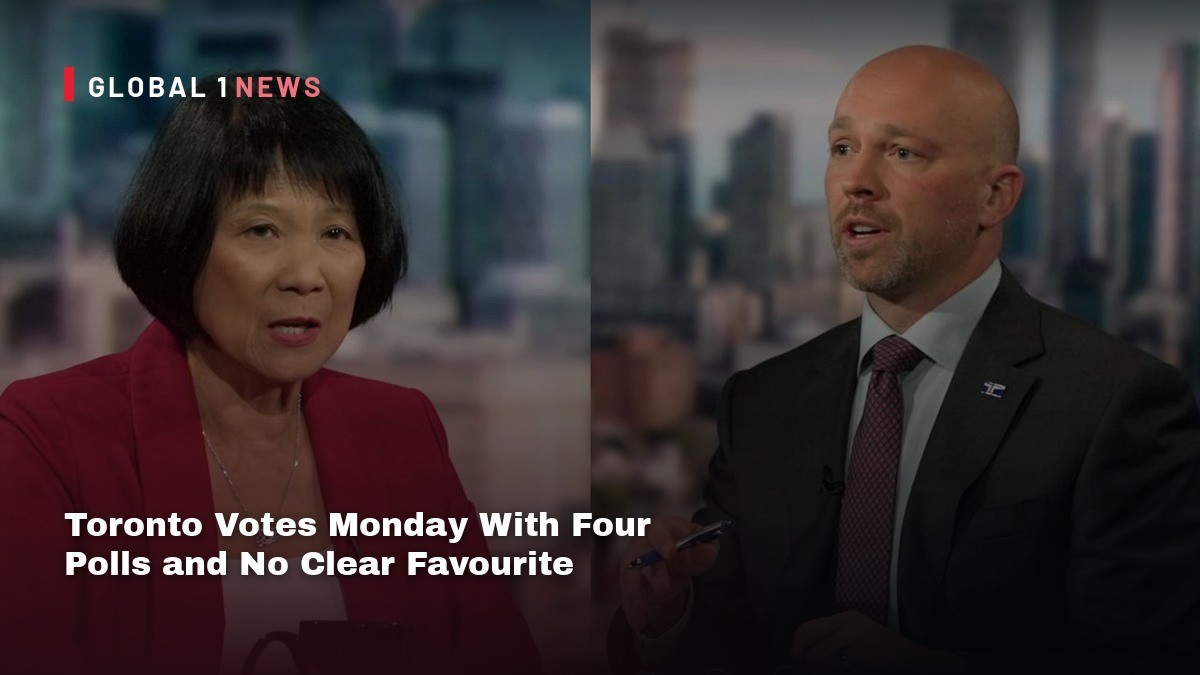
Three days before Toronto votes, the mayor's race is a coin flip that four polling firms cannot call the same way. The last televised debate is over, the advance ballots are already cast, and nobody can tell you who is winning. Here is what is actually on the table before Monday, Oct. 26.
Toronto Votes Monday With Four Polls and No Clear Favourite
Toronto, Canada — Olivia Chow and Brad Bradford met Thursday night, Oct. 22, for the final debate of the 2026 mayoral campaign, a 90-minute commercial-free broadcast on CP24 titled "Toronto Decides: The Municipal Debate." Chow, elected the city's 66th mayor in the June 26, 2023 by-election, is asking voters for a second mandate. Bradford, the Beaches-East York councillor first elected in 2018, is asking them to fire her. Advance voting has closed. Election day is Monday, Oct. 26. The stakes are control of a $19-billion city budget and a council that turns over alongside the mayor's chair.
Four Polls, Four Different Answers
Nanos Research, polling for CP24 and CTV News Toronto, surveyed 762 Toronto residents by telephone and online between Oct. 15 and Oct. 18 and put Chow at 49.8 per cent and Bradford at 46.6 per cent among 682 decided voters, a 3.8-point margin of error on that subsample, 19 times in 20. Liaison Strategies surveyed 1,000 residents by phone and interactive voice response on Oct. 18 and 19 and found the reverse: Bradford 49, Chow 47, margin 3.1 points. Mainstreet Research, which surveyed 1,000 adults Oct. 16 to 18 by conventional phone IVR, reported Bradford at 48.9 and Chow at 47.5, margin 3.1 points. Pollara Strategic Insights, fielding 695 online panel respondents and 404 by live telephone between Oct. 13 and Oct. 19 for CUPE Local 416, found Chow ahead 53 to 46 among decided voters and states no margin of error applies to an online panel. Four firms, four field windows, four answers. The first three leads sit inside their own margins of error. Pollara's seven-point Chow edge carries no margin at all, because part of its sample came from an online panel.
The Final Debate: Water, Taxes and a Resignation Pledge
The sharpest exchange of the night came over Bradford's plan to convert Toronto Water into an independent, publicly owned utility corporation modeled on Toronto Hydro. Chow pressed him: "why are you trying to give away our water?" She said the plan would hand the system to Premier Doug Ford and open the door to privatization. Bradford called that "wild accusations, misinformation, frankly dishonesty," said provincial law would not allow privatization of the city's water, and made a pledge: he would resign his seat if water were privatized under his plan. He argued the utility structure would fund infrastructure and cut a household water bill by $300. In a separate round on how she would pay for her promises, Chow said much of the money is already "booked into the 2027 budget." On data centres, Bradford said council voted a pause, "which I voted for and supported." Chow said she wants a moratorium: "We have to protect the residents around the data centre... which is why I said no."
Housing: Two Sets of Numbers, One Argument
Bradford went to the record on Chow's pledge to deliver 65,000 purpose-built rental units by 2030. "Today, only 1,500 have been delivered. That is a mere two per cent of her target of her commitment to Torontonians," he said. "And if we were to continue at that pace, it would take 115 years for the mayor to deliver on her commitment." He said housing starts have "cratered" to the lowest level in 30 years. Chow answered that no affordable housing was built while Bradford chaired the Housing and Planning Committee, that approvals have been sped up by 80 per cent on her watch, and that development charges have been lowered. Chow put her own target on the same stage: "at least 10,000 to start this year," backed by what she called multi-billion-dollar investment and the confidence of Prime Minister Mark Carney. Both sets of numbers are campaign claims made on a debate stage. Neither is an audit.
Taxes and the Bait-and-Switch Charge
Bradford came with a phrase: Chow is "delivering the biggest bait and switch in Toronto municipal history." His charge is that she "promised a modest tax increase and leveled the biggest tax increase in Toronto's history, nearly 20 per cent over her term and administration." Chow's answer is a promise to hold the property tax increase at or around the rate of inflation, and a defense of her first term: "It's like if you have a home, the roof is leaking. You have to go fix it. Yeah, first two years were very difficult, but we have turned a corner." Bradford's counter-promise is a property tax freeze in year one, plus elimination of the municipal land transfer tax, which he priced at $18,000 back in the pocket of the average Toronto home buyer. He also wants an outside line-by-line budget review, citing a $19-billion budget and an auditor general finding of $11 million spent on Microsoft Office licenses for retirees.
Strong Mayor Powers and the Question Bradford Did Not Answer
A citizen question asked each candidate whether they would use strong mayor powers when council stood against them. Bradford did not answer directly. He said he would focus on crime, congestion and costs, that he is seeking a "mandate from the people of Toronto," and that "I'm going to work with everybody to make sure that we can get that done." Chow pounced: "I didn't hear an answer there." She said she would work with councillors who disagree with her and would not override a council majority against her plan. Bradford retorted that Chow used the strong mayor powers during her first term. Bradford's point was that Chow had already used those powers in her first term, which is why the question went to both of them. On the same stage, Chow attacked Bradford's ward record on a Dawes Road apartment building; Bradford called her account "simply not true" and said the landlord now faces a fine of over a million dollars.
The Advance Vote Broke a Record
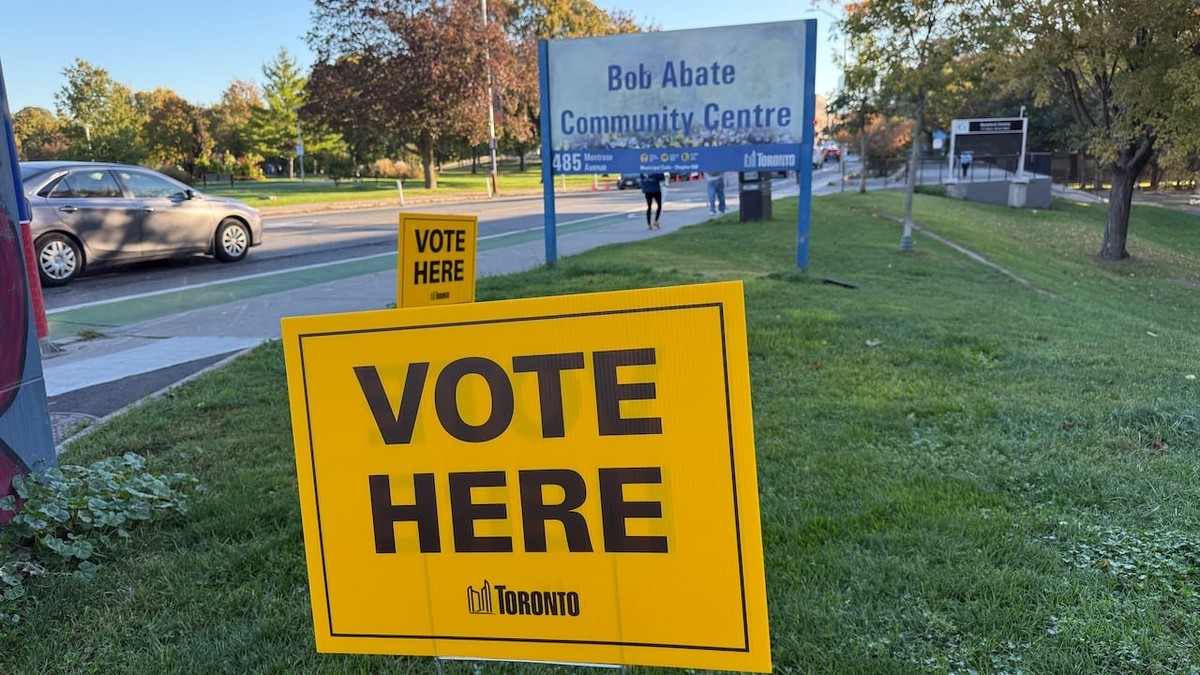
The City of Toronto reported 222,550 ballots cast over six days of advance voting, Oct. 6 through Oct. 11. That is a record for a Toronto municipal election. The daily counts climbed through the week: 36,743 on Oct. 6, 31,018 on Oct. 7, 28,666 on Oct. 8, 33,579 on Oct. 9, 39,181 on Oct. 10, and 53,363 on the final day, Oct. 11. The comparison is stark. The 2023 mayoral by-election drew 129,745 advance votes, a jump of nearly 72 per cent. The 2022 election drew 115,911. The 2018 election drew 124,299. The 2014 election drew 161,147, and 2010 drew 77,365. Both camps read the number their own way. Chow's team credited hundreds of volunteers knocking on doors during the advance window. Bradford spokesperson Laryssa Waler said: "People aren't waiting for October the 26th to make up their minds."
Where the Map Splits: Renters, Homeowners and Wards
The Nanos regional breakdown among 682 decided voters puts Chow ahead in Toronto and East York at 58.2 to 37.2, and in Scarborough at 50.9 to 46.3. Bradford leads Etobicoke and York at 52.9 to 45.1, and North York at 54.1 to 41.2. Mainstreet's Quito Maggi reported the same shape: Bradford ahead in Etobicoke and North York, Chow ahead in Scarborough and downtown. The splits run along geography, age and gender, and they do not all point the same way. Nanos found men breaking for Bradford 53.7 to 42.1 and women for Chow 56.8 to 40.0. Pollara found Chow at 60 per cent among decided women to Bradford's 39. A Liaison survey of 1,000 residents taken Oct. 8 and 9, during advance voting, found renters for Chow 57 to 40 and homeowners for Bradford 50 to 45. Two candidates, two electorates, one ballot.
Two Closing Arguments
Chow closed on experience and the city she governs. "The reason people should vote for me is I'm experienced. You know who I am, and I love the city," she said. Asked for the biggest misconception about her, she said: "that I have too much fun, and I'm not doing the kind of work that needs to be done as a mayor. But look, try getting $17 billion from other levels of government. It took a lot of work." Bradford closed on change. "This is about change... the status quo isn't working, and if you want to change the city, you have to change the mayor," he said. His opening had set the frame: "We are stuck in traffic, we are stuck feeling less safe and we are stuck paying more and getting less." Asked the same misconception question, he said: "that I don't have fun while I'm at work." Former mayor John Tory, on CTV as a municipal affairs expert, said the debate could move people: "It could be that some of the people who are watching will literally decide tonight based on the performance of the candidates who they're going to vote for."
The Numbers That Are Still Only Claims
Nanos found 13 per cent of respondents open to switching their vote based on the debate, and another 16 per cent somewhat open. That is nearly three in ten voters in play after the last head-to-head. The same survey put 16 per cent of all respondents undecided. Chow's response to the polling has been to dismiss it: "That's the one that counts," she said of election day. "It's the people that count, not the polls." What is on the record from Thursday night: the water utility question, the 1,500-unit figure, the 115-year projection, the bait-and-switch charge, the 80 per cent approvals claim, the $18,000 land transfer tax saving, the $300 water bill cut, the 1,000 additional frontline officers, the 10,000 homes. Every one of those is a candidate's assertion from a debate stage, not a finding. What is not settled is which argument Toronto believes.
Monday: What Happens Next
Polls open at 10 a.m. and close at 8 p.m. on Monday, Oct. 26. Voting locations are printed on voter cards and posted on the city's website. The mayoral ballot runs alongside council races across the city, including Ward 19 Beaches-East York, where Bradford's council seat is on the line and where Chow has endorsed former Liberal MP Nate Erskine-Smith. In the final week Chow picked up endorsements from filmmaker Sarah Polley and musician Leslie Feist, and CityNews reported backing from Ontario NDP Leader Marit Stiles and former Liberal premier Kathleen Wynne. Bradford spent his last days in Etobicoke reiterating his plan to add officers to the Toronto police over the next term. The polls close at 8 p.m. Monday. Four surveys, four field windows, four answers, and one ballot box to settle it.
By Jessica Ali, Staff Writer
This article was produced with AI-assisted research and editorial support. Sources: CP24, Nanos Research, CBC News, Global News, CityNews. Photographs: CBC News and Global News.
What's Your Reaction?
 Like
0
 Dislike
0
 Love
0
 Funny
0
 Wow
0
 Sad
0
 Angry
0

Editor-in-Chief at Global1.News. Atlanta-based journalist who cuts through the BS and tells it like it is. Lead anchor, host, and the voice you hear when the spin stops and the truth starts.









Comments (0)