
Russia’s Anti-War Theater Artists Search for a New Stage in Exile
By October 2026, the exodus of Russian theater artists forced by the war in Ukraine has created a fragmented yet resilient diaspora, struggling to rebuild careers while confronting the realities of exile.
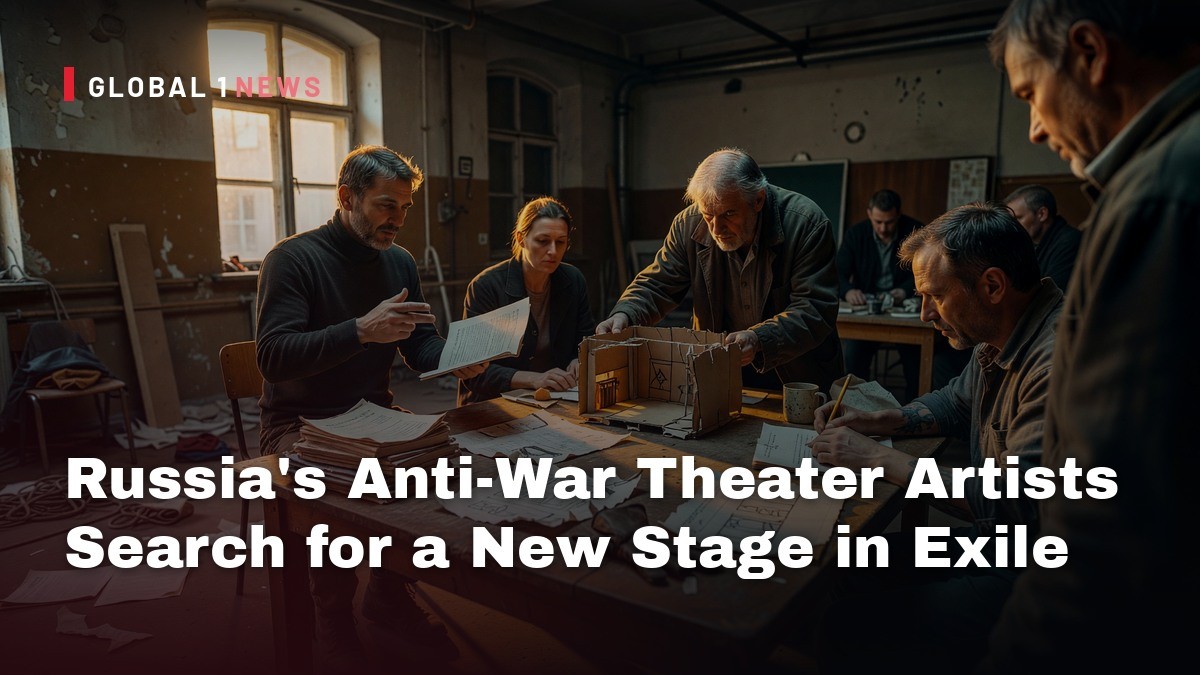
By October 2026, the exodus of Russian theater artists forced by the war in Ukraine has created a fragmented yet resilient diaspora, struggling to rebuild careers while confronting the realities of exile. The story of a handful of directors, actors and playwrights illustrates how state repression, censorship and the loss of institutional support have reshaped the Russian theatrical landscape abroad, and how new networks are emerging to keep the art form alive beyond the Kremlin’s reach.
From sold‑out festivals to empty rehearsal rooms
Kirill Serebrennikov, one of the most prominent Russian directors working in Europe, recently staged a ten‑day festival at Berlin’s Komische Oper that sold out months in advance. The event, which blended theater, film and public discussion in German, Russian and English, demonstrates how established artists can leverage international platforms to continue their work despite exile.
For the majority of less‑known practitioners, however, the picture is starkly different. Maya Dorozhenko, a 30‑year‑old director and screenwriter who graduated from Moscow’s GITIS school, recounts how she and her lead actress were forced to abandon a planned anti‑war production on Hannah Arendt after Russian venues deemed the project too risky. Their subsequent move to Yerevan left them rehearsing in a cramped room where “the narrow space between the bed and the wall” was the only stage available. Such conditions underscore the abrupt loss of professional infrastructure that many artists face when leaving Russia.
The tightening grip of censorship at home
Since the full‑scale invasion began, Russian theaters have been subjected to intensified state control. In 2024, director Yevgenia Berkovich and playwright Svetlana Petriychuk received six‑year penal colony sentences for “justifying terrorism” over a play about Russian women joining Islamist militants in Syria. While the official charge references terrorism, observers note that Berkovich’s outspoken anti‑war poetry and criticism of the invasion likely motivated the prosecution.
These high‑profile cases send a chilling signal to the artistic community: dissenting voices risk severe punishment, prompting many to seek safety abroad. The resulting brain drain has depleted the domestic theater scene of both emerging talent and seasoned professionals, further consolidating state‑approved narratives within Russia.
Geographic hubs of exile: Armenia, Georgia and beyond
Visa‑free access and sizable Russian‑speaking populations have turned Armenia and Georgia into primary destinations for displaced theater workers. Actor Yegor Rybakov, 43, relocated to Tbilisi in 2022 after receiving online threats of being reported to authorities for his Kremlin criticism and support for Ukraine. At the time, he performed in productions ranging from intimate shows for 35 spectators to massive performances for 5,000, illustrating the stark contrast between elite Moscow stages and the modest venues available in exile.
In Tbilisi, Rybakov has had to supplement his income by hosting events and teaching acting, while also navigating language barriers and the need to forge new professional connections. Similar challenges confront many exiles, who must decide whether to cater to Russian‑language audiences in diaspora communities or to integrate into local theater ecosystems that demand linguistic adaptation and cultural translation.
International breakthroughs and persistent obstacles
Some artists have managed to break into the broader European circuit. Director Anastasiia Anisimova, based in Paris, has seen her bilingual play “Deep Fake” performed in Tbilisi, Berlin, at the Avignon Festival and scheduled for Amsterdam. Yet even for such successes, funding constraints and bureaucratic hurdles remain significant. Anisimova emphasizes that “theater in exile is not about making money at all,” underscoring the primacy of artistic purpose over financial gain.
While Anisimova claims a personal opposition to overt political theater, she acknowledges that art and politics are intertwined, suggesting that the exile community negotiates a delicate balance between overt protest and broader artistic expression. This tension reflects a broader debate within the diaspora about the role of theater as a vehicle for dissent versus a space for universal storytelling.
Thematic focus on war, displacement and identity
Exiled productions frequently grapple with the war and its human toll. Works such as “Vanya Is Alive,” depicting a Russian soldier’s mother, and “Inostranka” (The Foreigner) explore the emotional landscape of those forced to leave their homeland. “Letters Home” similarly interrogates the experience of separation, offering audiences a window into the personal dimensions of geopolitical conflict.
These narratives provide a platform for artists to address subjects that would be censored within Russia, turning exile into a crucible for politically charged art. Yet, as Anisimova notes, not all exile theater is explicitly political; some creators seek to distance themselves from overt messaging, arguing that artistic integrity does not require constant alignment with political agendas.
Fragility of collaborative networks in exile
The instability of exile life hampers long‑term planning. Rybakov observes that constant movement—some artists relocating again, others staying put—disrupts rehearsals and project continuity. Dorozhenko echoes this sentiment, describing a four‑year period of “professional isolation” after leaving Russia, during which she and peers resorted to side jobs such as animation, teaching and other freelance work to survive.
These conditions force the community to rely on ad‑hoc collaborations and festival circuits to maintain cohesion. The Lubimovka festival, originally founded in Moscow in 1990, exemplifies this adaptive strategy. After moving abroad to evade censorship, it has evolved into a decentralized network of readings and collaborations spanning Europe, Asia and the United States, operating as a grassroots, nonprofit initiative.
Festivals as lifelines for a dispersed community
Festival platforms have become essential for sustaining the Russian theatrical diaspora. The Echo of Lubimovka series, for instance, emerged spontaneously as exiled artists sought venues for play readings, organizing events in cities such as Tbilisi and Tel Aviv when large‑scale productions in Moscow became impossible. These gatherings not only preserve a pipeline for new Russian‑language drama but also introduce the work to non‑Russian audiences, expanding its reach beyond the traditional diaspora.
By fostering connections across borders, festivals help mitigate the isolation that many exiled artists experience, offering a semblance of the professional networks lost at home. As the community continues to adapt, the interplay between grassroots initiatives and established international festivals will likely shape the future trajectory of Russian theater in exile, determining whether it remains a marginal diaspora art form or evolves into a significant cultural bridge between Russia and the wider world.
This article was produced with AI-assisted research and editorial support. Reporting is based on the source material cited below. Sources: The Moscow Times; themoscowtimes.com; Global1.News (24 October 2026).
By Irina Volkov, Staff Writer
What's Your Reaction?
 Like
0
 Dislike
0
 Love
0
 Funny
0
 Wow
0
 Sad
0
 Angry
0
Russia/Eastern Europe Correspondent at Global1.News. Covering Russian politics, energy, security, and the shifting dynamics of the post-Soviet space. Provides clear-eyed analysis on one of the world's most opaque regions.










Comments (0)