
IIT Bombay scholar builds low cost air purifier starting at ₹2,000, can bring down AQI by 85% - How he did it? Details
India’s battle with deteriorating air quality has entered a new phase as a young researcher from the Indian Institute of Technology Bombay seeks to democratise clean indoor air.
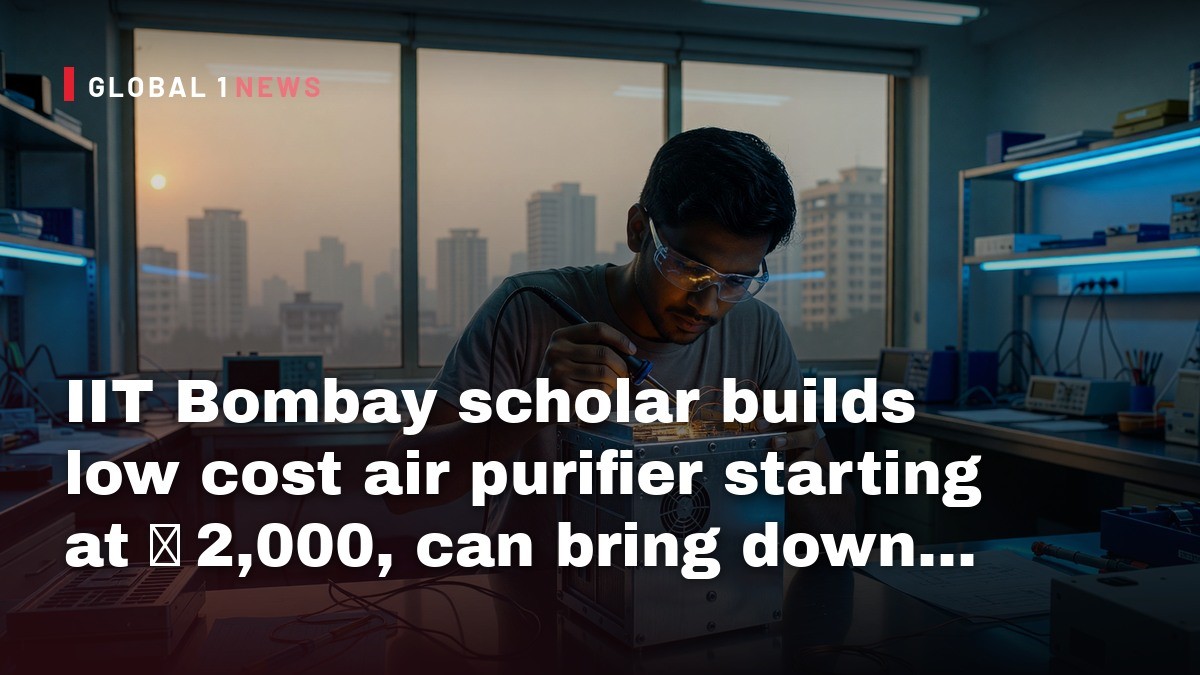
India’s battle with deteriorating air quality has entered a new phase as a young researcher from the Indian Institute of Technology Bombay seeks to democratise clean indoor air. Rohan Kumar, a 27‑year‑old civil‑engineering PhD scholar, is finalising an affordable air‑purification system that blends natural fibres, living plants and beneficial microbes. The Enviroforge Air Purifier, priced from roughly ₹2,000, claims to cut indoor pollution by up to 85 percent in laboratory trials, offering a potential lifeline to millions of households that cannot afford premium imported units.
Why indoor air quality matters in India’s urban centres
Recent readings from the Delhi‑NCR region illustrate the chronic nature of the problem: the capital recorded an AQI of 171 on a Thursday, categorised as “unhealthy”. Such levels are not confined to the north; Mumbai, too, reported an unhealthy index of 171 the previous day. Seasonal factors—post‑monsoon dust, winter temperature inversions and festival‑related fire‑crackers—exacerbate the situation, prompting a surge in demand for air‑purifying devices during the festive months.
While outdoor air quality can be monitored through government networks, indoor environments remain largely unregulated. In densely populated apartments and informal settlements, ventilation is often limited, and the cost of commercial purifiers—frequently exceeding ₹20,000—places them out of reach for lower‑income families. The gap between need and affordability creates a policy imperative: without scalable, low‑cost solutions, public health goals articulated in the National Clean Air Programme risk being undermined.
From wastewater treatment to air purification: Kumar’s interdisciplinary leap
Kumar’s journey began in the realm of wastewater treatment, where he learned to design low‑energy, high‑efficiency systems. He recognised that the same principles—layered filtration, adsorption, and biological degradation—could be transposed to address airborne contaminants. “Working with water treatment taught me how to design low‑energy, effective, and practical systems,” he told Livemint, underscoring the cross‑disciplinary nature of environmental engineering.
His personal exposure to varied air‑quality conditions across Bihar, Delhi, Gujarat, Karnataka and Maharashtra sharpened his resolve. Experiencing stark contrasts—from the smog‑laden streets of Delhi to relatively cleaner air in parts of Karnataka—highlighted the uneven access to clean indoor environments. This lived experience, combined with his academic background, propelled him to prototype a device that could be manufactured locally using readily available natural materials.
Design anatomy: natural fibres, adsorbents and living microbes
The Enviroforge Air Purifier integrates multiple treatment stages. Air first traverses layers of bamboo, coconut, banana and jute fibres, as well as muslin, cotton, silk and micro‑nano‑fibrillated cellulose. These fibrous matrices act as mechanical filters, capturing particulate matter such as PM2.5 and PM10. Subsequent layers incorporate activated carbon, bio‑char and zeolite—materials known for their high surface area and adsorption capacity—to trap gaseous pollutants like volatile organic compounds (VOCs) and nitrogen oxides.
What distinguishes Kumar’s design is the inclusion of a biological layer. Beneficial bacteria, cultivated to thrive on the adsorbent media, break down chemical pollutants through metabolic processes. Complementing the microbes, indoor plants are positioned to continuously photosynthesise, absorbing CO₂ and releasing oxygen while also filtering certain toxins. This synergy of physical, chemical and biological mechanisms reflects a “nature and science working together” approach, as Kumar described.
Cost tiers and market positioning
The pricing strategy is deliberately tiered to broaden market penetration. The entry‑level model is slated at approximately ₹2,000, positioning it alongside basic fans and LED lights in terms of household expenditure. Mid‑range variants, priced between ₹5,000 and ₹6,000, likely incorporate additional layers or larger surface areas for higher throughput. A premium version, around ₹10,000, may offer enhanced capacity, longer lifespan or integrated smart features, though specific differentiators have not been disclosed.
By anchoring the base price at ₹2,000, the product undercuts many imported alternatives, aligning with the Indian government’s “Make in India” ethos and encouraging domestic manufacturing. If the device achieves the claimed 80‑85 percent reduction in indoor pollutants, it could become a benchmark for low‑cost, high‑impact interventions, especially in low‑income urban housing and rural schools where indoor air quality is often overlooked.
Performance claims and the need for independent validation
Internal testing involved placing the purifier in an enclosed space of roughly 800 cubic feet. Within 20 minutes, the system reportedly achieved an 80‑85 percent reduction in air‑pollution metrics. While these figures are promising, they stem from a single, self‑reported trial and have yet to be corroborated by an external laboratory or certification body.
Independent validation is crucial for consumer confidence and for potential integration into public health programmes. Standards such as those set by the Bureau of Indian Standards (BIS) for indoor air‑purifiers require rigorous testing across varied pollutant concentrations, humidity levels and temperature ranges. Without such data, policymakers may be hesitant to endorse the device for large‑scale deployment, despite its attractive price point.
Commercialisation pathway: incubation, co‑founders and launch timeline
The Enviroforge project is incubated at the Indian Institute of Management Mumbai, indicating a structured business development framework. Kumar collaborates with co‑founders Vipul, Debashish and Abhinav, suggesting a multidisciplinary team that blends engineering, business and possibly supply‑chain expertise. The scheduled commercial launch in December 2026 aligns with the festive season, a period when consumer spending on home appliances typically spikes.
Given the incubation at IIM Mumbai, the venture is likely to benefit from mentorship in scaling production, navigating regulatory approvals and securing distribution networks. Partnerships with local manufacturers of natural fibres and bio‑char could further reduce costs and ensure a sustainable supply chain, while also supporting rural economies that produce these raw materials.
Policy implications and the road ahead for affordable clean‑air technologies
The emergence of a low‑cost, biologically‑enhanced air purifier dovetails with several national initiatives. The National Clean Air Programme (NCAP) emphasizes source‑based mitigation, yet acknowledges the role of indoor interventions in protecting vulnerable populations, especially children and the elderly. If the Enviroforge device proves effective in real‑world settings, it could be incorporated into NCAP’s recommended household measures, potentially qualifying for subsidies or inclusion in public health schemes.
Moreover, the device’s reliance on locally sourced natural materials aligns with the government’s push for circular economy practices. By converting agricultural residues into functional adsorbents and leveraging indigenous fibre industries, the purifier could stimulate green manufacturing clusters, echoing the objectives of the Ministry of New and Renewable Energy.
Looking forward, the critical next steps involve rigorous third‑party testing, certification and field trials across diverse Indian climatic zones. Successful validation would not only cement the Enviroforge Air Purifier’s credibility but also set a precedent for future low‑cost, bio‑engineered environmental technologies. In a country where air‑quality crises recur with alarming regularity, such innovations could become a cornerstone of public‑health‑oriented climate resilience.
This article was produced with AI-assisted research and editorial support. Reporting is based on the source material cited below. Sources: Livemint; livemint.com; Global1.News (24 October 2026).
By Dr. Raj Patel, Staff Writer
What's Your Reaction?
 Like
0
 Dislike
0
 Love
0
 Funny
0
 Wow
0
 Sad
0
 Angry
0

India/South Asia Correspondent at Global1.News. Analytical voice with a background in science and health journalism. Based in New Delhi, covering Indian politics, education, healthcare, technology, and policy. Breaks down complex data into clear, actionable reporting.















Comments (0)