
Equinix EPIC: Colo giant launches liquid-cooled testing environment for AI workloads
Equinix just rolled out its EPIC (Enhanced Performance Innovation Centers) in four flagship sites – Frankfurt, London, Osaka and Paris – and the move sends a clear signal: the colo giant is betting hard on liquid‑cooled AI hardware.
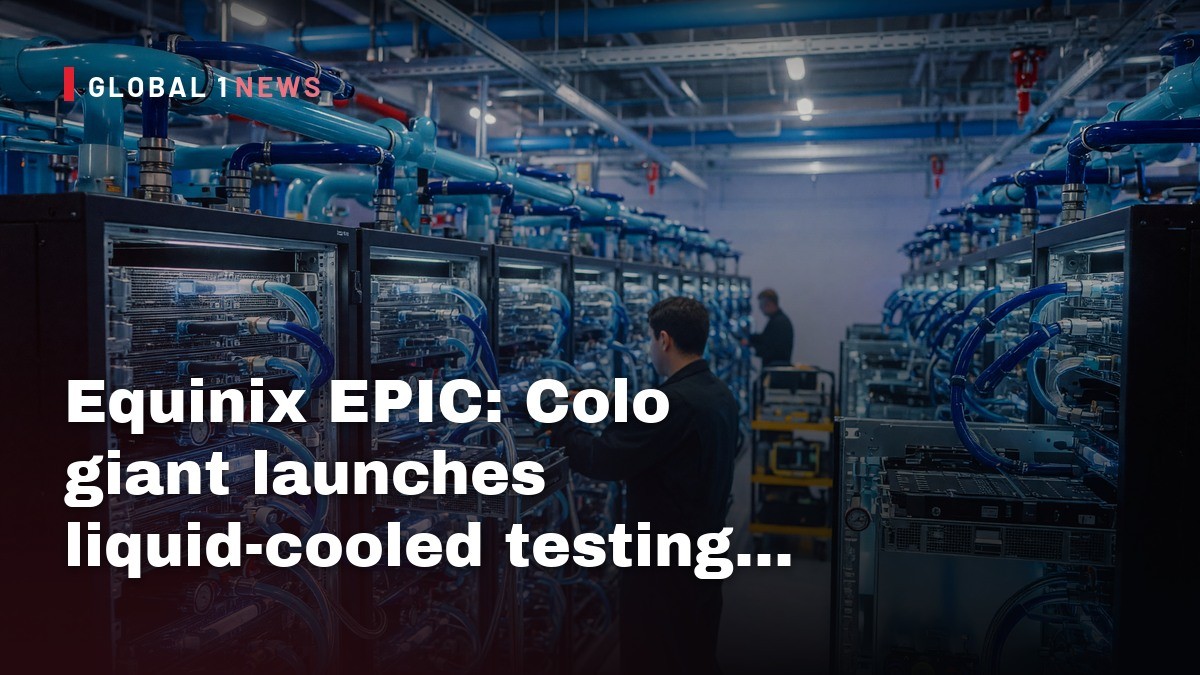
Equinix just rolled out its EPIC (Enhanced Performance Innovation Centers) in four flagship sites – Frankfurt, London, Osaka and Paris – and the move sends a clear signal: the colo giant is betting hard on liquid‑cooled AI hardware. From a founder’s perspective, the announcement is both a warning and an opportunity. It underscores how the market is shifting from the old “rack‑and‑fan” paradigm to a high‑density, liquid‑cooled reality, and it forces independent providers to ask whether they can afford to sit on the sidelines while the big players start handing out “test‑beds” for AI workloads.
Why liquid cooling is no longer a nice‑to‑have
Equinix’s own words make it plain: “Liquid cooling is an essential component of modern enterprise infrastructure and a hard requirement for customers deploying AI.” That’s not marketing fluff – it’s a reality check for anyone still relying on traditional air‑cooled chassis. The heat output of today’s GPU and CPU accelerators simply outpaces what a conventional data hall can dissipate without massive over‑provisioning of power and cooling.
For a provider running a modest footprint, the implication is stark. You either invest in liquid‑cooled racks, or you watch your customers drift to hyperscalers that already have the plumbing in place. The EPIC rollout is Equinix’s way of institutionalising that shift, offering a “production‑ready” environment where enterprises can trial high‑density AI gear without committing to a full‑scale build‑out.
The EPIC model: a test‑bed for the cautious
Equinix frames EPIC as a “global network of production‑ready liquid cooling environments” where businesses can “test, build and deploy high‑density AI infrastructure” with the backing of Equinix experts and hardware partners. The value proposition is simple: give customers a sandbox that mirrors real‑world conditions, then let them walk away with confidence that their designs will scale.
From a risk‑management angle, that’s a clever play. Enterprises can validate GPU‑heavy training or inference pipelines without the capital outlay of building their own liquid‑cooled racks. They also get on‑site support to “identify and solve operational issues ahead of full deployments.” In practice, that means fewer surprise failures when they go live, and a smoother path to production.
What this means for independent colos
Independent providers have been hearing the same hype about AI for years, but the EPIC launch makes the pressure concrete. If you’re running a mid‑size data centre with traditional cooling, you now have a clear benchmark: customers will expect liquid‑cooled options or risk being poached by the likes of Equinix. The cost of retrofitting a facility with liquid cooling is non‑trivial, but the alternative – losing high‑margin AI workloads – is a bigger threat.
One practical response is to partner with hardware vendors that already offer liquid‑cooled modules and to start small pilot projects in a dedicated aisle. You don’t need to replicate Equinix’s global footprint, but you do need to prove you can deliver the same “production‑ready” experience – reliability, uptime, and on‑site expertise.
The role of ecosystem partners
Equinix leans heavily on its “hardware partners” to supply the liquid‑cooled GPU and CPU platforms that customers will trial. That ecosystem approach is a reminder that the hardware side of AI is as competitive as the real‑estate side. Vendors that can bundle their accelerators with liquid‑cooling solutions become natural allies for colos looking to attract AI workloads.
For independent operators, cultivating relationships with these partners can be a differentiator. By offering a curated selection of validated, liquid‑cooled hardware, you can position your facility as a trusted testing ground, much like Equinix’s EPIC but on a scale that matches your capacity.
From validation to production: the EPIC pipeline
The EPIC offering builds on Equinix’s earlier Solution Validation Centers, launched in 2024 for “regular workloads.” The progression is logical: first prove the concept with standard applications, then layer on the added complexity of AI’s power and cooling demands. This staged approach reduces risk for both the provider and the customer.
For a founder, the lesson is to adopt a similar phased rollout. Start with a validation environment that lets customers test low‑density workloads, then expand to high‑density, liquid‑cooled zones as demand grows. This incremental investment protects cash flow while still keeping pace with market expectations.
Looking ahead: EPIC expansion and the AI arms race
Equinix says it will add more EPIC locations in 2027, signalling a longer‑term commitment to AI‑focused infrastructure. The company also highlighted a recent collaboration with Nvidia and Together AI on an inference platform, underscoring the strategic importance of AI to its roadmap.
That forward‑looking plan is a clear indicator that the AI infrastructure market will keep tightening around providers who can deliver liquid‑cooled, high‑density environments at scale. Independent colos must decide whether to double‑down on niche, highly‑engineered services or risk being sidelined as the hyperscalers and large colos lock down the premium AI segment.
Actionable steps for founders
First, audit your current cooling capacity against the heat density of modern AI accelerators. If you’re already operating near the limits of air cooling, the gap to liquid cooling is a strategic priority, not a nice‑to‑have upgrade.
Second, map out a validation program that mirrors EPIC’s model: create a dedicated test aisle, partner with at least one hardware vendor that offers liquid‑cooled modules, and staff it with engineers who can troubleshoot AI workloads in real time. This will give you a tangible selling point when courting AI‑focused customers.
Third, factor the cost of liquid‑cooling retrofits into your capital planning and explore financing options that align with the revenue cycles of AI projects, which often involve multi‑year contracts.
Finally, keep an eye on the broader ecosystem. As Equinix expands EPIC and other large players double down, the market will reward those who can deliver the same confidence and support at a lower price point. Your competitive edge will be the combination of hands‑on expertise, flexible pricing, and the willingness to roll up your sleeves and get into the nitty‑gritty of liquid‑cooled AI deployments.
— Allan Ali, Founder
This article was produced with AI-assisted research and editorial support. Reporting is based on the source material cited below. Sources: Data Center Dynamics; datacenterdynamics.com; Global1.News (21 October 2026).
By Allan Ali, Global1.News
What's Your Reaction?
 Like
0
 Dislike
0
 Love
0
 Funny
0
 Wow
0
 Sad
0
 Angry
0

Publisher of Global1.News. Automation architect, systems builder, and the guy making sure the truth gets published.












Comments (0)