
DILG chief Remulla says he regrets not arresting Bato dela Rosa
Interior Secretary Jonvic Remulla publicly expressed remorse on Monday, October 19, for a decision that allowed fugitive Senator Bato dela Rosa to slip away from the Senate’s jurisdiction earlier this year.
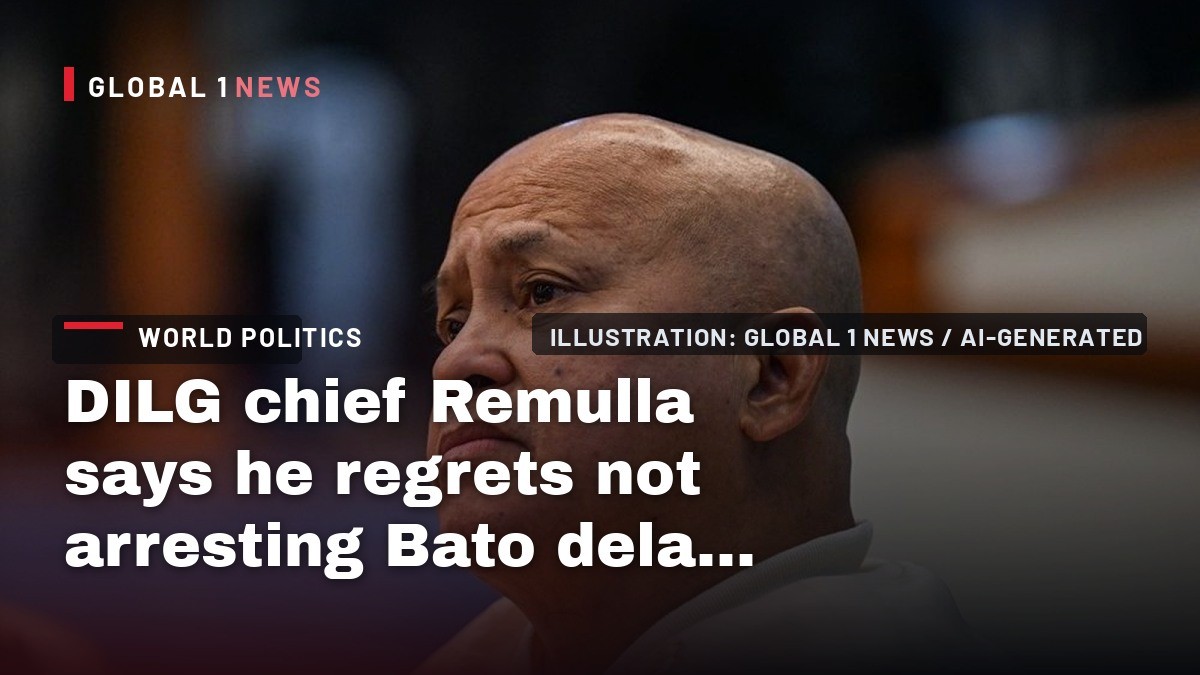
Interior Secretary Jonvic Remulla publicly expressed remorse on Monday, October 19, for a decision that allowed fugitive Senator Bato dela Rosa to slip away from the Senate’s jurisdiction earlier this year. In an interview with ANC, Remulla admitted that a “gentleman’s agreement” he reached with Senator Alan Peter Cayetano—intended to keep the Senate’s autonomy intact—ultimately cost the government a critical chance to detain a lawmaker already wanted by the International Criminal Court (ICC). The admission has sparked a fresh wave of debate in the Senate, the Department of Justice, and among ordinary Filipinos who wonder how political bargains intersect with the pursuit of justice for alleged crimes against humanity.
Background on the “gentleman’s agreement”
The agreement in question was a private understanding between Secretary Remulla and Senator Cayetano, reached before May 2026. Its purpose, as Remulla described, was to honor the Senate’s long‑standing practice of allowing lawmakers to avoid arrest while on the Senate floor. By “honoring” this practice, the two officials hoped to preserve the legislative branch’s independence from executive enforcement actions.
However, the arrangement proved problematic when the ICC issued an arrest warrant for Senator dela Rosa on May 11, 2026. The warrant, which cited alleged involvement in the killing of at least 32 people during the drug war under former President Rodrigo Duterte, placed the senator squarely in the crosshairs of both domestic and international law‑enforcement agencies. The “gentleman’s agreement” thus became a point of contention: it shielded a lawmaker from immediate detention while the ICC’s demand for accountability grew louder.
The missed arrest on Senate premises
On May 13, a violent clash erupted between personnel of the Office of the Senate Sergeant at Arms and agents of the National Bureau of Investigation. The confrontation, occurring within the Senate’s precincts, underscored the tension between law‑enforcement duties and legislative privilege. The following morning, Senator dela Rosa escaped the Senate compound by boarding the van of fellow lawmaker Senator Robin Padilla.
Padilla, who now faces complaints of obstruction of justice before the Department of Justice, allegedly facilitated the escape. Remulla recounted that he had informed Cayetano of the lost “privilege”—the ability of law‑enforcement officers to detain a lawmaker on Senate grounds—once the senator fled. The missed opportunity to arrest dela Rosa inside the Senate remains a sore point for Remulla, who said, “I dropped the ball. I should have arrested him in the Senate.”
Government’s current stance on the fugitive senator
According to Remulla, Senator dela Rosa is believed to be hiding in Mindanao under the protection of a “powerful group” with which the government is presently negotiating for his turnover. While the administration maintains that it possesses the legal authority to apprehend the senator, Remulla emphasized that a large‑scale tactical operation is off the table because of the risk of casualties.
“We do not want a civil war to start because of our arrest of one man,” Remulla warned. He added that any action must be “proper, judicious, and clean.” This cautious approach reflects the delicate balance the executive seeks to maintain: upholding the rule of law while avoiding a flashpoint that could destabilize already volatile regions in the south.
Implications for the ICC and international accountability
The ICC’s involvement adds a layer of complexity to the domestic political drama. The court’s arrest warrant, issued on May 11, specifically accuses Senator dela Rosa of crimes against humanity tied to the Duterte‑era drug war. The alleged killings, said to number at least 32 victims between July 2016 and April 2018, place the case among the most serious human‑rights inquiries the Philippines has faced in recent years.
International observers have noted that the Philippines’ cooperation—or lack thereof—with the ICC could signal the nation’s broader commitment to human‑rights norms. Remulla’s admission of regret may be read as an attempt to reassure both domestic and foreign audiences that the government is not willfully obstructing justice, even as it navigates politically sensitive terrain.
Political fallout within the Senate
The episode has reignited debates over the Senate’s privilege to shield its members from arrest. Critics argue that the “gentleman’s agreement” set a dangerous precedent, allowing a lawmaker facing serious international charges to evade immediate custody. Supporters, however, contend that preserving legislative independence is essential to a functioning democracy, especially when the executive branch wields significant coercive power.
Senator Jinggoy Estrada’s own arrest on June 1—over plunder charges—served as a stark reminder that the Senate’s protective shield is not absolute. Estrada’s detention, carried out personally by Remulla, demonstrated that the Department of Justice can and will act when the alleged crimes are deemed severe enough. The contrast between Estrada’s swift arrest and dela Rosa’s escape may fuel calls for clearer guidelines on when and how law‑enforcement agencies can intervene in legislative matters.
Impact on ordinary Filipinos and the broader fight for justice
For many Filipinos, especially those in barangays and small sari‑sari stores, the saga is more than a political drama; it is a reflection of how the state protects—or fails to protect—its citizens from abuse. The alleged killings tied to the drug war have left deep scars in communities across Luzon, Visayas, and Mindanao. Families who lost loved ones often recount the fear that the same forces that once hunted drug suspects now operate with impunity.
Remulla’s acknowledgment of a “mistake” resonates with a public that has long called for accountability. While the government’s cautious approach aims to prevent further bloodshed, ordinary Filipinos continue to demand that the law be applied equally, whether the accused sits in a Senate chamber or a provincial barangay hall. The outcome of negotiations for dela Rosa’s surrender will likely shape public trust in both the Department of the Interior and the broader justice system.
Looking ahead: possible scenarios and next steps
As negotiations with the “powerful group” protecting Senator dela Rosa continue, several scenarios could unfold. A voluntary turnover could pave the way for a smooth handover to the Department of Justice, allowing the ICC’s warrant to be executed without further bloodshed. Conversely, a stalled or failed negotiation might compel the government to consider a more forceful operation, risking the very civil conflict Remulla warned against.
Regardless of the path taken, the episode underscores the need for clearer protocols when international arrest warrants intersect with domestic legislative privileges. Lawmakers, law‑enforcement officials, and civil society groups may push for legislative reforms that balance the Senate’s autonomy with the imperatives of justice and human‑rights compliance. For now, the nation watches as the government navigates a delicate dance—honoring its democratic institutions while confronting the weight of international accountability.
This article was produced with AI-assisted research and editorial support. Reporting is based on the source material cited below. Sources: Philstar.com; Global1.News (20 October 2026).
By Bella Reyes, Staff Writer
What's Your Reaction?
 Like
0
 Dislike
0
 Love
0
 Funny
0
 Wow
0
 Sad
0
 Angry
0

Philippines/Southeast Asia Correspondent at Global1.News. Manila-based journalist covering Philippine politics, environment, maritime security, and social issues. Passionate about marine conservation and the communities protecting the Philippines' natural heritage.












Comments (0)