
Bougainville Needs a Credible Timetable for PNG’s Independence Vote. Australia Can Help.
The 2001 Bougainville peace agreement, signed in the aftermath of a decade‑long civil war, stipulated that a referendum on independence be held within ten to fifteen years of the establishment of the Autonomous Bougainville Government.
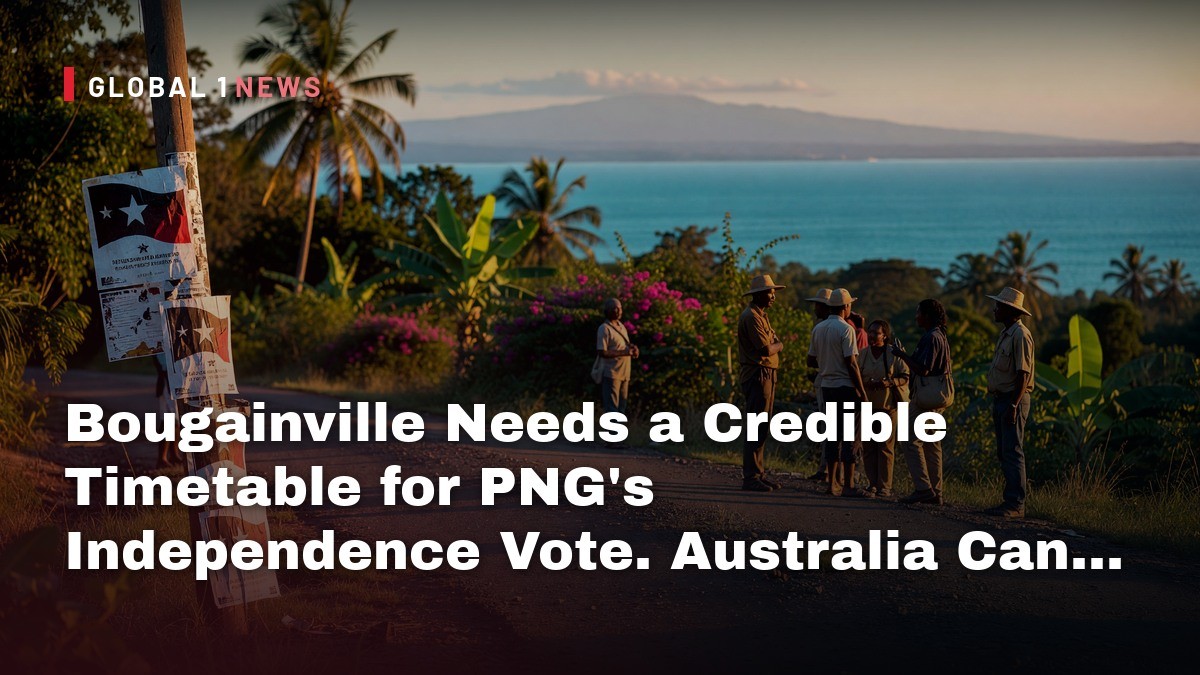
The 2001 Bougainville peace agreement, signed in the aftermath of a decade‑long civil war, stipulated that a referendum on independence be held within ten to fifteen years of the establishment of the Autonomous Bougainville Government. The referendum, conducted in 2019, produced a 97.7 percent vote in favour of secession, yet the result was expressly non‑binding, leaving the final decision to the Parliament of Papua New Guinea (PNG). Seven years on, the absence of a statutory deadline for parliamentary action has created a protracted political limbo that now threatens to erode the fragile trust that underpins the peace process.
Historical framework of the Bougainville peace process
The 2001 peace agreement and the subsequent 2022 Era Kone Covenant constitute the principal legal instruments governing Bougainville’s path to self‑determination. While the peace agreement mandated a referendum within a ten‑to‑fifteen‑year window, it deliberately granted PNG’s parliament the ultimate authority to endorse or reject independence, without prescribing a concrete timetable for that parliamentary decision. The Era Kone Covenant attempted to impose an outer limit of 2027 for any final settlement, yet it likewise omitted a specific date for the parliamentary vote. Moreover, the covenant’s sole interim deadline—to table the referendum result in parliament by the end of 2023—was missed by almost three years, underscoring the chronic postponement of the issue.
These documents reflect a delicate balance: they recognise Bougainville’s right to self‑determination while preserving PNG’s constitutional sovereignty. The resulting ambiguity, however, has become a structural vulnerability. Each missed deadline not only delays a political resolution but also tests the credibility of former combatants who now serve as political leaders, many of whom built their legitimacy on the promise that a negotiated political process would deliver a definitive answer.
Current parliamentary stalemate and its procedural dimensions
Prime Minister James Marape’s proposal to hold a parliamentary vote on 30 August 2026 was formally received on 27 August, after which the legislature adjourned without casting a vote. The subsequent two‑day debate scheduled by Peter Tsiamalili Jr., Bougainville’s regional MP and leader of government business, for 20‑21 October represents a modest procedural advance. Yet the agenda does not clarify whether the debate will culminate in a binding vote or merely a postponement, leaving Bougainville’s leadership uncertain about the next steps.
Compounding the procedural opacity is the three‑quarters majority threshold (89 of 118 members) that parliament set in June for ratification. Bougainville’s leaders have contested both the numerical threshold and the process by which it was adopted, arguing that the rule was imposed without adequate consultation. This dispute illustrates how procedural disagreements can become politicised, potentially undermining the legitimacy of any eventual decision.
Political timing and the looming PNG election
The provisional parliamentary timetable schedules the national election for 26 June to 9 July 2027. Should parliament fail to vote before that window, the decision on Bougainville’s status will be transferred to a newly elected legislature, which will be only a month old when the “firm timetable” set by Bougainville’s leadership—September 1, 2027—takes effect. This temporal overlap creates a high‑risk scenario: a nascent parliament may inherit a contentious agenda without a clear mandate, increasing the likelihood of further delays or a reversal of prior commitments.
From a strategic perspective, the synchronisation of the parliamentary vote with the election cycle raises questions about political incentives. Incumbent parties may be reluctant to endorse a decisive outcome that could polarise the electorate, while opposition forces might leverage the issue to rally support. The timing thus injects domestic political calculus into a matter that is fundamentally about the future of a distinct polity.
Australia’s diplomatic position and strategic interests
Australia’s involvement in the Bougainville process is anchored in its historical role as a co‑signatory of the 2001 peace agreement and as the lead nation of the Peace Monitoring Group that oversaw the ceasefire. Under the Pukpuk Treaty, which entered into force in July, Australia and PNG are formal allies with an obligation to consult on threats to each other’s sovereignty, peace, or stability. Consequently, any escalation of tension between Port Moresby and Buka could obligate Canberra to intervene diplomatically, a scenario it would prefer to avoid.
Australian officials have consistently articulated a policy of non‑interference in the ultimate outcome of the independence question. Deputy Prime Minister Richard Marles, in 2022, framed Canberra’s role as “supporting Papua New Guinea.” Nevertheless, the Australian government can exert constructive influence by encouraging PNG to adhere to a credible timetable, thereby preserving regional stability and upholding its own alliance commitments without dictating the substantive result.
Potential consequences of indefinite postponement
Each extension of the parliamentary decision‑making window erodes the trust that underpins the Bougainville peace accords. President Ishmael Toroama, a former rebel commander turned political leader, has warned that “trust is under strain” as delays accumulate. The longer Bougainville’s populace must wait for a definitive answer, the greater the risk that former combatants and civil society groups will become disillusioned, potentially reviving grievances that could destabilise the region.
Moreover, the absence of a clear deadline creates a strategic opening for hardliners on both sides. In PNG, nationalist factions may argue that any concession threatens territorial integrity, while in Bougainville, separatist elements may view prolonged inaction as a betrayal, prompting calls for unilateral action. The combination of political impatience and unresolved procedural disputes heightens the spectre of renewed conflict, undermining the decades‑long peacebuilding effort.
Pathways for Australian facilitation
Australia can play a constructive role by leveraging existing ministerial dialogues to secure a concrete parliamentary vote date and a transparent schedule for resolving the disputed three‑quarters majority rule. Such facilitation would not prescribe the outcome but would ensure that the process does not languish indefinitely. Additionally, Australia could assist in documenting any joint statements between Prime Minister Marape and President Toroama, establishing a public record of agreed timelines, contested issues, and contingency plans should the next deadline be missed.
In the event that a pre‑election vote proves infeasible, a jointly authored record—maintained by both PNG and Bougainville with Australian consent—could serve as a safeguard, ensuring that the transition of parliamentary authority does not erase prior commitments. By acting as a neutral custodian of this record, Canberra would reinforce the credibility of the peace process while respecting PNG’s constitutional prerogatives.
Forward‑looking assessment and policy recommendations
Given the convergence of procedural ambiguity, electoral timing, and regional security considerations, the imperative for a credible timetable is acute. The 2027 outer limit set by the Era Kone Covenant remains the final deadline for any settlement, but the lack of an intermediate parliamentary deadline risks compressing a complex decision into a narrow post‑election window. To mitigate this risk, the following steps are advisable:
- Secure a definitive parliamentary vote date before the PNG election, ideally through a joint declaration by Prime Minister Marape and President Toroama, with Australian diplomatic endorsement.
- Clarify the voting threshold by convening a bilateral technical committee—potentially facilitated by Australia—to reconcile the contested three‑quarters majority rule with constitutional norms.
- Establish a transparent monitoring mechanism that publicly reports progress, missed deadlines, and reasons for any delays, thereby sustaining Bougainvillean public confidence.
- Prepare a contingency framework for a post‑election vote, including a pre‑agreed schedule for parliamentary deliberations and a clear protocol for handling dissenting positions.
Implementing these measures would not only advance the immediate objective of a credible timetable but also reinforce the broader architecture of peace and stability in the western Pacific. By aligning diplomatic facilitation with the expressed wishes of both PNG and Bougainville, Australia can help ensure that the long‑awaited question of Bougainville’s political status is resolved through a transparent, accountable, and mutually respected process, rather than being deferred into an uncertain future.
This article was produced with AI-assisted research and editorial support. Reporting is based on the source material cited below. Sources: The Diplomat; thediplomat.com; Global1.News (24 October 2026).
By Prof. David Park, Staff Writer
What's Your Reaction?
 Like
0
 Dislike
0
 Love
0
 Funny
0
 Wow
0
 Sad
0
 Angry
0

East Asia/Technology Correspondent at Global1.News. Seoul-based voice covering Korean politics, technology, business, and culture. Analyzes how technology and geopolitics intersect across East Asia.










Comments (0)