
Why Thailand Should Accept Cambodia’s Offer to Normalise Diplomatic Ties Now
Over the past year, the border between Thailand and Cambodia has been more than a line on a map; it has become a flashpoint for grief, displacement and a surge of hostile rhetoric that has seeped into everyday conversations.
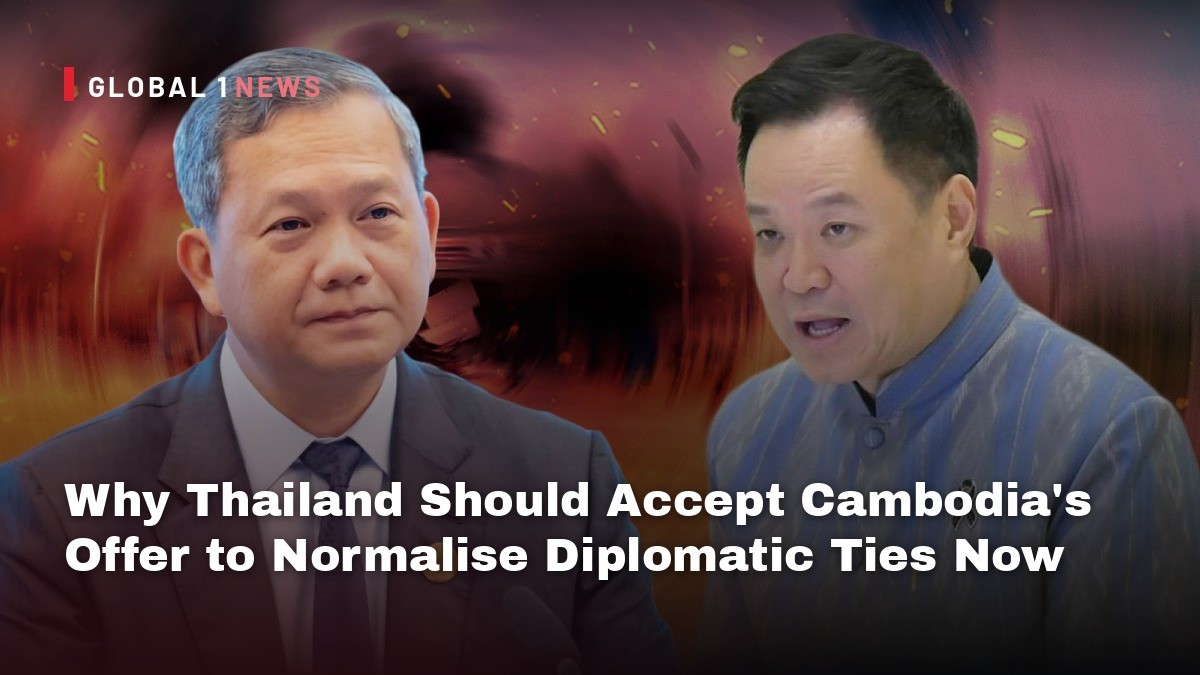
Over the past year, the border between Thailand and Cambodia has been more than a line on a map; it has become a flashpoint for grief, displacement and a surge of hostile rhetoric that has seeped into everyday conversations. In a televised interview on Tuesday, Cambodian Deputy Prime Minister and Foreign Minister Prak Sokhonn extended an olive branch, urging both nations to restore full diplomatic representation and move beyond the recent clashes. His appeal, aired on National Television of Cambodia (TVK) after the second meeting of the Cambodia–Thailand Conciliation Commission under UNCLOS, carries a message that resonates deeply with the Buddhist principle of compassion and the Thai value of “nam jai” – generosity of spirit.
Why the diplomatic downgrade matters
Since the undeclared war began, diplomatic ties have been reduced to the level of second secretaries – the lowest rung of representation between the two neighbours. Prak described this as “the lowest level of representation,” underscoring how the lack of senior diplomats hampers direct dialogue and quick conflict resolution. In Thai and Cambodian societies, where personal relationships and face‑to‑face communication are central to resolving disputes, such a downgrade leaves a void that can be filled only by mistrust and speculation.
Beyond the practical challenges, the downgrade has symbolic weight. In Buddhist thought, the health of a relationship mirrors the health of the mind; when communication breaks down, anxiety and anger grow. The current diplomatic limbo has allowed a “runaway metamorphosis of mutual hate speech” across social media and in the press, turning ordinary citizens into unwilling participants in a war of words. Restoring full diplomatic channels would re‑establish a respected avenue for calm, measured discussion, aligning with the cultural emphasis on maintaining harmony (santi) in the region.
The human cost of the conflict
The past twelve months have seen not only artillery exchanges but also a tragic loss of life. Dozens of soldiers and civilians have been killed, and tens of thousands of people have been displaced on both sides of the border. These figures, while stark, only hint at the deeper wounds inflicted on families, villages and the collective psyche of border communities. In Thai villages, the sound of distant gunfire disrupts the rhythm of rice planting, while in Cambodian towns, markets once bustling with Thai tourists now stand eerily quiet.
For monks and elders who counsel their communities, the ongoing hostility creates a climate of fear that contradicts the teachings of impermanence and non‑attachment. The Buddhist notion that suffering arises from clinging to anger offers a powerful lens through which to view the conflict: the longer the hostility persists, the deeper the karmic imprint on both societies. Healing, therefore, requires more than a ceasefire; it demands a restoration of trust through diplomatic engagement.
Economic implications for both nations
Thailand’s projected GDP growth of 2.1 percent this year and a similar outlook for 2027 places the country among the slower‑growing economies in ASEAN. While the numbers are modest, they reflect a broader reality: the conflict has diverted attention and resources away from pressing economic challenges. The boycott of Thai products in Cambodia and the sharp decline in Thai tourists – who once formed the largest group of foreign visitors to Cambodia – have compounded these pressures.
Normalising relations would open the door to lifting the boycott and welcoming back Thai travellers, reviving border markets that sustain countless families. The resumption of ambassadorial‑level ties would also smooth the path for continued UNCLOS negotiations and future border talks, creating a stable environment for cross‑border trade and investment. In a region where economies are increasingly interlinked, a peaceful Thai‑Cambodian corridor could become a conduit for broader Southeast Asian prosperity.
Political dynamics within Thailand
Domestically, the conflict has become a political flashpoint. The main opposition People’s Party, which has ridden “ultranationalist waves” over the past year, has offered little resistance to the two brief undeclared wars. Meanwhile, the Pheu Thai Party, reflecting on its own handling of Thai‑Cambodian relations when it was in government last year, faces an opportunity to demonstrate responsible leadership by urging the ruling coalition to accept Prak’s offer.
Deputy Prime Minister and Foreign Minister Sihasak Phuangketkeow now stands at a crossroads. Accepting the olive branch would signal a willingness to move beyond the zero‑sum mindset that has dominated recent discourse, while rejecting it could risk “causing Cambodia to lose face,” making future rapprochement more difficult. The decision, therefore, carries weight not only for diplomatic protocol but also for the credibility of Thailand’s democratic institutions.
The role of civil society and the media
Both Thai and Cambodian media have, at times, amplified the conflict, often highlighting negative news with a sense of schadenfreude. This “race to the bottom” distracts citizens from pressing concerns such as livelihoods, health and education. Yet, the same media platforms hold the power to reshape narratives, promoting stories of cooperation, shared cultural heritage and mutual respect.
Community leaders, monks and teachers can also play a pivotal role. By organising inter‑border cultural exchanges, joint festivals and dialogue sessions, they can foster person‑to‑person connections that counteract the prevailing hostility. In Buddhist societies, the practice of “metta” – loving‑kindness – can be a guiding principle for civil society to bridge the divide, reminding both peoples that the path to peace begins with compassion at the grassroots level.
Regional and international perspectives
The conflict has not gone unnoticed beyond the two capitals. The Japanese Embassy in Bangkok, for example, faced a barrage of angry comments on its Facebook page after merely suggesting the reopening of border checkpoints to ease supply‑chain disruptions. This incident illustrates how the Thai public’s frustration can spill over onto allies, risking collateral damage to diplomatic relationships that Thailand values.
Within the broader ASEAN framework, stability on the Thai‑Cambodian frontier is essential for collective security and economic integration. The UNCLOS talks, which continue under the Cambodia–Thailand Conciliation Commission, are a testament to the willingness of both sides to engage in rule‑based dialogue. Restoring full diplomatic ties would reinforce ASEAN’s principle of non‑interference and showcase the region’s capacity to resolve disputes peacefully.
Looking ahead: a legacy for future generations
Perhaps the most compelling reason to accept Prak’s proposal lies in the responsibility owed to the younger generations of both nations. The conflict’s “toxic legacy” threatens to be inherited by children who have already known displacement, loss and a climate of suspicion. In Thai and Cambodian cultures, where respect for elders and the concept of “karma” intertwine, the moral imperative to break this cycle is clear.
By moving swiftly to restore ambassadorial‑level relations, Thailand and Cambodia can demonstrate that peace is not a distant ideal but a practical, everyday choice. Such a step would send a powerful message to schools, monasteries and families: that dialogue, compassion and mutual respect are the foundations of a shared future. As the Buddhist calendar turns, the hope is that both peoples can step into a new year of harmony, leaving behind the shadows of conflict and embracing the bright possibilities of cooperation.
This article was produced with AI-assisted research and editorial support. Reporting is based on the source material cited below. Sources: Khaosod English; khaosodenglish.com; Global1.News (23 October 2026).
By Ann Srisawat, Staff Writer
What's Your Reaction?
 Like
0
 Dislike
0
 Love
0
 Funny
0
 Wow
0
 Sad
0
 Angry
0
Southeast Asia Correspondent at Global1.News. Based in Bangkok, covering Thai and Southeast Asian politics, economy, technology, and culture. Deep regional perspective on one of the world's most dynamic regions.











Comments (0)