
Ukrainian Drone Strike Sparks Fire at Oil Transit Hub in Tambov Region
Early on Tuesday, a Ukrainian drone strike ignited a blaze at a key oil‑pipeline hub in Russia’s Tambov region, underscoring the expanding front of the conflict beyond Ukraine’s borders.
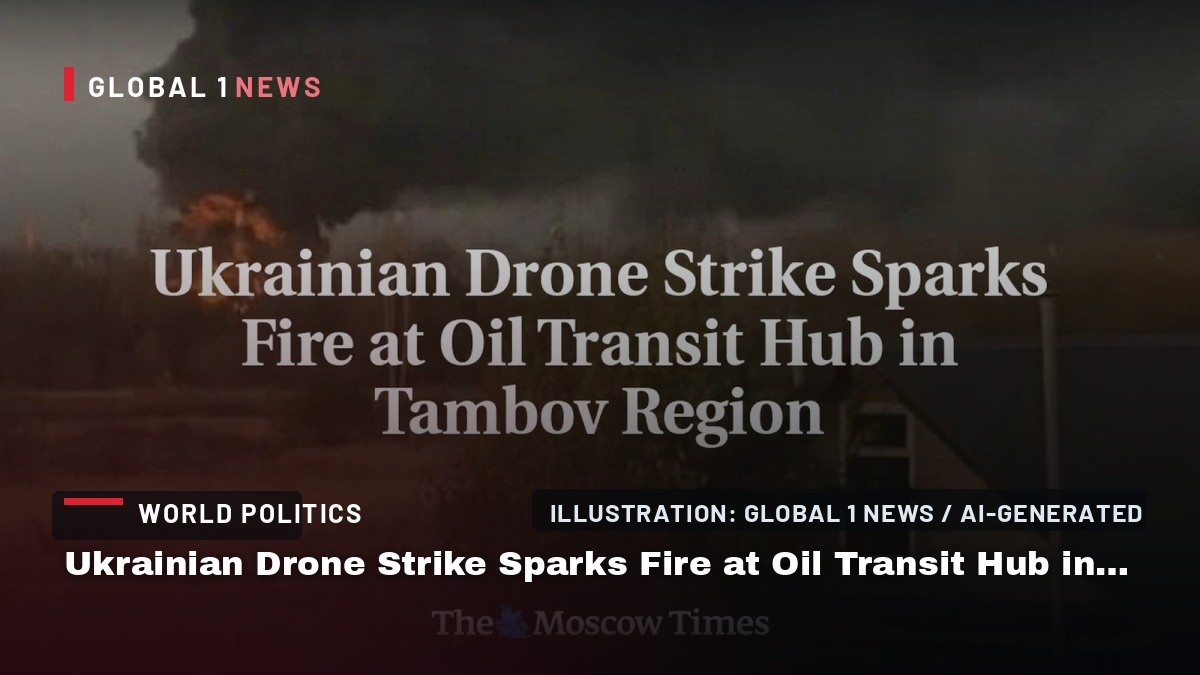
Early on Tuesday, a Ukrainian drone strike ignited a blaze at a key oil‑pipeline hub in Russia’s Tambov region, underscoring the expanding front of the conflict beyond Ukraine’s borders. The incident, confirmed by regional authorities, targeted a Transneft facility that serves as a critical node on the Druzhba pipeline, which supplies crude and refined fuels to a swath of Eastern and Central Europe. The attack, its timing, and the surrounding diplomatic developments reveal a complex interplay of military, economic, and political pressures that are reshaping the Kremlin’s strategic calculus.
Location and Immediate Impact of the Strike
Governor Yevgeny Pervyshov reported that a fire broke out at “one of the enterprises in the Michurinsky district,” without initially naming the specific installation. He confirmed that no casualties were reported among personnel on site. The district houses Transneft’s Nikolskoye linear production and dispatch station, a facility identified by the exiled news outlet Astra through eyewitness footage as the precise target of the drone attack.
The Nikolskoye station functions as a hub for receiving, storing, and transporting a range of petroleum products—including diesel, gasoline, jet fuel and fuel oil. Its pumping capacity is estimated at 300,000 metric tons per day, making it a substantial conduit for Russian energy exports to Europe. The fire, while quickly contained, temporarily disrupted the flow of these commodities, raising questions about the vulnerability of Russia’s energy infrastructure to low‑cost aerial attacks.
Ukrainian Operational Reach
Official statements from Ukrainian authorities have not been released regarding the operation, but the use of a drone to strike a high‑value target deep within Russian territory signals an escalation in Kyiv’s offensive capabilities. The choice of a pipeline hub—rather than a military installation—suggests a strategic intent to undermine Russia’s energy revenue streams, which remain a cornerstone of the Kremlin’s fiscal resilience amid Western sanctions.
Analysts interpret the attack as part of a broader Ukrainian doctrine that leverages asymmetrical tools to impose economic costs on Russia. By targeting the Druzhba pipeline, Ukraine not only disrupts a logistical node but also sends a message to European consumers and governments that Russian energy supplies are increasingly exposed to conflict‑related risks.
Parallel Developments on the Frontlines
In a separate incident, a Russian drone struck near a highway linking Kyiv to the Black Sea port of Odesa, killing three people, according to the Ukrainian prosecutor’s office. This attack underscores the reciprocal nature of aerial warfare in the region, where both sides employ unmanned systems to target infrastructure and civilian areas alike.
Concurrently, a Russian offensive on Ukrainian energy assets left more than 32,700 families in the Odesa region without electricity after strikes on three facilities of DTEK, the country’s largest private energy company. The loss of power for tens of thousands of households highlights the humanitarian dimension of energy targeting, a tactic that has become a recurring feature of the conflict’s escalation.
U.S. Diplomatic Maneuvering and Its Energy Implications
On the same day as the Tambov strike, former U.S. President Donald Trump announced an agreement with the Kremlin to increase Russian diesel exports to global markets. The deal was framed as a response to rising energy prices driven by the ongoing U.S.–Israeli war with Iran, positioning Russian diesel as a stabilising factor in world markets.
This diplomatic overture, however, sits uneasily alongside the Kremlin’s recent designation of The Moscow Times as an “undesirable” organization—a label that criminalises the outlet’s operations and threatens its staff with prosecution. The juxtaposition of a commercial agreement with heightened repression of independent media suggests a Kremlin strategy that seeks to extract economic concessions while tightening internal control over the narrative surrounding the war.
Strategic Significance of the Druzhba Pipeline
The Druzhba pipeline, one of the world’s longest oil transport networks, has long been a lever of Russian foreign policy, delivering fuel to countries that rely on Moscow’s energy supplies. Disruption at the Nikolskoye station, even temporarily, can ripple through the supply chain, potentially prompting European refiners to seek alternative sources or to reassess inventory levels.
From an analytical perspective, the attack may be intended to test the resilience of the pipeline’s operational redundancies. If repeated strikes can force the Kremlin to divert resources to repair and security, the cumulative economic strain could erode Russia’s ability to fund its war effort, especially as sanctions continue to tighten.
Domestic Repression and Information Control
In the wake of the attack, Russia’s Prosecutor General’s Office designated The Moscow Times as an “undesirable” organization, a move that criminalises its reporting and places its journalists at risk of prosecution. This action follows an earlier classification of the outlet as a “foreign agent,” reflecting an intensifying crackdown on independent media that challenges the official narrative.
Such legal pressures are part of a broader Kremlin strategy to control information about the war and related incidents. By silencing outlets that provide detailed accounts of attacks on Russian infrastructure, the state seeks to minimise domestic dissent and maintain the perception of invulnerability, even as the conflict’s geography expands.
Implications for Future Energy Security and Conflict Dynamics
The Tambov drone strike illustrates a growing convergence of energy security and military strategy in the Russia‑Ukraine war. As Ukraine continues to develop and deploy low‑cost aerial platforms, critical Russian energy nodes become increasingly exposed to disruption. Each successful strike not only hampers the flow of oil and refined products but also forces the Kremlin to allocate additional security and repair resources, potentially diverting them from other fronts.
Looking ahead, the pattern of targeting energy infrastructure is likely to persist, especially as Western support enables Kyiv to acquire more sophisticated drone technologies. Simultaneously, Russia’s attempts to secure new commercial agreements—such as the diesel export deal announced by former President Trump—may be undermined by the very vulnerabilities that Ukraine is exploiting. The interplay between diplomatic overtures, economic dependencies, and battlefield realities will shape the next phase of the conflict, with European energy markets and regional stability hanging in the balance.
This article was produced with AI-assisted research and editorial support. Reporting is based on the source material cited below. Sources: The Moscow Times; themoscowtimes.com; Global1.News (20 October 2026).
By Irina Volkov, Staff Writer
What's Your Reaction?
 Like
0
 Dislike
0
 Love
0
 Funny
0
 Wow
0
 Sad
0
 Angry
0

Russia/Eastern Europe Correspondent at Global1.News. Covering Russian politics, energy, security, and the shifting dynamics of the post-Soviet space. Provides clear-eyed analysis on one of the world's most opaque regions.














Comments (0)