
‘The Suicidal Fall of Europe’: Russia Reacts to Riots in France
Violent riots erupted across French cities over the weekend of 17‑18 October, adding a new flashpoint to the continent’s already volatile social climate.
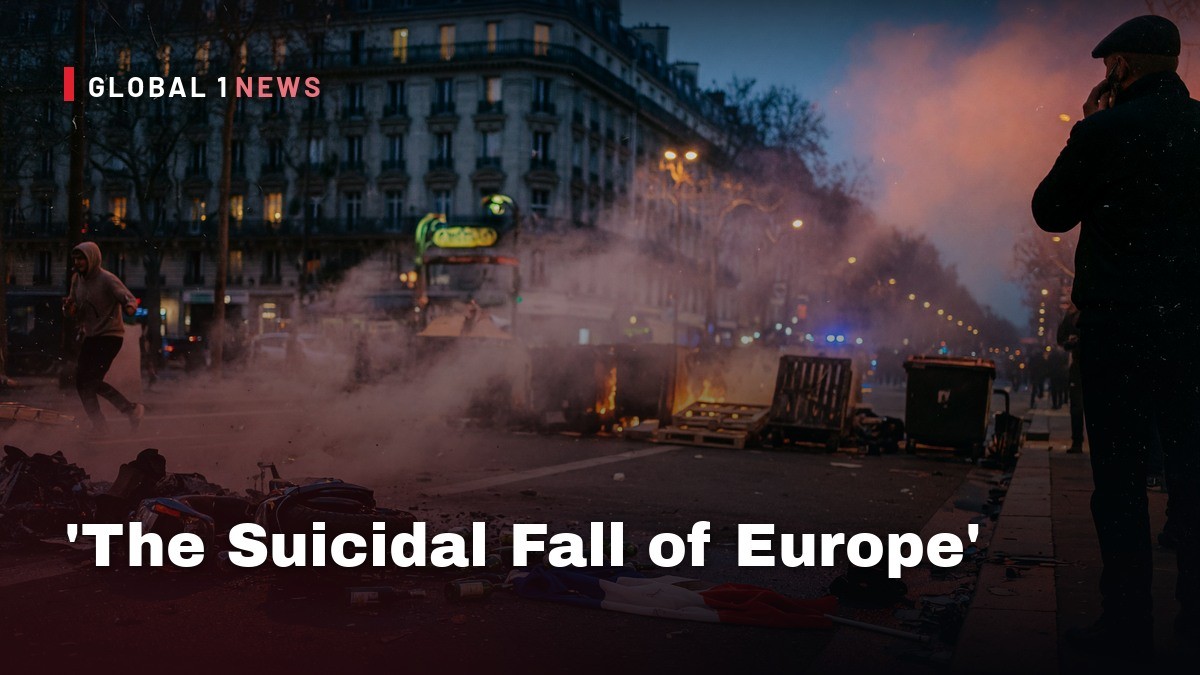
Violent riots erupted across French cities over the weekend of 17‑18 October, adding a new flashpoint to the continent’s already volatile social climate. While French authorities framed the unrest as a law‑and‑order issue, reactions within Russia have ranged from outright celebration to strategic commentary, revealing how the Kremlin seeks to exploit European instability for its own geopolitical narrative.
Official Kremlin Assessment of the Crisis
Kremlin spokesman Dmitry Peskov described the situation in Europe as a “major crisis,” noting that it is unclear whether the turmoil is systemic or non‑systemic but emphasizing that the disturbances are “already bordering on chaos.”Tier B He framed the events as an internal matter for the affected countries, rejecting any implication of Russian involvement and dismissing such accusations as “absurd” and no longer taken seriously, even by European observers.Tier A
Peskov’s remarks signal a calculated distancing from direct meddling while simultaneously highlighting the depth of Europe’s internal fissures. By labeling the unrest as a crisis, the Kremlin positions itself as a detached yet observant commentator, ready to capitalize on any further deterioration.
Foreign Ministry’s Double‑Standard Narrative
Foreign Ministry spokeswoman Maria Zakharova used the French riots to accuse the West of hypocrisy. Citing President Emmanuel Macron’s pledge to be “unyielding” toward rioters, she contrasted this stance with what she described as Western silence when protests erupt elsewhere, accusing Europe of “double standards” on human‑rights issues.Tier B
Zakharova extended the critique to France’s fiscal policies, alleging that the French government diverts resources to “the terrorist regime in Kyiv” while neglecting domestic needs such as school supplies. She repeated the Kremlin’s long‑standing claim that Ukraine is a “neo‑Nazi regime,” a narrative that has been repeatedly debunked but remains a staple of Russian propaganda.Tier B
Strategic Messaging from the Energy and Migration Front
Kremlin special envoy Kirill Dmitriev amplified the political commentary with a broader geopolitical diagnosis, dubbing the unrest “The Suicidal Fall of Europe.” He linked the riots to Europe’s migration policies, arguing that the West’s “inability to discuss and correct consequential mistakes on migration, energy, and warmongering” has precipitated the crisis.Tier B
Dmitriev’s emphasis on migration mirrors a recurring Kremlin theme that portrays Europe’s demographic challenges as a self‑inflicted wound. By coupling migration with energy and military aggression, the envoy constructs a narrative that the West’s own policies are the root cause of its instability, thereby deflecting scrutiny from Russia’s own actions.
Parliamentary and Media Amplification
Senator Alexei Pushkov, head of the Federation Council’s Information Policy and Media Relations Commission, escalated the rhetoric by labeling the French unrest a “civil war.” He blamed free‑migration policies and a “windbag” president for the chaos, suggesting that Russians are not the French people’s enemies and should look elsewhere for adversaries.Tier B
State‑run media amplified these messages. RT editor‑in‑chief Margarita Simonyan posted comparative footage of protests in France, Italy, and Albania, portraying them as affluent societies “happily hand[ing] over their money to Kiev” while enjoying democratic freedoms. Simonyan also dismissed accusations of Russian meddling, implying that Western critics are themselves incapable of managing internal disorder.Tier B
Domestic Russian Media Framing
Russian outlets such as Kommersant and Vedomosti provided detailed coverage of the French disturbances, emphasizing looting, police challenges, and the “death throes of Macronism.” Kommersant’s correspondent Alexei Tarkhanov described the evening as one where “demonstrations of discontented protesters had broken up into bewildered activists and roving groups of looters.”Tier A Vedomosti highlighted the far‑right’s “win‑win” stance against the riots and projected that President Macron would leave office within seven months, suggesting a looming political transition.Tier A
These narratives serve a dual purpose: they underline the fragility of Western democracies while reinforcing the Kremlin’s claim that Europe is on the brink of self‑destruction. By focusing on the law‑and‑order dimension, Russian media subtly legitimizes its own stricter internal controls.
Analytical Perspectives on European Instability
State‑run TASS interviewed political analyst Ilya Graschenkov, who framed the protests as a response to “very real” socioeconomic grievances that have been building for years. He warned that the unrest could herald a “profound restructuring of the European political system,” noting ideological divergences between the United States under Donald Trump and much of Europe.Tier C
Graschenkov’s assessment aligns with the Kremlin’s broader strategy of portraying European unrest as an opportunity to reshape the continent’s political architecture in ways that may be more amenable to Russian interests. By emphasizing internal European fault lines, analysts like Graschenkov provide an intellectual veneer to the Kremlin’s more emotive messaging.
Public Sentiment and Propaganda Mechanics
On the Vesti news program, journalist Yelena Kondratyeva‑Salgero linked the riots to migration, specifically pointing to protesters bearing Palestinian, Moroccan, or Algerian flags as the primary instigators of violence. She suggested that those displaying French flags would not engage in destructive behavior, thereby casting migrants as the chief source of disorder.Tier B
This framing taps into longstanding xenophobic tropes within Russian state discourse, reinforcing a narrative that external “others” are responsible for societal decay. By associating the unrest with visible symbols of non‑European identity, Russian media seeks to validate domestic anti‑immigrant sentiment and justify stricter border policies.
This article was produced with AI-assisted research and editorial support. Reporting is based on the source material cited below. Sources: The Moscow Times; themoscowtimes.com; Global1.News (22 October 2026).
By Irina Volkov, Staff Writer
What's Your Reaction?
 Like
0
 Dislike
0
 Love
0
 Funny
0
 Wow
0
 Sad
0
 Angry
0
Russia/Eastern Europe Correspondent at Global1.News. Covering Russian politics, energy, security, and the shifting dynamics of the post-Soviet space. Provides clear-eyed analysis on one of the world's most opaque regions.









Comments (0)