
Helium designated a critical material in the U.S. amid global supply risk
The United States has formally added helium to its roster of critical materials, a move that underscores the gas’s strategic importance beyond party balloons.
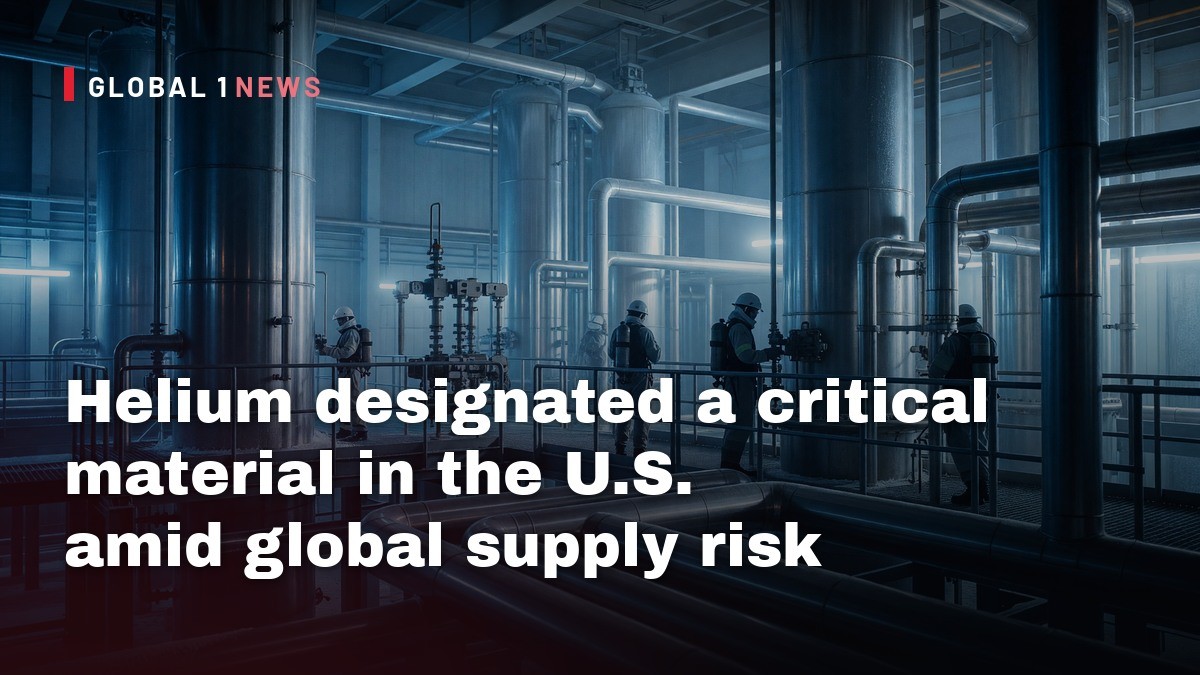
The United States has formally added helium to its roster of critical materials, a move that underscores the gas’s strategic importance beyond party balloons. The Energy Department’s designation, announced on 23 October 2026, signals that federal financing will be made available to helium producers and that the government will keep a closer watch on the supply chain. While the decision is an American policy shift, its ripple effects are felt north of the border, where Canada’s own natural‑gas‑linked helium industry watches closely for opportunities and challenges.
Why helium now?
Helium’s elevation to critical‑material status stems from its indispensable role in a suite of energy‑technology applications. According to the Energy Department, the gas is essential for semiconductor manufacturing, quantum and super‑computing, and superconducting magnets – all pillars of modern energy infrastructure. Assistant Secretary of Energy Audrey Robertson highlighted helium’s unique physical properties, noting that it is non‑combustible and has the lowest boiling point of any gas, making it irreplaceable for high‑precision cooling and leak detection.
These uses extend to wind, solar and nuclear power generation, as well as space exploration and medical imaging. The department’s criteria for a critical material require that the element serve an essential function in one or more energy technologies and that its supply chain face a high risk of disruption. Helium meets both tests, prompting the United States to act before a shortage could jeopardise sectors vital to national security.
Supply‑risk backdrop
Global helium supplies have become increasingly precarious. Qatar, the world’s second‑largest producer, has seen its exports sharply curtailed after Iran closed the Strait of Hormuz amid its war with Israel. Iranian strikes on Qatari infrastructure have further hampered output. Russia, another key supplier, imposed temporary export controls in April 2024 to protect its domestic market. These geopolitical shocks have heightened concerns about the reliability of foreign helium sources.
In the United States, helium is primarily a by‑product of natural‑gas processing. Although the country is the world’s largest producer of both natural gas and helium, extraction facilities are operating at capacity and new plants require years of permitting and construction. The Department of Energy notes that this bottleneck continues to constrain U.S. production, even as reserves in states such as Wyoming, Kansas, Texas, Oklahoma, Colorado and Utah remain abundant.
Domestic production and capacity
U.S. helium output in 2025 reached 81 million cubic metres, representing roughly 43 percent of global supply, according to the Energy Department. Of that amount, 38 million cubic metres were exported. Production has hovered around 80 million cubic metres annually since 2021, with the most active extraction sites located in Kansas, Texas, Colorado, New Mexico, Arizona and Oklahoma as of 2023.
Despite these figures, the industry faces a capacity ceiling. Existing plants are at their limits, and the lengthy approval process for new facilities means that expanding output cannot happen quickly. Avanti Helium Corp., a North American gas exploration firm, warned that without accelerated investment in new reserves, the United States could become dependent on foreign helium – a scenario the company says the critical‑material designation aims to avert.
Policy implications and funding
The designation unlocks federal financing for helium producers, a tool the Energy Department intends to use to stimulate domestic capacity. Energy Secretary Chris Wright framed the move as part of a broader strategy to free America from reliance on foreign critical materials, bolster domestic manufacturing, and safeguard jobs. “President Trump is bringing back America’s manufacturing industry, and that means making sure we have the materials needed to build things in America again,” Wright said in a statement.
By bringing helium under the statutory authority that governs critical minerals, the United States can direct resources toward exploration, plant construction and research into more efficient extraction methods. The policy also aligns helium with other critical items such as metallurgical coal, added to the list in 2025, and fluorine, the only other gas on the roster.
Environmental considerations
Helium extraction is tied to natural‑gas processing, raising environmental questions about greenhouse‑gas emissions. Greeshma Gadikota of Columbia University’s Lenfast Center for Sustainable Energy noted that while burning natural gas releases CO₂, extracting helium alone does not directly add to emissions. She suggested a cleaner pathway: using natural gas to produce hydrogen and solid carbon, the latter serving as a permanent sequestration form and a feedstock for industrial products.
This perspective highlights a tension between expanding helium production and meeting Canada’s climate commitments. Any increase in extraction capacity will need to balance economic benefits with the imperative to reduce carbon footprints, a challenge that Canadian policymakers will likely weigh as they assess cross‑border supply dynamics.
Impacts for Canada
Canada’s helium industry, though smaller than that of its southern neighbour, shares many of the same geological basins, particularly in the western provinces. The U.S. move may open avenues for Canadian firms to partner with American firms seeking additional supply or technology transfer. Moreover, the heightened focus on helium could spur Canadian regulators to revisit permitting timelines, potentially accelerating domestic projects.
From a strategic standpoint, Canada benefits from a diversified supply chain. While the United States seeks to reduce dependence on Qatar and Russia, Canada can position itself as a reliable alternative source, especially for sectors like semiconductor manufacturing that are integral to both countries’ high‑tech economies. The critical‑material designation also serves as a reminder that helium, like rare earths and other minerals, is a shared security concern across North America.
Future outlook
Helium’s elevation to critical‑material status marks a decisive step by the United States to safeguard a resource that underpins a range of energy‑technology applications. The policy promises increased federal support for domestic producers, but the industry’s capacity constraints mean that scaling up will take time. In the interim, geopolitical disruptions in Qatar and Russia continue to pose supply‑risk challenges.
For Canada, the development offers both a cautionary tale and an opportunity. As the United States tightens its domestic supply chain, Canadian producers may find new markets and collaborative projects, while also confronting the need to align expansion with climate goals. The coming years will likely see intensified dialogue between Ottawa and Washington on helium, mirroring broader discussions about critical minerals and the shared goal of securing a resilient, low‑carbon energy future for North America.
This article was produced with AI-assisted research and editorial support. Reporting is based on the source material cited below. Sources: Global News Canada; globalnews.ca; Global1.News (23 October 2026).
By Alex Thompson, Staff Writer
What's Your Reaction?
 Like
0
 Dislike
0
 Love
0
 Funny
0
 Wow
0
 Sad
0
 Angry
0

Canada Correspondent at Global1.News. Based in Toronto, covering Canadian politics, energy, trade, and US-Canada relations. Provides the Canadian perspective on North American and global affairs.














Comments (0)