
Canada eyes Türkiye's defense agency as model for domestic arms sector
Canada’s quest to reshape its defence procurement landscape is taking shape against a backdrop of shifting alliances and a growing appetite for strategic autonomy among middle powers.
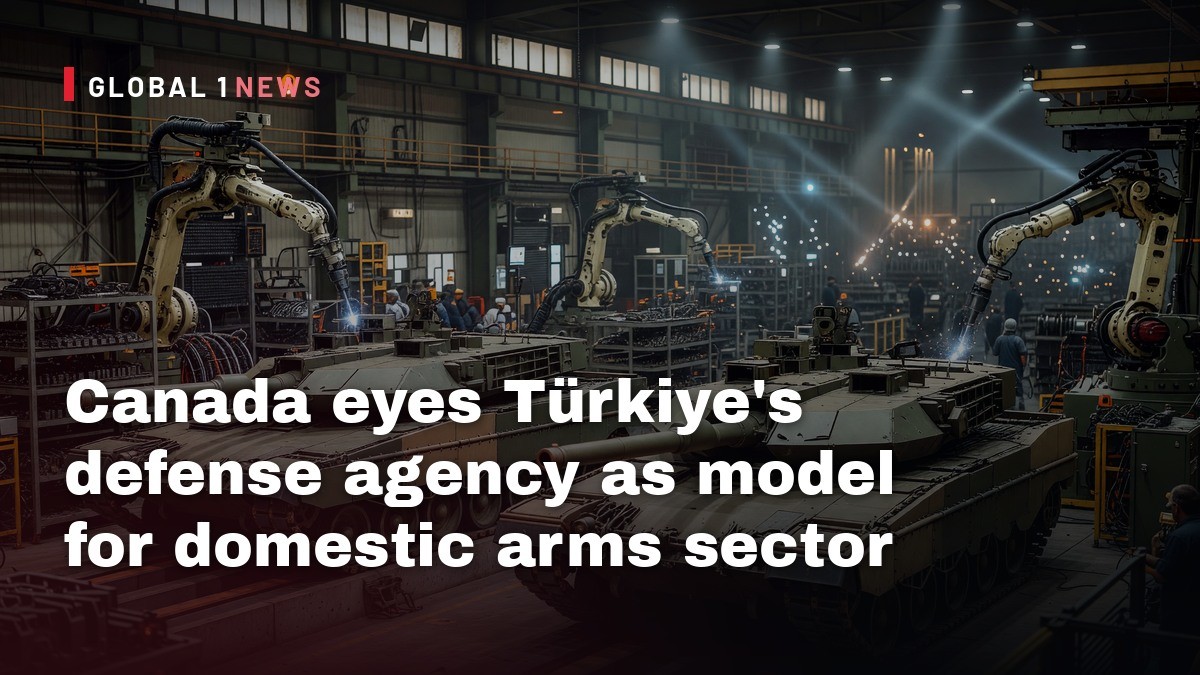
Canada’s quest to reshape its defence procurement landscape is taking shape against a backdrop of shifting alliances and a growing appetite for strategic autonomy among middle powers. Prime Minister Mark Carney’s historic visit to Türkiye underscores a broader trend: NATO members seeking alternatives to traditional U.S.‑centric supply chains while tapping the expertise of nations that have mastered domestic defence industrialisation. The Turkish model, embodied by the Presidency of Defence Industries (SSB), now sits at the centre of Ottawa’s blueprint for a more self‑reliant arms sector.
Strategic context: why Canada looks east
The timing of Carney’s Ankara trip is significant. It arrives as NATO elevated its internal ties to a “strategic partnership” after the leaders of Canada and Turkey discussed trade, defence, security and energy. For Canada, the partnership is not merely diplomatic; it is a pragmatic response to a perceived over‑reliance on United States‑supplied systems. Ottawa’s ambition to diversify its procurement sources aligns with a wider “middle powers” initiative that seeks to pool resources among like‑minded allies, as evidenced by the newly launched Defence Security and Resilience Bank.
That multilateral bank, which Türkiye has joined as one of ten founding members, aims to mobilise up to £100 billion in low‑cost financing for defence projects. While the precise financial figures are not the focus here, the institution reflects a collective desire to underwrite indigenous capabilities, a goal that dovetails with Canada’s domestic policy agenda.
The SSB model: centralised coordination and localisation
The Turkish Presidency of Defence Industries (SSB) functions as the primary procurement authority for the nation’s armed forces, orchestrating everything from localisation targets to public‑private partnerships. According to the source, the SSB “organises nearly all areas of Türkiye’s defence industry, including localisation, production, innovation, procurement, regulation, public‑private cooperation and corporate financing.” This breadth of mandate creates a single‑point decision‑making hub that can translate military requirements into rapid industrial responses.
Ottawa is keen to emulate this structure. Carney highlighted that Türkiye meets roughly 80 % of its defence needs domestically—a benchmark Canada does not yet achieve. He expressed a desire to raise Canada’s own “local‑content rate above 80 %,” signalling an ambition to replicate the SSB’s high localisation ratio through policy reforms and targeted investments.
Policy levers: from the Defence Investment Agency to the Defence Security and Resilience Bank
Canada’s domestic reforms already include the Defence Investment Agency, established last year to streamline procurement and cut bureaucratic delays. The agency’s mandate complements the broader strategic shift Carney outlined: boosting the domestic industry’s share of defence spending to 70 % over the next decade. While the target falls short of the 80 % benchmark set by Turkey, it marks a clear trajectory toward greater self‑sufficiency.
In parallel, the Defence Security and Resilience Bank offers a financing conduit that could underwrite joint Canadian‑Turkish projects. By pooling capital with other middle powers, Canada hopes to secure “cheap financing” for initiatives that might otherwise be constrained by national budgetary limits. This financial architecture, combined with the SSB’s industrial coordination model, could provide a dual pathway—policy and capital—to accelerate domestic capability building.
Technology transfer and joint projects: the focus on unmanned systems
During his Ankara visit, Carney singled out Turkish expertise in space, aviation and, notably, unmanned aerial systems (UAS). Meetings with executives from Aselsan—renowned for electro‑optical, radar and avionics technologies—and Baykar, a leader in UAS and autonomous software, signal a concrete interest in technology transfer. The source notes Carney’s intention to “run joint defence projects with Türkiye and to buy Turkish products,” underscoring a two‑track approach: co‑development alongside procurement.
Such collaboration could address gaps in Canada’s current UAV capabilities while providing Turkish firms with access to North American markets and research ecosystems. The SSB’s role in “raising firms’ export earnings” suggests that Turkey views these partnerships as mutually beneficial, extending its export footprint while supporting allied defence industries.
Regional implications: Poland and the broader NATO landscape
The appeal of the SSB model extends beyond Canada. Poland’s deputy prime minister and defence minister, Wladyslaw Kosiniak‑Kamysz, has publicly praised the agency, indicating a desire to adopt a similar framework. Poland’s interest reflects a wider NATO discourse on reducing dependence on external suppliers and enhancing national defence industrial bases.
Collectively, these moves hint at a subtle re‑balancing within the alliance. While the United States remains the dominant supplier, the emergence of a “middle‑power” network—anchored by institutions like the Defence Security and Resilience Bank and coordinated through agencies such as the SSB—could diversify supply chains and introduce new standards for localisation and innovation across Europe and North America.
Challenges ahead: aligning ambitions with capabilities
Adapting the Turkish model to Canada’s industrial context will not be without hurdles. The SSB oversees an ecosystem of more than 4,500 companies, a scale that Canada does not currently possess. Building a comparable network will require sustained investment, regulatory reforms, and perhaps most critically, the cultivation of a domestic supplier base capable of meeting stringent defence specifications.
Moreover, achieving an 80 % local‑content rate will demand coordinated action across federal procurement policies, research institutions, and private sector stakeholders. The Defence Investment Agency’s mandate to cut delays is a step forward, yet the broader challenge lies in aligning strategic goals with the realities of Canada’s industrial geography and existing supply chains.
Outlook: a partnership poised to reshape defence procurement
Canada’s outreach to Türkiye marks a decisive pivot toward a more diversified, domestically anchored defence posture. By studying the SSB’s centralised, localisation‑driven approach, Ottawa hopes to accelerate its own industrial transformation while deepening ties with a fellow NATO ally that has demonstrated success in meeting the majority of its defence needs internally.
As the Defence Sector Partnerships memorandum of understanding comes into force, the next months will reveal how quickly joint projects materialise, how effectively technology transfer proceeds, and whether the combined financial muscle of the Defence Security and Resilience Bank can sustain the ambitious localisation targets set by both nations. In a region where great‑power rivalry and energy security concerns drive strategic realignments, the Canada‑Türkiye defence collaboration could become a benchmark for other middle powers seeking to carve out greater autonomy in an increasingly contested security environment.
This article was produced with AI-assisted research and editorial support. Reporting is based on the source material cited below. Sources: Daily Sabah Middle East; dailysabah.com; Global1.News (24 October 2026).
By Malik Hassan, Staff Writer
What's Your Reaction?
 Like
0
 Dislike
0
 Love
0
 Funny
0
 Wow
0
 Sad
0
 Angry
0

Middle East Correspondent at Global1.News. Based in Beirut, covering politics, conflict, energy, and society across the Middle East. Brings context and depth to a region often reduced to headlines.












Comments (0)