
Cambodia urges Thailand to restore diplomatic ties
In a quiet yet significant interview aired on national television, Cambodia’s Deputy Prime Minister and Foreign Minister Prak Sokhonn appealed to Thailand to restore full diplomatic ties.
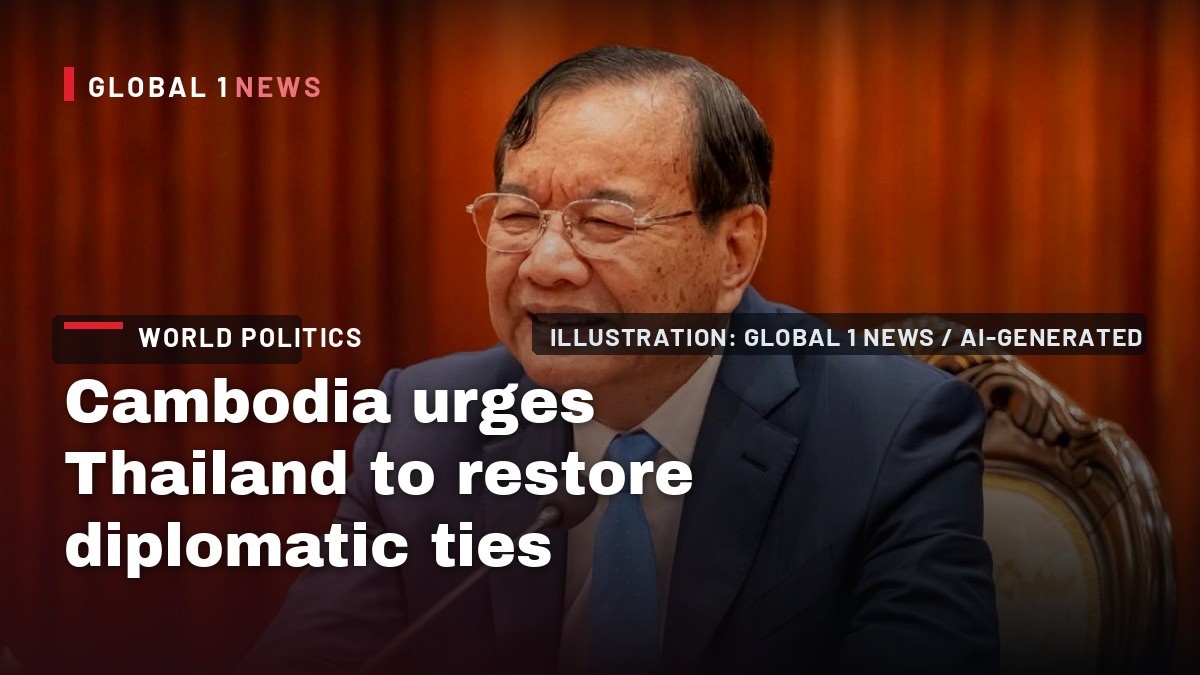
In a quiet yet significant interview aired on national television, Cambodia’s Deputy Prime Minister and Foreign Minister Prak Sokhonn appealed to Thailand to restore full diplomatic ties. His call comes at a moment when the two neighbours, bound by centuries of shared culture and Buddhist values, find their official channels reduced to the lowest rung of representation. Prak’s message, delivered on Tuesday evening, underscores a belief that dialogue—rooted in mutual respect—remains the most reliable path to resolve disputes without resorting to force.
Historical context of the diplomatic downgrade
Relations between Cambodia and Thailand have long been shaped by both cooperation and occasional tension, often reflecting deeper issues over borders, trade, and cultural heritage. In recent years, the diplomatic presence between the two capitals has been scaled back to the level of second secretaries, a rank that Prak described as the “lowest level of representation.” This downgrade limits the ability of senior officials to engage directly, leaving sensitive matters to be handled by junior staff.
The reduction in diplomatic rank did not happen overnight. It followed a series of disagreements that strained confidence on both sides, prompting each government to pull back its senior envoys. While the exact triggers are not detailed in the interview, the current situation reflects a broader pattern of cautious engagement that has left many bilateral issues unresolved.
Recent efforts to revive dialogue
Despite the lowered representation, both governments have shown a willingness to explore pathways back to fuller diplomatic engagement. In Kuala Lumpur last year, the prime ministers of Cambodia and Thailand reached an agreement to restore ties to a more appropriate level. The accord tasked their foreign ministers with working out the practical steps needed to lift the diplomatic downgrade.
Following that meeting, a series of discussions were held, during which both sides agreed on dates for their deputy heads of mission to return to their respective posts. However, as tensions resurfaced, the plan was placed on hold, illustrating how fragile the progress remains when underlying disputes flare up.
May confidence‑building measures
In May of this year, the two prime ministers reconvened and agreed on a set of confidence‑building measures aimed at easing the diplomatic strain. Central to these measures was the proposal to return deputy heads of mission to their posts, a step that would signal a mutual desire to re‑establish higher‑level communication.
After the May meeting, the countries exchanged diplomatic notes confirming the agreed measures. Yet, as Prak noted, the implementation has not yet materialised. The delay highlights a gap between verbal commitments and concrete actions, a gap that can be bridged only through sustained political will on both sides.
Prak Sokhonn’s appeal for practical action
In his televised interview, Prak emphasized that restoring diplomatic representation would provide a “more effective means of addressing disagreements through dialogue.” He framed diplomacy not merely as a formal protocol but as a living channel that reflects the shared values of the Thai and Cambodian peoples.
Prak’s appeal is rooted in the belief that a functioning diplomatic channel can prevent misunderstandings from escalating into military confrontations. By urging Thailand to honour its declared support for dialogue, he calls for the practical execution of previously reached agreements, rather than allowing them to remain symbolic gestures.
The role of UNCLOS in the conciliation process
The interview followed the second meeting of the Cambodia‑Thailand Conciliation Commission, convened under the United Nations Convention on the Law of the Sea (UNCLOS). This forum provides a structured environment for the two nations to discuss maritime boundaries and related disputes, offering a legal framework that complements diplomatic dialogue.
UNCLOS serves as a reminder that both countries are bound by international law, and that resolving maritime issues through legal mechanisms can reduce the risk of conflict. The commission’s work, therefore, supports Prak’s broader call for diplomatic channels to handle disputes that might otherwise become flashpoints.
Implications for regional stability
Thailand and Cambodia share more than a border; they are part of a cultural tapestry woven through centuries of Buddhist practice, trade, and migration. A breakdown in their diplomatic relations can ripple across Southeast Asia, affecting not only bilateral trade but also the broader sense of regional harmony championed by ASEAN.
By restoring full diplomatic ties, both nations would reinforce a model of peaceful resolution that resonates with the Buddhist principle of “right speech” – speaking truthfully and kindly to avoid conflict. Such a move would signal to neighbouring countries that dialogue remains the preferred path, even when tensions run high.
Looking ahead: pathways to restored ties
The road to fully restored diplomatic relations will require concrete steps beyond verbal agreements. Prak’s call to action suggests that Thailand’s next move should be the swift reinstatement of deputy heads of mission, followed by a gradual elevation of representation to senior levels.
Both governments will need to translate confidence‑building measures into tangible outcomes, ensuring that diplomatic notes become operational realities. As the year progresses, the eyes of the region will be on how quickly the two sides can move from promises to practice, reaffirming a shared commitment to peace, mutual respect, and the enduring cultural bonds that have linked Thailand and Cambodia for generations.
This article was produced with AI-assisted research and editorial support. Reporting is based on the source material cited below. Sources: Khaosod English; khaosodenglish.com; Global1.News (21 October 2026).
By Ann Srisawat, Staff Writer
What's Your Reaction?
 Like
0
 Dislike
0
 Love
0
 Funny
0
 Wow
0
 Sad
0
 Angry
0
Southeast Asia Correspondent at Global1.News. Based in Bangkok, covering Thai and Southeast Asian politics, economy, technology, and culture. Deep regional perspective on one of the world's most dynamic regions.










Comments (0)