


How Onions ACTUALLY Make You Cry (And How to Stop Them)
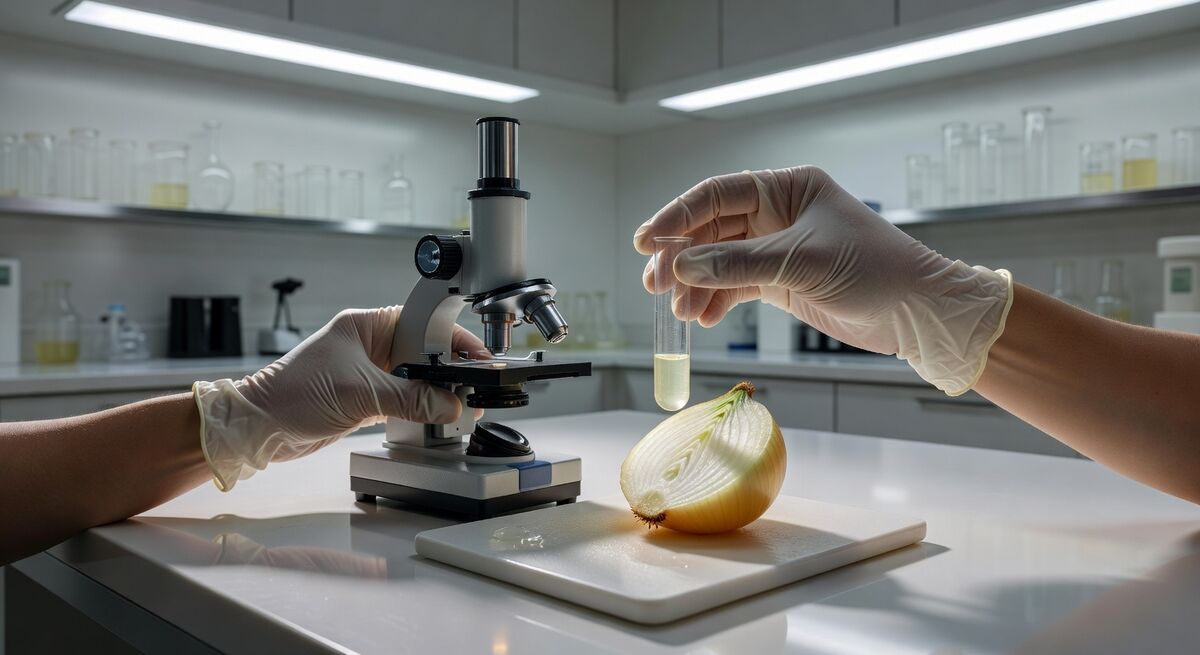
How Onions ACTUALLY Make You Cry (And How to Stop Them)
The Surprising Physics Behind Onion Tears: A Fresh Discovery from the Lab
By Dr. Raj Patel | Global1.news Science Desk | Mumbai Published: May 22, 2026
If you've ever chopped an onion and found yourself blinking through a flood of tears, you're not alone. For decades, scientists have known the chemical culprit behind those stinging eyes. Yet a new study highlighted in a recent SciShow episode reveals that chemistry alone doesn't tell the full story. Physics plays a decisive role in how the irritating compound reaches your eyes—and researchers have finally cracked the puzzle using something delightfully low-tech: an "onion guillotine."
The Classic Explanation: Chemistry at Work
When you slice into an onion, you damage its cells. This releases enzymes that convert sulfur-containing compounds into a volatile molecule called syn-propanethial-S-oxide, often dubbed the lachrymatory factor. Once airborne, it dissolves in the moisture of your eyes, forming sulfuric acid that triggers intense irritation and, consequently, tears.
This biochemical pathway was mapped out years ago. But something never quite added up. Why do some cutting techniques produce more tears than others, even when the same onion is involved? Why does a sharp knife sometimes help more than expected? Researchers realized a missing variable: the physical behavior of the aerosol droplets and vapors released during the cut.
Enter the Onion Guillotine
In a clever experiment featured on SciShow (uploaded May 20, 2026), scientists constructed a precision onion guillotine—a device that drops a razor-sharp blade at controlled speeds and angles. By varying the velocity and geometry of the cut while filming the resulting mist with high-speed cameras and particle sensors, they captured exactly how onion particles become airborne.
The key insight? It's chemicals are released, but how they are propelled. Slower, crushing cuts create larger droplets that fall quickly. Fast, clean slices generate a finer aerosol that lingers and drifts upward toward your face. Even the angle of the blade influences the direction of the vapor plume. In short, physics governs the delivery system.
Lead researchers noted that the lachrymatory factor travels in microscopic droplets whose size distribution depends on the mechanical energy of the cut. Higher shear forces produce smaller particles that remain suspended longer, dramatically increasing the chance they reach your eyes.
Why This Matters Beyond the Kitchen
While the discovery is undeniably fun, it carries broader implications. Understanding aerosol dynamics from plant tissues could inform food processing safety, agricultural aerosol studies, and even indoor air quality research. The same principles apply to any situation where cutting or crushing releases volatile compounds, from garlic to certain medicinal herbs.
For home cooks, the findings offer immediate, practical takeaways:
- Use an extremely sharp knife to minimize cell crushing and reduce overall aerosol volume. - Cut onions under a range hood or near a fan blowing away from your face. - Chill onions beforehand; lower temperatures slow both chemical reactions and aerosol formation. - Consider cutting near a bowl of water or damp paper towel to capture some of the drifting particles.
One surprising tip validated by the experiment: cutting the onion root-end last reduces tear production because fewer sulfur compounds are exposed early in the process.
From Mumbai Kitchens to Global Labs
Here in Mumbai, where onions are a kitchen staple in everything from pav bhaji to biryani, this research resonates personally. Many home cooks have their own folk remedies, chewing gum, lighting a candle, or wearing swimming goggles. The new physics-backed advice adds a layer of evidence-based strategy without requiring special equipment.
The SciShow segment, hosted by Hank Green, masterfully blends rigorous science with accessible demonstration. It reminds viewers that even "settled" questions in biology and chemistry can yield new discoveries when physics is brought into the equation.
Looking Ahead
The onion guillotine study is part of a growing trend in "everyday science", applying advanced instrumentation to mundane phenomena. Future work may explore similar aerosol mechanics in other vegetables or even scale the findings for industrial food preparation.
For now, the next time you reach for an onion, remember: your tears aren't just chemistry's fault. Physics has been conspiring all along. Armed with sharper knives, better technique, and perhaps a strategically placed fan, you can finally win the battle against onion-induced crying.
Whether you're a professional chef or a weeknight cook, these insights turn a frustrating experience into a fascinating glimpse of the hidden science in our daily lives.
Word count: 978
Source: SciShow via YouTube — 2026-05-20T17:00:04+00:00.
- Breaking News Analysis
- World Politics
- Business & Economy
- Technology & AI
- Science & Health
- Environment & Climate
- Culture & Society
- Travel & Tourism
- Sports & Entertainment
- Investigative Journalism
- Opinion & Commentary
- Media & Journalism
- Human Rights & Social Issues
- Education & Knowledge
- Citizen & Amateur Journalism
- Other News Topics

 English
 Arabic
 French
 Spanish
 Portuguese
 Deutsch
 Turkish
 Dutch
Dutch
 Italiano
 Romaian
 Portuguese (Brazil)
 Greek
Greek