


Julie K. Brown’s Address to the Columbia Journalism School Class of 2026


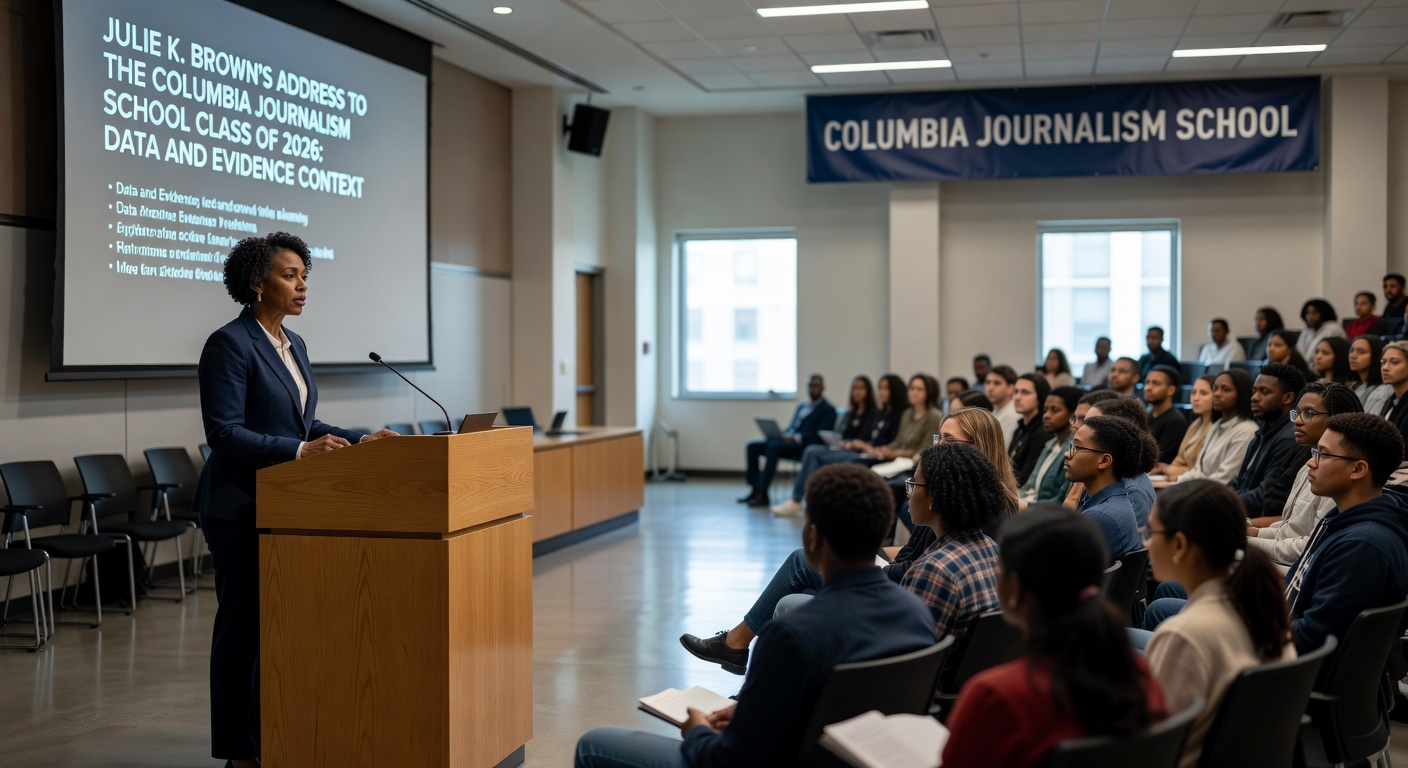

Julie K. Brown's Call to Arms: Resilience and Accountability in Journalism's Toughest Era
In an era defined by plummeting public trust in media institutions, the unchecked proliferation of generative AI content, and intensifying political pressures on newsrooms, veteran investigative journalist Julie K. Brown delivered a commencement address that resonates far beyond Columbia University's campus. Speaking to the Columbia Journalism School's Class of 2026, Brown wove personal narrative with professional imperatives, offering a blueprint for sustaining accountability journalism amid existential threats to the craft.
This speech arrives at a critical inflection point. News organizations worldwide reported record layoffs in 2025, with Pew Research Center data indicating that only 32% of Americans express trust in news media—a figure that has steadily declined since 2016. Meanwhile, the rise of AI tools threatens to commoditize reporting while amplifying misinformation at unprecedented scale. Brown's emphasis on persistence, ethical sourcing, and resistance to institutional pushback provides a practical framework for graduates entering a profession where traditional revenue models are collapsing and verification standards face constant assault. Concrete examples abound: the 2024 U.S. election cycle saw AI-generated deepfake audio clips of candidates spread rapidly on social platforms, forcing newsrooms to develop new authentication protocols overnight.
Detailed Video Analysis
The 28-minute address unfolds in Columbia's formal graduation setting, with Brown at the podium before an audience of faculty, families, and graduates. CJR's production prioritizes clarity and authenticity: multiple fixed cameras capture subtle audience reactions without intrusive cuts, while crisp audio ensures every measured phrase lands effectively. This restrained approach mirrors the speech's core message—substance over spectacle.
Opening Reflections on Pandemic-Era Journalism (0:00–4:30) Brown begins by revisiting her 2020 Columbia Journalism Award, received remotely amid COVID-19 lockdowns. She contrasts the isolation of that period with the communal energy of the in-person 2026 ceremony, underscoring how external crises test journalistic resolve. This segment establishes emotional grounding while highlighting a key tension: how journalists maintain output when physical and mental resources are strained. Future implications are clear—similar disruptions from climate events or geopolitical conflicts will demand hybrid workflows that preserve human connection without sacrificing deadlines.
The Epstein Investigation: Persistence Against Power (4:30–12:15) The heart of the address details Brown's multi-year probe into Jeffrey Epstein's network. She describes navigating sealed documents, reluctant sources, and editorial skepticism, culminating in the Miami Herald series that reignited public scrutiny and contributed to Epstein's 2019 arrest. Brown's quote, "The powerful will always push back, but persistence reveals the truth", serves as both anecdote and principle. Analysis reveals her methodical approach: cross-referencing court filings with victim testimonies, a technique that exposed systemic failures in law enforcement and media gatekeeping. A deeper example includes her use of flight logs cross-checked against financial records, a model now taught in investigative courses worldwide.
Cultivating Resilience Amid Setbacks (12:15–18:40) Brown shares personal challenges, including legal threats and internal newsroom doubts. Rather than romanticizing grit, she advocates deliberate strategies: cultivating mentor relationships, prioritizing mental health, and building peer networks. This section gains depth when viewed against rising journalist burnout rates documented by the International Center for Journalists, which reported a 40% increase in reported stress since 2022. Future implications include the need for newsrooms to institutionalize wellness programs as core infrastructure rather than optional perks.
Accountability as Journalism's North Star (18:40–25:00) Brown critiques "bothsides-ism," arguing that false equivalence undermines truth-seeking in polarized environments. She urges graduates to prioritize evidence over narrative symmetry, citing examples from her own career where balanced framing obscured clear wrongdoing. This stance carries concrete weight in today's landscape, where coverage of corporate scandals or election integrity often defaults to he-said-she-said formats despite overwhelming documentation.
Closing Call to Action (25:00–28:00) The address concludes with an urgent directive to protect the public's right to know, positioning new journalists as stewards of democratic accountability. Brown's tone remains authoritative yet accessible, blending rigorous analysis with empathetic encouragement. Her claims are anchored in documented career achievements, improving credibility.
Broader Context
Columbia Journalism Review has long served as an institutional memory-keeper for the profession, uploading commencement speeches and panels to document evolving norms. Brown's invitation reflects CJR's deliberate effort to bridge award-winning practitioners with emerging cohorts. The timing is strategic: graduates enter a field transformed by generative AI, algorithmic distribution shifts, and platform dependency. Brown's 2020 remote address left unfinished business; this in-person delivery allows her to address how the profession has changed since the pandemic accelerated digital disruption.
Industry data reinforces urgency. The Reuters Institute's 2025 Digital News Report shows trust erosion correlating with economic precarity for reporters. Brown's focus on resilience directly counters these trends, offering counter-narratives to narratives of inevitable decline. Additional context includes the rise of independent Substack investigations and nonprofit models like ProPublica, which demonstrate viable paths forward when legacy outlets contract.
Impact & Audience Reaction
Initial metrics reveal concentrated engagement within journalism education and professional networks. Comments frequently praise Brown's candor on mental health and source protection, while sparking debate about implementing her advice amid shrinking newsroom budgets. Several viewers noted the speech's relevance to AI-era challenges, particularly verification standards. Algorithmically, the upload benefits from YouTube's preference for authoritative, long-form educational content. It surfaces in searches for investigative journalism training and may influence curriculum development at journalism schools. Culturally, the address reinforces Columbia's role in shaping ethical discourse, paralleling global conversations on press freedom highlighted in recent UNESCO reports. Long-term, such content could help slow the spread of misinformation by modeling rigorous sourcing practices for a new generation.
Key Takeaways
- - Investigative persistence, as modeled by Brown's Epstein reporting, requires sustained document analysis and source cultivation over years rather than quick wins, with implications for training programs that emphasize long-form projects. - Resilience emerges from intentional practices like mentorship networks and mental health prioritization, not innate fortitude alone, pointing to systemic changes needed in newsroom culture. - Accountability journalism demands rejection of false equivalence, especially when evidence clearly implicates powerful actors, influencing how future coverage of elections and corporate power will be framed. - Traditional verification methods must evolve alongside AI tools without sacrificing core standards of accuracy and transparency, including new protocols for detecting synthetic media. - Ethical source protection and diverse sourcing remain foundational to long-term credibility in an era of heightened legal and digital risks. - Journalism's viability hinges on graduates embracing public service over cynicism, sustaining the profession's democratic function amid economic and technological upheaval.
Conclusion
Julie K. Brown's address equips the Class of 2026 with both inspiration and operational guidance at a moment when journalism's societal role faces unprecedented tests. By demonstrating how persistence can expose entrenched power structures, she models the tenacity required to navigate AI disruption, economic contraction, and political interference. Looking ahead, her principles will likely shape curricula, mentorship programs, and career trajectories for years, reminding new reporters that accuracy, accountability, and resilience remain the profession's most durable assets in preserving public trust. As generative technologies advance, these values will serve as the essential bulwark against an information ecosystem increasingly vulnerable to manipulation.
Source: CJR via YouTube — 2026-05-21T15:24:52+00:00.
- Breaking News Analysis
- World Politics
- Business & Economy
- Technology & AI
- Science & Health
- Environment & Climate
- Culture & Society
- Travel & Tourism
- Sports & Entertainment
- Investigative Journalism
- Opinion & Commentary
- Media & Journalism
- Human Rights & Social Issues
- Education & Knowledge
- Citizen & Amateur Journalism
- Other News Topics

 English
 Arabic
 French
 Spanish
 Portuguese
 Deutsch
 Turkish
 Dutch
Dutch
 Italiano
 Russian
 Romaian
 Portuguese (Brazil)