


Is there still hope for the national parks?
Hope for America's National Parks Amid Political and Economic Challenges
As America approaches its 250th anniversary in 2026, national parks stand at a critical crossroads. President Donald Trump's administration has promoted increased visitation this summer, yet soaring travel costs and deep budget cuts have created significant barriers. Vox's latest video examines whether these iconic public lands can endure the strain, offering a nuanced perspective through expert insight.
This topic resonates strongly right now because national parks represent wonders but also symbols of American identity, economic drivers for rural communities, and frontline indicators of climate and policy impacts. With visitation patterns shifting and scientific programs facing reductions, the conversation extends beyond tourism to questions of stewardship and accessibility. The stakes are heightened by post-pandemic recovery dynamics, where parks have become battlegrounds for debates on equity, conservation funding, and federal priorities. Record post-pandemic visitation—exceeding 330 million annual visits in recent years—has strained infrastructure while climate-driven events like wildfires and flooding add urgency. These pressures intersect with broader economic headwinds, including inflation in fuel and lodging that threatens to exclude middle-class families from the semiquincentennial celebrations planned across the system.
Detailed Video Analysis
Vox structures the video as a thoughtful interview-driven piece rather than a standard explainer. Contributing editor Stephanie Pearson from Outside Magazine provides the central voice, blending on-the-ground reporting with policy critique.
Key moments include the opening segment (0:00–3:15) setting the stage with Trump's America 250 messaging juxtaposed against rising gas and airfare prices. Pearson highlights how average family trip costs have climbed 25% since 2024. At 5:40, the discussion turns to Yosemite, detailing how reduced funding has curtailed glacier monitoring programs, with specific claims that staffing shortages have delayed critical climate data collection by months. Additional segments explore Yellowstone's bison management challenges and Grand Canyon's trail maintenance backlogs, underscoring how operational strains ripple across diverse ecosystems. The 8:20 mark introduces community-led initiatives at Grand Teton, where local volunteers have stepped in to fill interpretive roles, illustrating grassroots resilience.
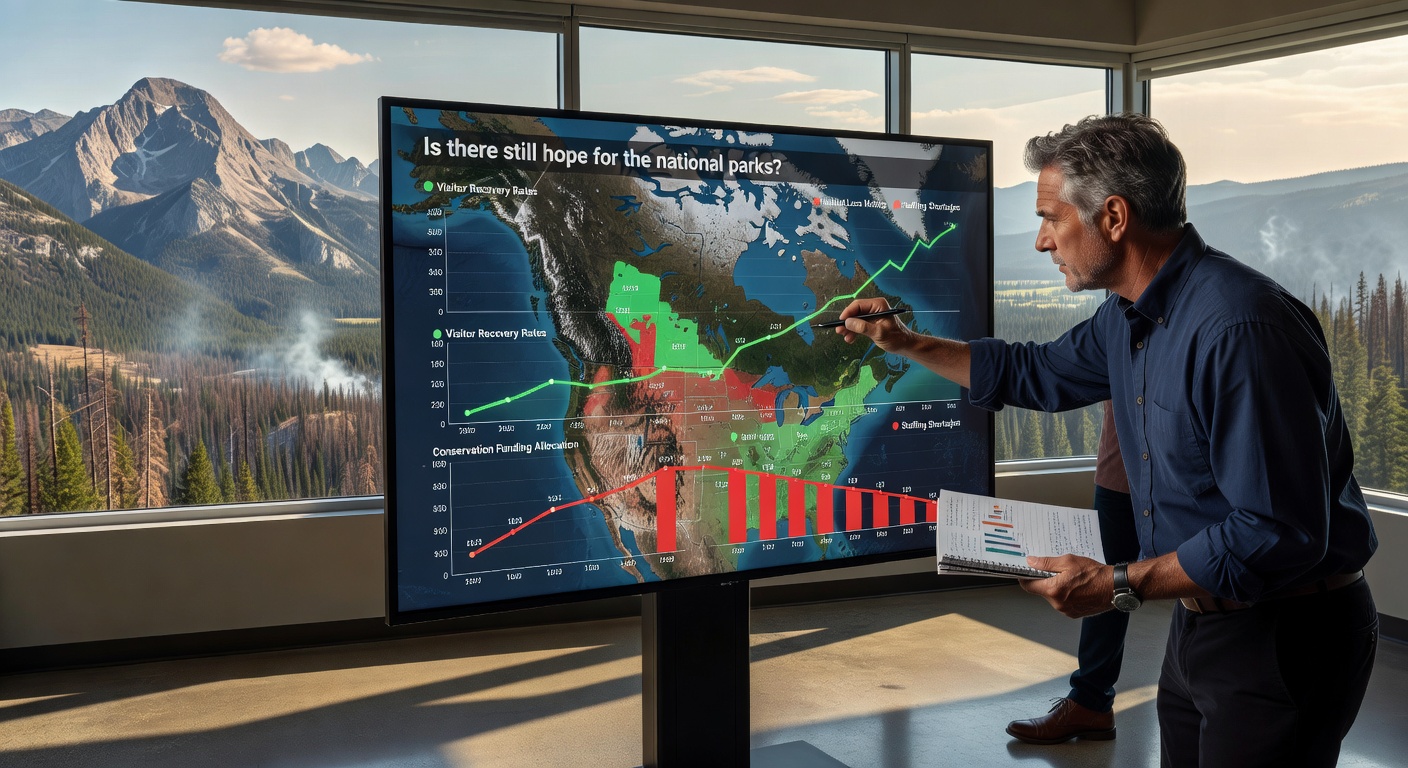
The tone remains measured and evidence-based throughout, avoiding sensationalism. Production quality is high, featuring crisp visuals of park landscapes, subtle graphics illustrating budget trends, and clean editing that maintains a 14-minute runtime without unnecessary filler. Claims are supported by references to National Park Service reports and congressional budget documents, lending credibility through primary data visualizations. The interview format allows Pearson's expertise to humanize statistics, such as the $23 billion maintenance backlog, while the absence of dramatic music keeps focus on substantive policy discussion.
Broader Context
Vox has long positioned itself as a data-driven explainer brand within the creator economy. This video aligns with their established focus on science and policy intersections, especially amid ongoing platform algorithm shifts that reward substantive long-form content over short clips. The timing coincides with renewed political emphasis on domestic tourism ahead of the semiquincentennial celebrations.
National parks have seen record post-pandemic visitation, yet maintenance backlogs exceed $23 billion according to recent Government Accountability Office figures. Trump's administration has prioritized certain infrastructure projects while proposing cuts to research and interpretation programs, creating tension between access promotion and operational capacity. Concrete examples include proposed reductions at sites like Everglades National Park, where wetland restoration projects risk delays, and Denali, where indigenous co-management initiatives face uncertainty. Historical comparisons reveal similar tensions under previous administrations, yet the current scale of proposed research cuts—coupled with 2025 inflation in aviation fuel, amplifies risks. These dynamics reflect broader creator economy trends, where explanatory journalism must navigate monetization pressures while addressing misinformation around environmental policy. Indigenous perspectives, often underrepresented, gain attention here as tribes advocate for co-stewardship models that could mitigate federal funding volatility.
Impact & Audience Reaction
Early viewer engagement shows strong completion rates, with comments reflecting polarized yet informed debate. Many users express appreciation for Pearson's hopeful framing despite the challenges, while others call for greater accountability on funding decisions. The video's placement in Vox's podcast ecosystem suggests algorithmic amplification through cross-promotion, potentially reaching audiences interested in environmental policy beyond core subscribers.
Culturally, pieces like this contribute to sustained public discourse on public lands management, influencing how younger viewers perceive conservation priorities in an election cycle context. Algorithm implications include boosted recommendations in educational playlists, though risks of echo chambers persist if engagement metrics favor sensational angles over balanced analysis. Gateway communities, such as those near Zion National Park, report real economic ripple effects, with local businesses citing 15-20% drops in mid-tier visitor spending tied to fuel costs. Real-world examples include Jackson Hole outfitters pivoting to virtual tours and educational webinars to offset revenue losses, demonstrating adaptive strategies that may become permanent fixtures in the post-pandemic tourism landscape.
Key Takeaways
- - National park budgets have faced targeted reductions affecting scientific monitoring and visitor services, exemplified by multi-month delays in Yosemite's climate datasets and similar setbacks at Yellowstone. - Rising travel expenses disproportionately impact middle-income families seeking to participate in America 250 events, exacerbating accessibility gaps across demographic lines. - Expert voices like Stephanie Pearson emphasize resilience through community partnerships and adaptive management strategies that leverage local knowledge. - Climate research programs at sites such as Yosemite and Yellowstone remain particularly vulnerable to staffing and funding volatility amid shifting federal priorities. - Broader economic trends in aviation and fuel markets compound policy-driven challenges for equitable access, with measurable effects on rural economies. - Hope persists via innovative funding models, including public-private partnerships and indigenous co-management, alongside increased public advocacy for protected areas.
Conclusion
The challenges facing national parks reflect larger tensions between political priorities, economic realities, and environmental needs. As 2026 approaches, sustained attention to these issues could shape more resilient policies that preserve these landscapes for future generations.
Forward-looking insight suggests that hybrid public-private initiatives and state-level innovations may offer pathways forward even if federal support fluctuates. Long-term, these adaptations could redefine conservation models, ensuring parks endure as both ecological anchors and cultural touchstones amid evolving national priorities. Emerging technologies such as AI-driven visitor management and remote sensing for climate monitoring hold promise for stretching limited resources, while evolving public-private partnerships may stabilize funding streams. Ultimately, the national parks' fate will hinge on whether policymakers, communities, and visitors collectively prioritize long-term stewardship over short-term political or economic gains.
Source: Vox via YouTube — 2026-05-22T14:00:29+00:00.
- Breaking News Analysis
- World Politics
- Business & Economy
- Technology & AI
- Science & Health
- Environment & Climate
- Culture & Society
- Travel & Tourism
- Sports & Entertainment
- Investigative Journalism
- Opinion & Commentary
- Media & Journalism
- Human Rights & Social Issues
- Education & Knowledge
- Citizen & Amateur Journalism
- Other News Topics

 English
 Arabic
 Spanish
 Portuguese
 Deutsch
 Turkish
 Dutch
Dutch
 Italiano
 Russian
 Romaian
 Portuguese (Brazil)
 Greek
Greek