


Trump orders banks to check customers' citizenship status
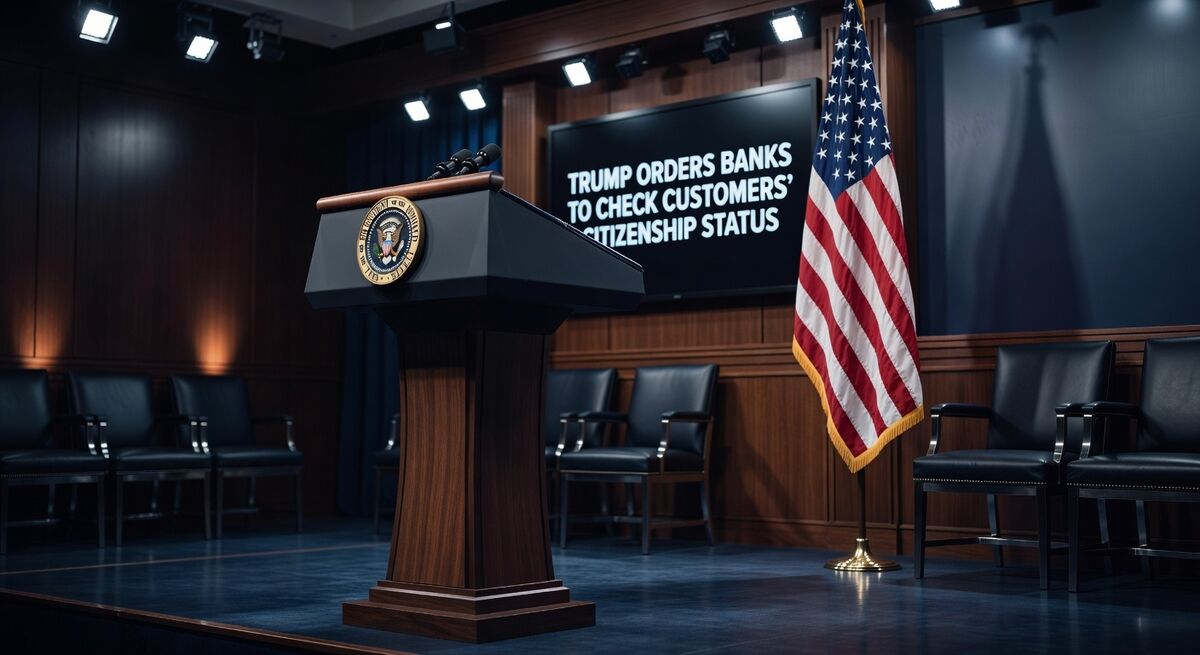
Trump orders banks to check customers' citizenship status
Trump's Bold Move: Banks Ordered to Verify Citizenship in Sweeping Immigration Crackdown
By Alex Thompson | May 20, 2026
In a decisive step that underscores the Trump administration's ongoing commitment to border security and immigration enforcement, President Donald Trump signed an executive order on Tuesday requiring banks and financial institutions across the United States to scrutinize the citizenship status of their customers. This directive, issued amid heightened national debates over illegal immigration, aims to prevent individuals living in the country unlawfully from accessing banking services that could facilitate their continued presence.
The order comes at a critical juncture. With enforcement actions ramping up at the southern border and interior removals increasing, the administration is extending its reach into the financial sector. Banks must now implement improved verification processes, potentially including cross-checks with federal databases like those maintained by the Department of Homeland Security and the Social Security Administration.
What the Executive Order Entails
Under the new rules, financial institutions are mandated to collect and verify proof of citizenship or legal residency during account openings, loan applications, and even routine transactions above certain thresholds. Non-compliance could result in significant penalties, including fines or restrictions on operations. The measure builds on existing know-your-customer (KYC) regulations but adds a specific citizenship layer, signaling a shift toward using the banking system as a tool for immigration control.
Officials within the White House have framed this as a necessary evolution in policy. "We are closing every avenue that allows illegal immigrants to embed themselves in our economy," a senior administration source stated shortly after the signing. This approach echoes previous efforts, such as workplace raids and E-Verify expansions, but targets a new frontier: personal finance.
Implications for Banks and Customers
For major banks like JPMorgan Chase, Bank of America, and Wells Fargo, the order introduces operational challenges. Compliance teams are already scrambling to update protocols, train staff, and integrate new software for real-time citizenship verification. Smaller community banks and credit unions may face disproportionate burdens, potentially leading to higher fees passed on to consumers.
Everyday customers could notice changes soon. New account applications might require additional documentation, such as birth certificates, passports, or naturalization papers. Existing clients could face periodic audits. Privacy advocates are raising alarms, warning that this could erode financial confidentiality and disproportionately affect naturalized citizens, mixed-status families, and even long-term residents with minor documentation issues.
"This isn't just about undocumented individuals," noted one banking industry analyst. "It risks creating a chilling effect where legitimate customers hesitate to engage with the system due to fear of scrutiny."
Broader Context in Trump's Immigration Agenda
This executive order fits seamlessly into President Trump's broader immigration strategy, which has intensified since his return to office. From reinstating the "Remain in Mexico" policy to expanding expedited removals, the administration has prioritized deterrence. Extending checks to banks represents an innovative, if controversial, tactic to disrupt the economic underpinnings of unauthorized residency.
Critics argue it could drive unbanked populations further underground, complicating efforts to track remittances or prevent money laundering. Supporters, however, see it as long-overdue accountability. Polls this week indicate divided public opinion, with strong backing from conservative voters who view it as essential for national sovereignty.
Reactions from Across the Spectrum
Democratic leaders have condemned the move as overreach. Senate Minority Leader Chuck Schumer called it "an assault on privacy and due process," vowing legislative pushback. Civil rights groups are preparing lawsuits, citing potential violations of equal protection principles.
On the other side, Republican lawmakers praised the order. "President Trump continues to deliver on his promises to secure our nation," said House Judiciary Committee Chair Jim Jordan in a statement released Tuesday evening.
Internationally, the policy has drawn attention from allies concerned about its impact on cross-border finance and trade relations. Canadian officials, given our proximity, are monitoring closely for any spillover effects on North American banking cooperation.
Looking Ahead
As implementation unfolds over the coming weeks, expect guidance from federal regulators and possible congressional hearings. This story highlights how immigration policy is intersecting with everyday institutions in unprecedented ways—stories that often slip under the mainstream radar.
The ripple effects could reshape how millions interact with their finances. This underscores the administration's determination to leave no stone unturned in its enforcement push.
This is Alex Thompson for Global1.news, reporting from Toronto.
Source: AP via YouTube — 2026-05-20T22:07:42+00:00.
- Breaking News Analysis
- World Politics
- Business & Economy
- Technology & AI
- Science & Health
- Environment & Climate
- Culture & Society
- Travel & Tourism
- Sports & Entertainment
- Investigative Journalism
- Opinion & Commentary
- Media & Journalism
- Human Rights & Social Issues
- Education & Knowledge
- Citizen & Amateur Journalism
- Other News Topics

 English
 Arabic
 Spanish
 Portuguese
 Deutsch
 Turkish
 Dutch
Dutch
 Italiano
 Russian
 Romaian
 Portuguese (Brazil)
 Greek
Greek